
牛痘病毒与肽受体放射疗法协同作用可改善腹膜癌的治疗效果。
Vaccinia virus and peptide-receptor radiotherapy synergize to improve treatment of peritoneal carcinomatosis.
作者信息
Ottolino-Perry Kathryn, Mealiea David, Sellers Clara, Acuna Sergio A, Angarita Fernando A, Okamoto Lili, Scollard Deborah, Ginj Mihaela, Reilly Raymond, McCart J Andrea
机构信息
Toronto General Research Institute, University Health Network, 200 Elizabeth Street, M5G 2C4 Toronto, ON, Canada.
Institute of Medical Science, University of Toronto, 1 King's College Circle, M5S 1A8 Toronto, ON, Canada.
出版信息
Mol Ther Oncolytics. 2023 Apr 10;29:44-58. doi: 10.1016/j.omto.2023.04.001. eCollection 2023 Jun 15.
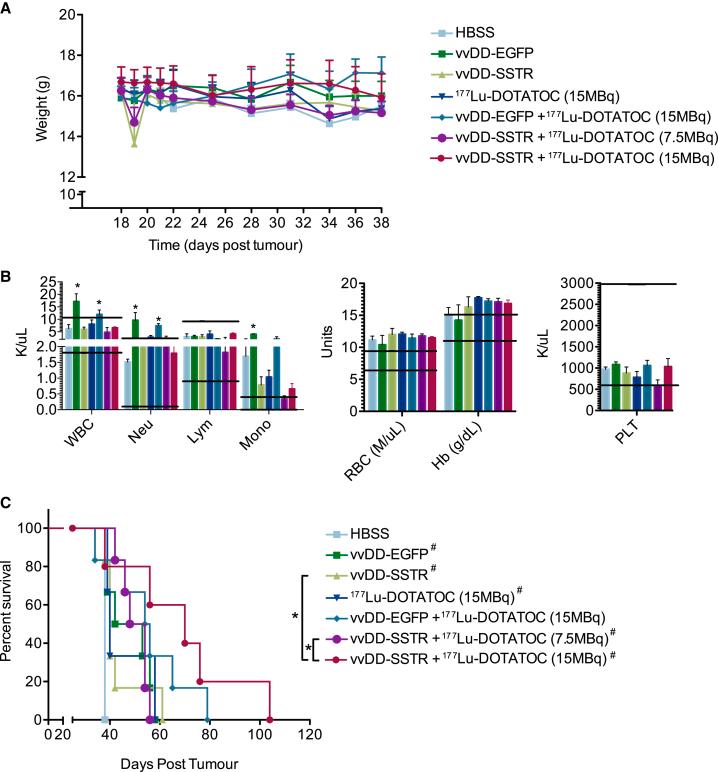
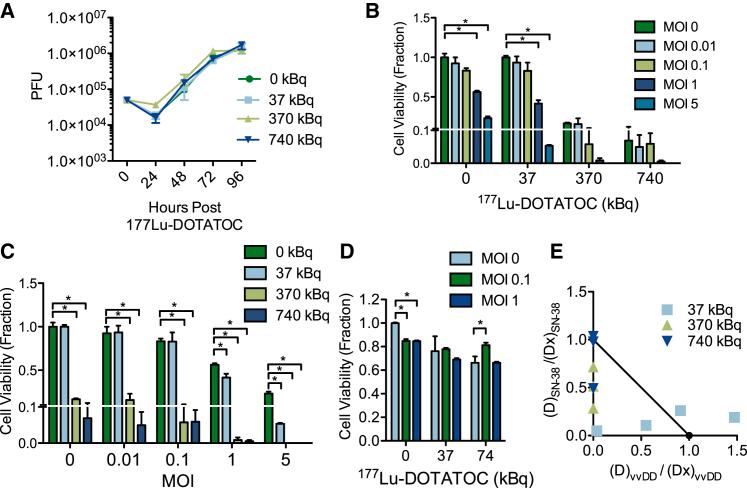
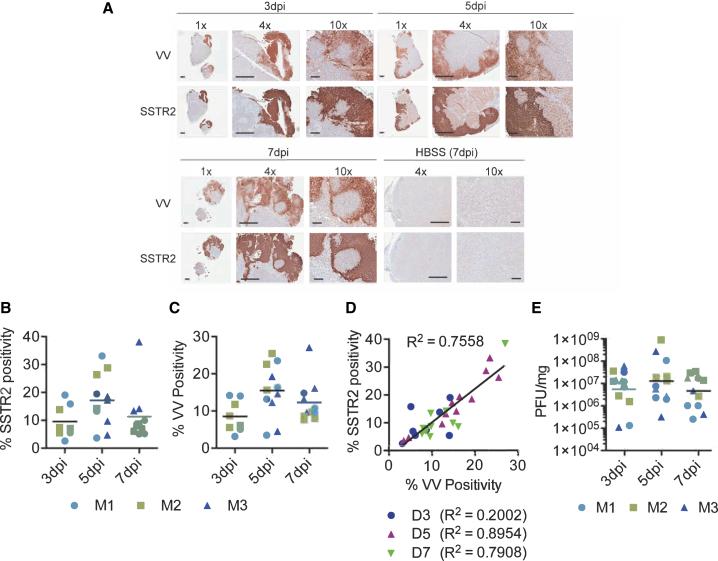
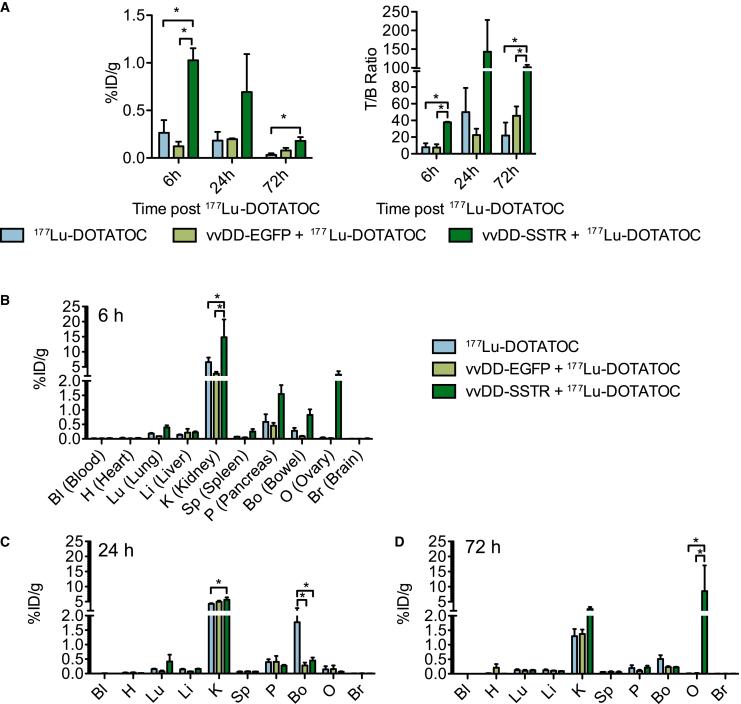
Tumor-specific overexpression of receptors enables a variety of targeted cancer therapies, exemplified by peptide-receptor radiotherapy (PRRT) for somatostatin receptor (SSTR)-positive neuroendocrine tumors. While effective, PRRT is restricted to tumors with SSTR overexpression. To overcome this limitation, we propose using oncolytic vaccinia virus (vvDD)-mediated receptor gene transfer to permit molecular imaging and PRRT in tumors without endogenous SSTR overexpression, a strategy termed radiovirotherapy. We hypothesized that vvDD-SSTR combined with a radiolabeled somatostatin analog could be deployed as radiovirotherapy in a colorectal cancer peritoneal carcinomatosis model, producing tumor-specific radiopeptide accumulation. Following vvDD-SSTR and Lu-DOTATOC treatment, viral replication and cytotoxicity, as well as biodistribution, tumor uptake, and survival, were evaluated. Radiovirotherapy did not alter virus replication or biodistribution, but synergistically improved vvDD-SSTR-induced cell killing in a receptor-dependent manner and significantly increased the tumor-specific accumulation and tumor-to-blood ratio of Lu-DOTATOC, making tumors imageable by microSPECT/CT and causing no significant toxicity. Lu-DOTATOC significantly improved survival over virus alone when combined with vvDD-SSTR but not control virus. We have therefore demonstrated that vvDD-SSTR can convert receptor-negative tumors into receptor-positive tumors and facilitate molecular imaging and PRRT using radiolabeled somatostatin analogs. Radiovirotherapy represents a promising treatment strategy with potential applications in a wide range of cancers.
受体的肿瘤特异性过表达使多种靶向癌症治疗成为可能,以肽受体放射性核素治疗(PRRT)治疗生长抑素受体(SSTR)阳性神经内分泌肿瘤为例。虽然PRRT有效,但仅限于SSTR过表达的肿瘤。为克服这一局限性,我们提出使用溶瘤痘苗病毒(vvDD)介导的受体基因转移,以便在无内源性SSTR过表达的肿瘤中进行分子成像和PRRT,这一策略称为放射病毒疗法。我们假设,在结直肠癌腹膜转移模型中,vvDD-SSTR与放射性标记的生长抑素类似物联合可作为放射病毒疗法,产生肿瘤特异性放射性肽蓄积。在给予vvDD-SSTR和镥-奥曲肽(Lu-DOTATOC)治疗后,评估病毒复制、细胞毒性以及生物分布、肿瘤摄取和生存期。放射病毒疗法未改变病毒复制或生物分布,但以受体依赖性方式协同增强了vvDD-SSTR诱导的细胞杀伤作用,并显著增加了Lu-DOTATOC的肿瘤特异性蓄积和肿瘤与血液的比值,使肿瘤可通过微型单光子发射计算机断层扫描/计算机断层扫描(microSPECT/CT)成像,且未引起明显毒性。与单独使用病毒相比,Lu-DOTATOC与vvDD-SSTR联合使用时显著提高了生存期,但与对照病毒联合使用时则不然。因此,我们证明了vvDD-SSTR可将受体阴性肿瘤转化为受体阳性肿瘤,并利用放射性标记的生长抑素类似物促进分子成像和PRRT。放射病毒疗法是一种有前景的治疗策略,在多种癌症中具有潜在应用价值。



 Zotero 插件