
超重的身体质量指数(BMI)与新诊断 1 型糖尿病患儿 C 肽水平升高有关,但也与 C 肽在两年临床观察期间的较大降幅有关。
Excessive BMI is associated with higher C-peptide level at recognition but also with its greater loss in two years clinical observation in children with new onset type 1 diabetes.
机构信息
Department of Pediatrics, Endocrinology, and Diabetology with Cardiology Division, Medical University of Bialystok, Białystok, Poland.
Department of Regenerative Medicine and Immune Regulation, Medical University of Bialystok, Białystok, Poland.
出版信息
Front Immunol. 2023 Apr 27;14:1176403. doi: 10.3389/fimmu.2023.1176403. eCollection 2023.
INTRODUCTION
The prevalence of obesity in general pediatric population increases without sparing children with T1D. We intended to find factors associated with the possibility of preserving endogenous insulin secretion in individuals with long-standing T1D. At onset, higher BMI is associated with higher C-peptide level, which may indicate to be one of the favorable factors involved in preserving residual β-cell function. The study determines the influence of BMI on C-peptide secretion in children newly diagnosed with T1D in two years observation.
METHODS
We assessed the possible relationship between selected pro- and anti-inflammatory cytokines, body mass at recognition and β-cell function status. 153 pediatric patients with newly diagnosed T1D were divided into quartiles according to BMI-SDS index. We separated a group consisted of patients with BMI-SDS >1. Participants were followed up for two years and examined for changes in body weight, HbA1c, and insulin requirement. C-peptide was assessed at baseline and after two years. We evaluated the patients' levels of selected inflammatory cytokines at baseline.
RESULTS
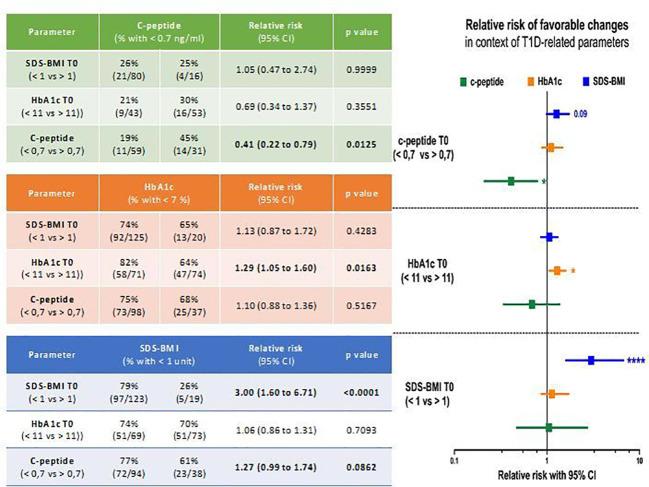
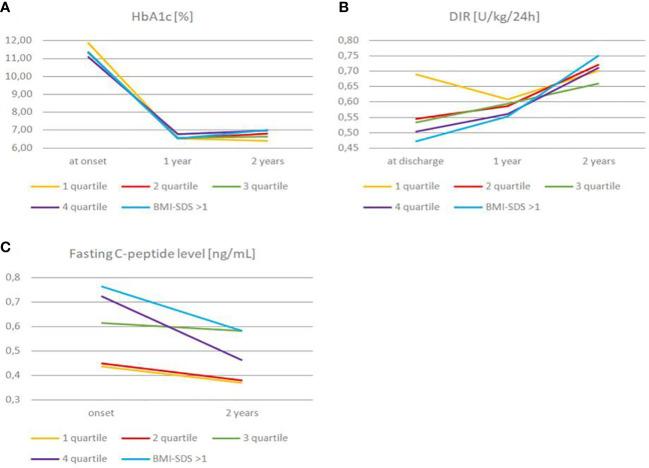
Subjects with higher BMI-SDS presented higher serum C-peptide levels and lower insulin requirements at diagnosis than children with lower body weight. The two-year follow-up showed that C-peptide levels of obese patients dropped more rapidly than in children with BMI-SDS within normal limits. The group with BMI-SDS >1 showed the greatest decrease in C-peptide level. Despite statistically insignificant differences in HbA1c at diagnosis between the study groups, in the fourth quartile and BMI-SDS >1 groups, HbA1c as well as insulin requirements increased after two years. The levels of cytokines varied the most between BMI-SDS <1 and BMI-SDS >1 groups and were significantly higher within BMI-SDS >1 group.
DISCUSSION
Higher BMI, associated with enhanced levels of inflammatory cytokines, relates to preservation of C-peptide at T1D recognition in children but is not beneficial in the long term. A decrease in C-peptide levels combined with an increase in insulin requirements and in HbA1c among patients with high BMI occur, which may indicate a negative effect of excessive body weight on the long term preservation of residual β-cell function. The process seems to be mediated by inflammatory cytokines.
简介
普通儿科人群的肥胖患病率不断上升,1 型糖尿病(T1D)患儿也未能幸免。我们旨在寻找与长期 T1D 个体保留内源性胰岛素分泌能力相关的因素。在发病时,较高的 BMI 与较高的 C 肽水平相关,这可能表明其是与保留残余β细胞功能相关的有利因素之一。本研究旨在通过两年的观察,确定 BMI 对新诊断为 T1D 的儿童 C 肽分泌的影响。
方法
我们评估了选定的促炎和抗炎细胞因子、发病时的体重与β细胞功能状态之间可能存在的关系。根据 BMI-SDS 指数,我们将 153 例新诊断为 T1D 的儿科患者分为四组。我们将 BMI-SDS>1 的患者分为一组。对参与者进行了为期两年的随访,检测了体重、HbA1c 和胰岛素需求的变化。在基线和两年后评估 C 肽。我们在基线评估了患者的选定炎症细胞因子水平。
结果
与体重较轻的儿童相比,BMI-SDS 较高的患者在诊断时具有更高的血清 C 肽水平和更低的胰岛素需求。两年的随访显示,肥胖患者的 C 肽水平下降速度比 BMI-SDS 正常范围内的儿童更快。BMI-SDS>1 的组 C 肽水平下降幅度最大。尽管在研究组之间,在诊断时的 HbA1c 没有统计学上的显著差异,但在第四四分位数和 BMI-SDS>1 组中,两年后 HbA1c 和胰岛素需求均增加。细胞因子的水平在 BMI-SDS<1 和 BMI-SDS>1 组之间变化最大,并且在 BMI-SDS>1 组中显著更高。
讨论
与炎症细胞因子水平升高相关的较高 BMI 与儿童 T1D 诊断时 C 肽的保留有关,但从长期来看并无益处。在 BMI 较高的患者中,C 肽水平下降,同时胰岛素需求和 HbA1c 增加,这可能表明体重过度对长期保留残余β细胞功能有负面影响。该过程似乎由炎症细胞因子介导。

 Zotero 插件