
SMARCA4 缺陷型非小细胞肺癌的临床特征和预后分析。
Clinical characteristics and prognostic analysis of SMARCA4-deficient non-small cell lung cancer.
机构信息
Department of Oncology, The First Affiliated Hospital of Zhengzhou University, Zhengzhou, China.
Department of Pathology, The First Affiliated Hospital of Zhengzhou University, Zhengzhou, China.
出版信息
Cancer Med. 2023 Jul;12(13):14171-14182. doi: 10.1002/cam4.6083. Epub 2023 May 15.
PURPOSE
To improve the understanding of special types of tumors, we summarized and analyzed the clinicopathological features and prognostic factors of SMARCA4-deficient non-small cell lung cancer (SMARCA4-dNSCLC).
METHODS
We selected 105 patients with SMARCA4-dNSCLC and 221 patients with SMARCA4-intact non-small cell lung cancer (SMARCA4-iNSCLC) by performing immunohistochemical analysis of 1520 NSCLC samples, and we assessed the patients' clinicopathological features and survival state.
RESULTS
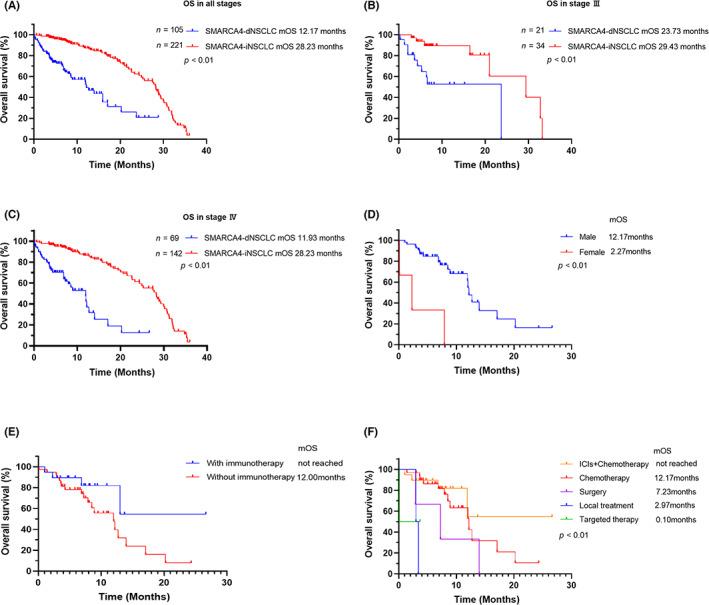
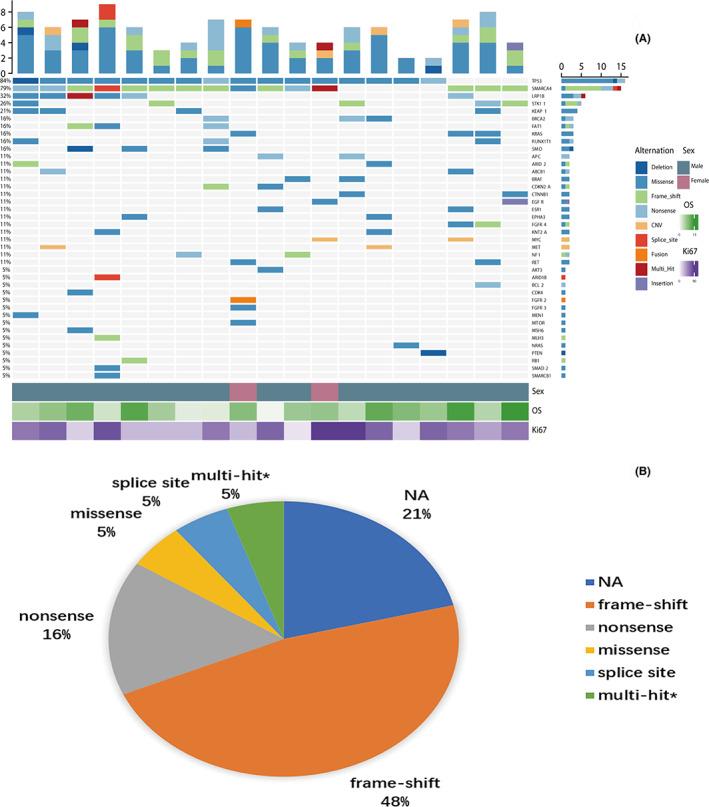
(1) SMARCA4-dNSCLC was significantly associated with older age, male sex, smoking history, larger invasive tumor size, higher tumor proliferation index (Ki-67), more adrenal metastases, more lymph node metastases, and few EGFR mutations (p < 0.05). The tumors were mostly negative for thyroid transcription factor-1 (TTF-1), CD34, and p40 and positive for cytokeratin 7 (CK7) in immunohistochemistry (IHC). Nineteen SMARCA4-dNSCLC patients mostly had TP53, SMARCA4, and LRP1B mutations, and 48% of them had SMARCA4 frameshift mutations. SMARCA4-dNSCLC patients have a worse prognosis than SMARCA4-iNSCLC patients (HR: 0.27; 95% CI: 0.17-0.45). The overall survival (OS) of patients with stage III SMARCA4-dNSCLC was worse than that of patients with SMARCA4-iNSCLC, and the OS of stage IV SMARCA4-dNSCLC patients was also worse than that of SMARCA4-iNSCLC patients (p < 0.01). (2) Multivariate regression analysis showed that sex (HR: 4.12; 95% CI: 1.03-16.39) and smoking history (HR: 2.29; 95% CI: 1.04-5.02) had significant effects on the survival time of SMARCA4-dNSCLC patients. In SMARCA4-dNSCLC patients without distant metastases (stage I-III), patients with stage N2 or N3 lymph node metastases (HR: 6.35; 95% CI: 1.07-37.47) had a poor prognosis. Among patients with SMARCA4-dNSCLC who were treated and had distant metastases (stage IV), male patients and patients treated with immunotherapy combined with chemotherapy showed a longer median overall survival (mOS).
CONCLUSION
SMARCA4-dNSCLC has unique clinicopathological features and a shorter survival prognosis than SMARCA4-iNSCLC. The efficacy of immunotherapy combined with chemotherapy needs to be observed for longer periods.
目的
为了提高对特殊类型肿瘤的认识,我们总结和分析了 SMARCA4 缺失型非小细胞肺癌(SMARCA4-dNSCLC)的临床病理特征和预后因素。
方法
我们通过对 1520 例 NSCLC 样本进行免疫组织化学分析,选择了 105 例 SMARCA4-dNSCLC 患者和 221 例 SMARCA4 完整型非小细胞肺癌(SMARCA4-iNSCLC)患者,并评估了患者的临床病理特征和生存状态。
结果
(1)SMARCA4-dNSCLC 与年龄较大、男性、吸烟史、较大的侵袭性肿瘤大小、较高的肿瘤增殖指数(Ki-67)、更多的肾上腺转移、更多的淋巴结转移以及较少的 EGFR 突变显著相关(p<0.05)。肿瘤在免疫组织化学(IHC)中大多为甲状腺转录因子-1(TTF-1)、CD34 和 p40 阴性,细胞角蛋白 7(CK7)阳性。19 例 SMARCA4-dNSCLC 患者大多存在 TP53、SMARCA4 和 LRP1B 突变,其中 48% 存在 SMARCA4 移码突变。SMARCA4-dNSCLC 患者的预后比 SMARCA4-iNSCLC 患者差(HR:0.27;95%CI:0.17-0.45)。III 期 SMARCA4-dNSCLC 患者的总生存期(OS)较 SMARCA4-iNSCLC 患者差,IV 期 SMARCA4-dNSCLC 患者的 OS 也较 SMARCA4-iNSCLC 患者差(p<0.01)。(2)多因素回归分析显示,性别(HR:4.12;95%CI:1.03-16.39)和吸烟史(HR:2.29;95%CI:1.04-5.02)对 SMARCA4-dNSCLC 患者的生存时间有显著影响。在无远处转移(I-III 期)的 SMARCA4-dNSCLC 患者中,N2 或 N3 淋巴结转移(HR:6.35;95%CI:1.07-37.47)的患者预后较差。在接受治疗并有远处转移(IV 期)的 SMARCA4-dNSCLC 患者中,男性患者和接受免疫治疗联合化疗的患者的中位总生存期(mOS)更长。
结论
SMARCA4-dNSCLC 具有独特的临床病理特征和比 SMARCA4-iNSCLC 更短的生存预后。免疫治疗联合化疗的疗效需要更长时间的观察。
 Zotero 插件