
用于检测小分子的酶电化学/荧光纳米生物传感器。
Enzymatic Electrochemical/Fluorescent Nanobiosensor for Detection of Small Chemicals.
机构信息
Department of Chemistry and Chemical Biology, Rutgers, The State University of New Jersey, Piscataway, NJ 08854, USA.
Department of Biomedical-Chemical Engineering, The Catholic University of Korea, 43 Jibong-ro, Bucheon-si 14662, Gyeonggi-do, Republic of Korea.
出版信息
Biosensors (Basel). 2023 Apr 19;13(4):492. doi: 10.3390/bios13040492.
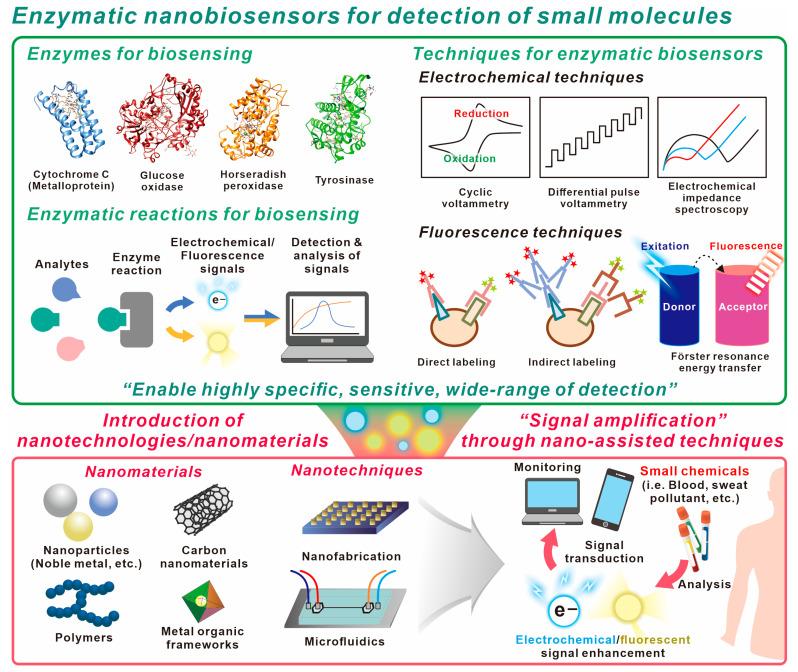
The detection of small molecules has attracted enormous interest in various fields, including the chemical, biological, and healthcare fields. In order to achieve such detection with high accuracy, up to now, various types of biosensors have been developed. Among those biosensors, enzymatic biosensors have shown excellent sensing performances via their highly specific enzymatic reactions with small chemical molecules. As techniques used to implement the sensing function of such enzymatic biosensors, electrochemical and fluorescence techniques have been mostly used for the detection of small molecules because of their advantages. In addition, through the incorporation of nanotechnologies, the detection property of each technique-based enzymatic nanobiosensors can be improved to measure harmful or important small molecules accurately. This review provides interdisciplinary information related to developing enzymatic nanobiosensors for small molecule detection, such as widely used enzymes, target small molecules, and electrochemical/fluorescence techniques. We expect that this review will provide a broad perspective and well-organized roadmap to develop novel electrochemical and fluorescent enzymatic nanobiosensors.
小分子的检测在化学、生物和医疗保健等各个领域引起了极大的兴趣。为了实现这种高精度的检测,到目前为止,已经开发出了各种类型的生物传感器。在这些生物传感器中,酶生物传感器通过与小分子的高度特异性酶反应显示出优异的传感性能。作为实现这种酶生物传感器传感功能的技术,电化学和荧光技术由于其优势而被广泛用于小分子的检测。此外,通过纳米技术的结合,可以提高基于每种技术的酶纳米生物传感器的检测性能,以准确测量有害或重要的小分子。本综述提供了与开发用于小分子检测的酶纳米生物传感器相关的跨学科信息,例如广泛使用的酶、目标小分子以及电化学/荧光技术。我们希望本综述将为开发新型电化学和荧光酶纳米生物传感器提供广阔的视角和有条理的路线图。


 Zotero 插件