
血清成纤维细胞生长因子21水平升高与脑出血后的不良临床结局相关。
Increased serum fibroblast growth factor 21 levels are associated with adverse clinical outcomes after intracerebral hemorrhage.
作者信息
Chen Keyang, Huang Wenting, Wang Jing, Xu Huiqin, Ruan Lixin, Li Yongang, Wang Zhen, Wang Xue, Lin Li, Li Xiaokun
机构信息
Department of Neurology, The Second Affiliated Hospital and Yuying Children's Hospital of Wenzhou Medical University, Wenzhou, China.
School of Pharmaceutical Sciences, Wenzhou Medical University, Wenzhou, China.
出版信息
Front Neurosci. 2023 May 5;17:1117057. doi: 10.3389/fnins.2023.1117057. eCollection 2023.
INTRODUCTION
Intracerebral hemorrhage (ICH) is the most prevalent cause of death. We sought to explore whether serum Fibroblast growth factor 21 (FGF21) is of substantial benefit in predicting poor prognosis in ICH patient.
METHODS
A prospective, multicenter cohort analysis of serum FGF21 levels in 418 ICH patients was carried out. At three months following ICH start, the primary endpoint was death or major disability, whereas the secondary endpoint was death. We investigated the association between serum FGF21 and clinical outcomes. We added FGF21 to the existing rating scale to assess whether it enhanced the prediction ability of the original model. Effectiveness was determined by calculating the C-statistic, net reclassification index (NRI), absolute integrated discrimination improvement (IDI) index.
RESULTS
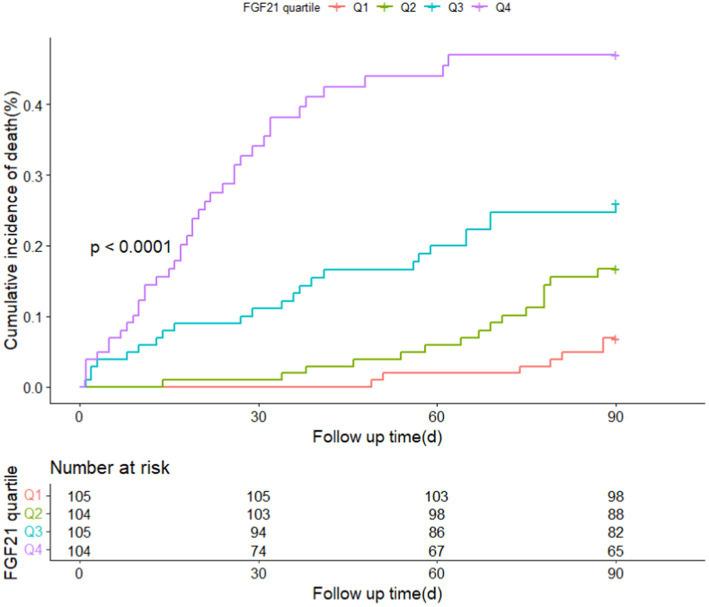
Among 418 enrolled patients, 217 (51.9%) of the all subjects had death or significant disability. Compared with patients in the lowest quartile group, those in the first quartile group had higher risk of the primary outcome (Odds ratio, 2.73 [95%CI,1.42-5.26, < 0.05]) and second outcome (Hazard ratio, 4.28 [95%CI,1.61-11.42, < 0.001]). The integration of FGF21 into many current ICH scales improved the discrimination and calibration quality for the integrated discrimination index's prediction of main and secondary findings (all < 0.05).
CONCLUSION
Elevated serum FGF21 is associated with increased risks of adverse clinical outcomes at 3 months in ICH patients, suggesting FGF21 may be a valuable prognostic factor.
引言
脑出血(ICH)是最常见的死亡原因。我们试图探讨血清成纤维细胞生长因子21(FGF21)在预测ICH患者不良预后方面是否具有显著益处。
方法
对418例ICH患者的血清FGF21水平进行了一项前瞻性、多中心队列分析。在ICH发病后三个月,主要终点是死亡或严重残疾,而次要终点是死亡。我们研究了血清FGF21与临床结局之间的关联。我们将FGF21添加到现有的评分量表中,以评估它是否增强了原始模型的预测能力。通过计算C统计量、净重新分类指数(NRI)、绝对综合判别改善(IDI)指数来确定有效性。
结果
在418例入选患者中,所有受试者中有217例(51.9%)出现死亡或严重残疾。与最低四分位数组的患者相比,第一四分位数组的患者发生主要结局的风险更高(优势比,2.73[95%CI,1.42 - 5.26,<0.05])和次要结局的风险更高(风险比,4.28[95%CI,1.61 - 11.42,<0.001])。将FGF21纳入许多当前的ICH量表中,提高了综合判别指数对主要和次要结果预测的判别和校准质量(均<0.05)。
结论
血清FGF21升高与ICH患者3个月时不良临床结局风险增加相关,提示FGF21可能是一个有价值的预后因素。


 Zotero 插件