
荷兰癌症幸存者化疗引起的周围神经病变的体验:症状、日常受限、医疗保健专业人员的参与和社会支持。
Experiences of cancer survivors with chemotherapy-induced peripheral neuropathy in the Netherlands: symptoms, daily limitations, involvement of healthcare professionals, and social support.
机构信息
CoRPS - Center of Research on Psychological disorders and Somatic diseases, Department of Medical and Clinical Psychology, Tilburg University, PO Box 90153, 5000 LE, Tilburg, The Netherlands.
Department of Research, Netherlands Comprehensive Cancer Organisation (IKNL), Utrecht, The Netherlands.
出版信息
J Cancer Surviv. 2024 Oct;18(5):1630-1639. doi: 10.1007/s11764-023-01402-4. Epub 2023 May 24.
PURPOSE
A significant proportion of cancer patients suffer from chemotherapy-induced peripheral neuropathy (CIPN). This descriptive study aimed to examine patients' experience of CIPN symptoms, daily limitations, involvement of healthcare professionals, and social support.
METHODS
Cross-sectional data have been collected in the Netherlands via a national online questionnaire comprising closed items only (February 2021).
RESULTS
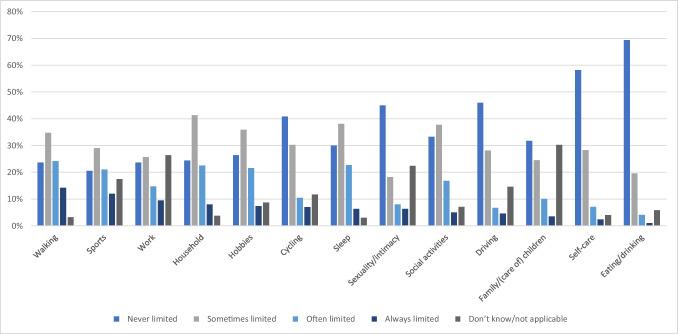
Out of 3752 respondents, 1975 received chemotherapy only (i.e., without targeted therapy) and were therefore included. The majority (71.2%) reported symptoms in both hands and feet (e.g., tingling and loss of sensation or diminished sensation). Participants reported most limitations in household chores, social activities, hobbies, sports, walking, and sleeping and least in family/(taking care of) children, cycling, driving, self-care, eating and drinking, and sexuality and intimacy. Many patients indicated that their healthcare professionals informed them about the possibility of CIPN development before treatment (58.4%), and they paid attention to CIPN during and after treatment (53.1%). However, many patients (43%) reported a lack of information on what to do when CIPN develops. Few participants (22%) visited their general practitioner (GP) for CIPN. In general, patients' social environments sometimes to always showed empathy to patients.
CONCLUSIONS
Symptoms of CIPN are frequently reported and can result in various daily limitations. Support from professionals and peers is crucial in managing CIPN, which is sometimes lacking. Appropriate guidance and support should be provided to patients to decrease the impact of CIPN on daily life. Future research should investigate differences in chemotherapeutic agents and the resulting symptoms and consequences.
目的
相当一部分癌症患者患有化疗引起的周围神经病(CIPN)。本描述性研究旨在检查患者的 CIPN 症状体验、日常活动受限情况、医护人员的参与情况以及社会支持情况。
方法
通过全国性在线问卷仅收集封闭式项目在荷兰进行了横断面数据收集(2021 年 2 月)。
结果
在 3752 名应答者中,有 1975 名仅接受化疗(即无靶向治疗),因此被纳入研究。大多数(71.2%)报告了双手和双脚的症状(例如,刺痛和感觉丧失或感觉减退)。参与者报告最多的受限活动是家务、社会活动、爱好、运动、行走和睡眠,受限最少的活动是照顾家庭/(照顾)孩子、骑自行车、开车、自理、饮食和饮水以及性生活和亲密关系。许多患者表示,他们的医护人员在治疗前就告知了他们 CIPN 发展的可能性(58.4%),并且在治疗期间和之后关注了 CIPN(53.1%)。但是,许多患者(43%)报告说,当 CIPN 发生时,他们缺乏关于该怎么做的信息。很少有参与者(22%)因 CIPN 而就诊于全科医生(GP)。一般来说,患者的社会环境有时会对患者表示同情。
结论
CIPN 的症状经常被报告,并可能导致各种日常活动受限。专业人员和同伴的支持对管理 CIPN 至关重要,而有时这种支持是缺乏的。应该为患者提供适当的指导和支持,以减少 CIPN 对日常生活的影响。未来的研究应该调查不同化疗药物及其导致的症状和后果的差异。

 Zotero 插件