
破译自身免疫性肾病的遗传密码。
Deciphering the Genetic Code of Autoimmune Kidney Diseases.
机构信息
Department of Medicine, Centre for Inflammatory Diseases, Monash University, Clayton, VIC 3168, Australia.
出版信息
Genes (Basel). 2023 Apr 30;14(5):1028. doi: 10.3390/genes14051028.
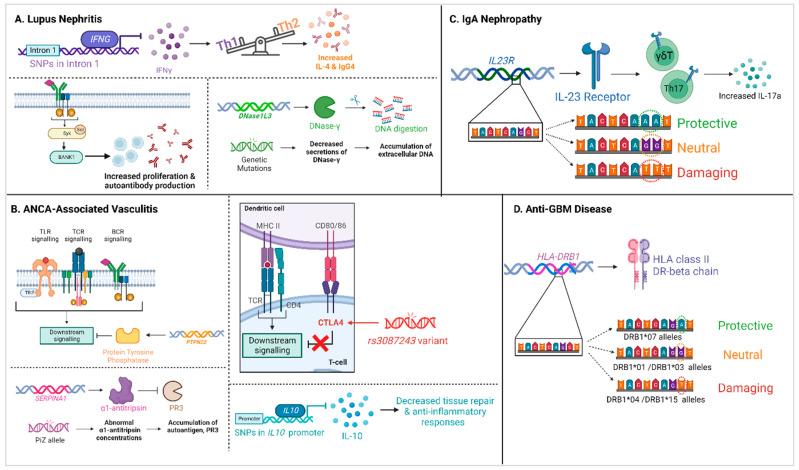
Autoimmune kidney diseases occur due to the loss of tolerance to self-antigens, resulting in inflammation and pathological damage to the kidneys. This review focuses on the known genetic associations of the major autoimmune kidney diseases that result in the development of glomerulonephritis: lupus nephritis (LN), anti-neutrophil cytoplasmic associated vasculitis (AAV), anti-glomerular basement disease (also known as Goodpasture's disease), IgA nephropathy (IgAN), and membranous nephritis (MN). Genetic associations with an increased risk of disease are not only associated with polymorphisms in the human leukocyte antigen (HLA) II region, which governs underlying processes in the development of autoimmunity, but are also associated with genes regulating inflammation, such as , and FC γ receptors (). Critical genome-wide association studies are discussed both to reveal similarities in gene polymorphisms between autoimmune kidney diseases and to explicate differential risks in different ethnicities. Lastly, we review the role of neutrophil extracellular traps, critical inducers of inflammation in LN, AAV, and anti-GBM disease, where inefficient clearance due to polymorphisms in DNase I and genes that regulate neutrophil extracellular trap production are associated with autoimmune kidney diseases.
自身免疫性肾病是由于自身抗原的耐受性丧失引起的,导致肾脏发生炎症和病理损伤。本综述重点介绍了导致肾小球肾炎的主要自身免疫性肾病的已知遗传相关性:狼疮性肾炎(LN)、抗中性粒细胞胞浆抗体相关性血管炎(AAV)、抗肾小球基底膜病(也称为 Goodpasture 病)、IgA 肾病(IgAN)和膜性肾病(MN)。与疾病风险增加相关的遗传相关性不仅与人类白细胞抗原(HLA)II 区的多态性有关,该区域控制着自身免疫发展的潜在过程,还与调节炎症的基因有关,如 和 FC γ 受体()。讨论了关键的全基因组关联研究,既要揭示自身免疫性肾病之间基因多态性的相似性,也要阐明不同种族之间的差异风险。最后,我们回顾了中性粒细胞胞外诱捕网的作用,中性粒细胞胞外诱捕网在 LN、AAV 和抗 GBM 病中是炎症的关键诱导因素,由于 DNA 酶 I 和调节中性粒细胞胞外诱捕网产生的基因的多态性导致清除效率降低,与自身免疫性肾病有关。

 Zotero 插件