
中国青少年学术压力、NR3C1 基因甲基化与焦虑症状的关联:巢式病例对照研究。
Association between academic pressure, NR3C1 gene methylation, and anxiety symptoms among Chinese adolescents: a nested case-control study.
机构信息
Department of Medical Statistics and Epidemiology, School of Public Health, Sun Yat-sen University, 74 Zhongshan Rd 2, 510080, Guangzhou, People's Republic of China.
Guangdong Provincial Key Laboratory of Food, Nutrition and Health, Sun Yat-sen University, 510080, Guangzhou, People's Republic of China.
出版信息
BMC Psychiatry. 2023 May 30;23(1):376. doi: 10.1186/s12888-023-04816-7.
BACKGROUND
Academic pressure is a prevalent stressor among Chinese adolescents and is often linked to anxiety symptoms, although the underlying mechanism remains unclear. This study aimed to investigate the association between NR3C1 gene methylation, academic pressure, and anxiety symptoms among Chinese adolescents.
METHODS
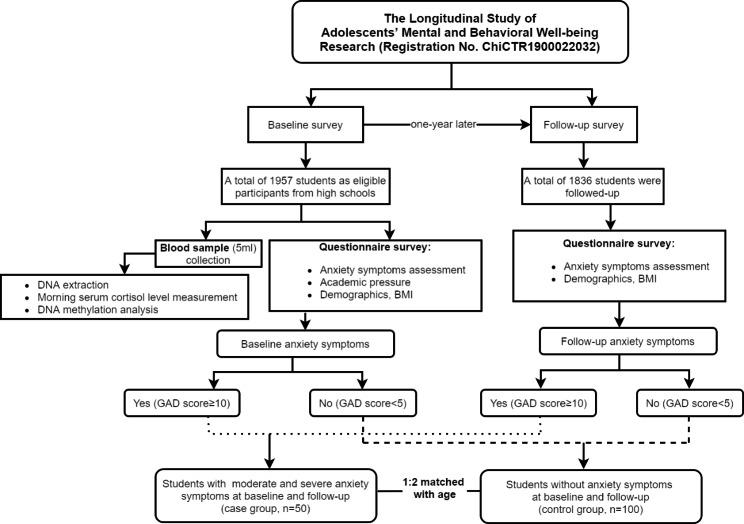
This nested-case control study included 150 adolescents (boys: 38.7%; baseline age: 12-17 years) from a school-based longitudinal study of Chinese adolescents. Cases (n = 50) were defined as those with anxiety symptoms at both baseline and follow-up, while controls (n = 100) were randomly selected from those without anxiety symptoms at both timepoints. The cases and controls were 1:2 matched by age. Academic pressure, anxiety symptoms, and potential covariates were measured using a self-report questionnaire. Peripheral whole blood samples were collected from each participant for the detection of cortisol level (i.e., morning serum cortisol level) and DNA methylation. The methylation analysis included a total of 27 CpG units at the NR3C1 promoter region.
RESULTS
The final adjusted models showed that students with heavy academic pressure at baseline were at a higher risk of anxiety symptoms at follow-up compared to those with mild academic pressure (β estimate: 6.24 [95% CI: 3.48 ~ 9.01]). After adjusting for covariates, the methylation level of one CpG unit (NR3C1-16 CpG10) in NR3C1 differed significantly between cases and controls (F = 6.188, P = 0.014), and the difference remained significant after correction for multiple testing (P < 0.025). The adjusted regression models showed that moderate (β estimate = 0.010 [95% CI: 0.000 ~ 0.020], P = 0.046) and heavy (β estimate = 0.011 [95% CI: 0.001 ~ 0.020], P = 0.030) academic pressure were significantly associated with the methylation level of NR3C1-16 CpG 10. Further mediation analysis demonstrated that the association of academic pressure and anxiety symptoms was significantly mediated by the methylation of NR3C1-16 CpG 10 (β estimate for indirect effect = 0.11 [95% CI: 0.005 ~ 0.32]; indirect/total effect = 8.3%).
CONCLUSION
The present study suggests that NR3C1-16 CpG 10 DNA methylation might be a potential mechanism that partially explains the lasting effects of academic pressure on subsequent anxiety symptoms among adolescents. Further studies with larger sample sizes are recommended to replicate this finding.
背景
学术压力是中国青少年普遍存在的压力源之一,常与焦虑症状相关,但其潜在机制尚不清楚。本研究旨在探讨中国青少年 NR3C1 基因甲基化、学术压力与焦虑症状之间的关系。
方法
本巢式病例对照研究纳入了一项基于学校的中国青少年纵向研究中的 150 名青少年(男生占 38.7%;基线年龄 12-17 岁)。病例(n=50)定义为基线和随访时均有焦虑症状的青少年,而对照组(n=100)则随机选自两个时间点均无焦虑症状的青少年。病例和对照组按年龄 1:2 匹配。采用自报问卷评估学术压力、焦虑症状和潜在的混杂因素。从每位参与者采集外周全血样,检测皮质醇水平(即晨血皮质醇水平)和 DNA 甲基化。甲基化分析包括 NR3C1 启动子区域内的 27 个 CpG 单位。
结果
最终调整后的模型显示,基线时学业压力较大的学生在随访时发生焦虑症状的风险高于学业压力较轻的学生(β估计值:6.24[95%CI:3.489.01])。在校正混杂因素后,NR3C1 中一个 CpG 单位(NR3C1-16 CpG10)的甲基化水平在病例和对照组之间存在显著差异(F=6.188,P=0.014),且经多重检验校正后差异仍有统计学意义(P<0.025)。调整后的回归模型显示,中度(β估计值=0.010[95%CI:0.0000.020],P=0.046)和重度(β估计值=0.011[95%CI:0.0010.020],P=0.030)学业压力与 NR3C1-16 CpG10 的甲基化水平显著相关。进一步的中介分析表明,学业压力与焦虑症状的关系部分通过 NR3C1-16 CpG10 的甲基化来介导(间接效应的β估计值=0.11[95%CI:0.0050.32];间接/总效应=8.3%)。
结论
本研究提示,NR3C1-16 CpG10 DNA 甲基化可能是部分解释青少年学术压力对后续焦虑症状持续影响的潜在机制。建议开展更大样本量的研究来重复这一发现。
 Zotero 插件