
澳大利亚老年人对预防痴呆症风险的态度和信念的横断面调查。
Cross-sectional survey of attitudes and beliefs towards dementia risk reduction among Australian older adults.
机构信息
MARCS Institute for Brain, Behaviour and Development, Western Sydney University, Sydney, NSW, 2145, Australia.
Centre for Health Systems and Safety Research, Australian Institute of Health Innovation, Macquarie University, Macquarie Park, NSW, 2109, Australia.
出版信息
BMC Public Health. 2023 May 30;23(1):1021. doi: 10.1186/s12889-023-15843-0.
BACKGROUND
Little is known about what drives older adults' motivation to change their behaviour and whether that is associated with their personal dementia risk profile. Our aims were to (i) understand what sociodemographic factors are associated with older Australians' motivation to change behaviour to reduce their dementia risk, and (ii) explore the relationship between socio-demographic factors and motivation to reduce dementia risk with health- and lifestyle-based dementia risk scores in older adults.
METHODS
A cross-sectional online postal or telephone survey was administered to community-dwelling older adults in New South Wales, Australia between January and March 2021. Measures included socioeconomic status, locality, and health status, the Motivation to Change Lifestyle and Health Behaviours for Dementia Risk Reduction (MCLHB-DRR) scale and the lifestyle-based dementia risk score (LIBRA index). Multiple linear regression analyses were used to explore the associations for (i) sociodemographic factors and motivation to reduce dementia risk (MCLHB-DRR scales) and (ii) sociodemographic factors and motivation to reduce dementia risk with health- and lifestyle-based dementia risk (LIBRA index).
RESULTS
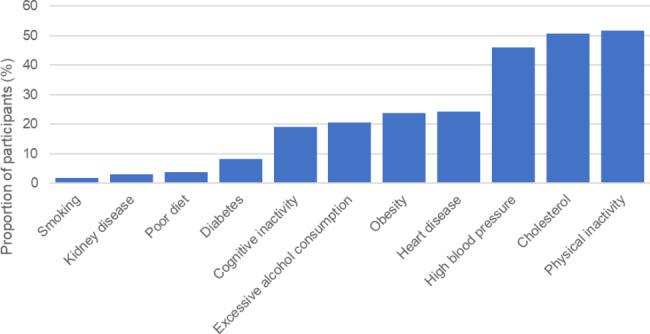
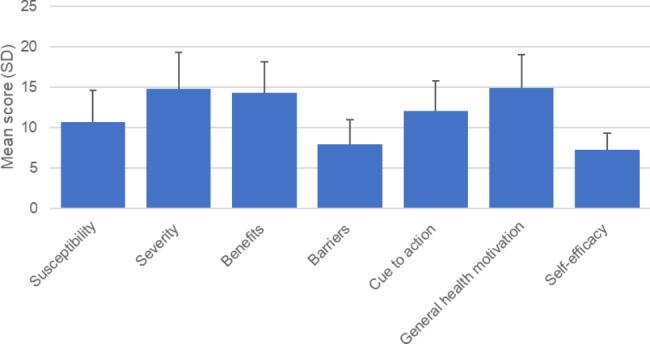
A total of 857 older adults (mean age 73.3 years, SD = 6.0, range 65-94; 70% women; 34.6% less than grade 6 education) completed the survey. Respondents reported high levels of motivation to adopt behaviour changes, agreeing on the importance of good health. Individuals who were younger were more likely to have greater motivation to modify lifestyle to reduce dementia risk and had higher perceived benefits to gain by adopting a healthy lifestyle. Dementia risk scores were moderately low (mean LIBRA index =- 2.8 [SD = 2.0], range - 5.9-3.8), indicating relatively moderate-to-good brain health. Men with low socioeconomic status and higher perceived barriers to lifestyle change had higher dementia risk scores.
CONCLUSIONS
Public health campaigns need to overcome motivational barriers to support reductions in dementia risk. A multifaceted and inclusive approach targeting both sociodemographic differences and impediments to brain healthy lifestyles is required to achieve genuine change.
TRIAL REGISTRATION
ACTRN12621000165886, Date of registration: 17/02/2021.
背景
人们对促使老年人改变行为以降低痴呆风险的因素知之甚少,也不清楚这些因素是否与他们个人的痴呆风险状况有关。我们的目的是:(i) 了解哪些社会人口因素与澳大利亚老年人改变行为以降低痴呆风险的动机有关,以及 (ii) 探讨社会人口因素与降低痴呆风险的动机与老年人健康和生活方式为基础的痴呆风险评分之间的关系。
方法
2021 年 1 月至 3 月期间,在澳大利亚新南威尔士州的社区居住的老年人中进行了一项横断面在线邮寄或电话调查。测量包括社会经济地位、地点和健康状况、改变生活方式和降低痴呆风险的动机量表 (MCLHB-DRR) 以及生活方式为基础的痴呆风险评分 (LIBRA 指数)。使用多元线性回归分析探讨 (i) 社会人口因素与降低痴呆风险的动机 (MCLHB-DRR 量表) 以及 (ii) 社会人口因素与降低痴呆风险与健康和生活方式为基础的痴呆风险 (LIBRA 指数) 之间的关系。
结果
共有 857 名老年人(平均年龄 73.3 岁,标准差=6.0,范围 65-94;70%为女性;34.6%未完成 6 年级教育)完成了调查。受访者报告说,他们有很高的动机改变生活方式以降低痴呆风险,并且非常重视健康。年轻的个体更有可能有更大的动机来改变生活方式以降低痴呆风险,并且通过采用健康的生活方式获得更高的收益。痴呆风险评分中等偏低(平均 LIBRA 指数=-2.8 [标准差=2.0],范围-5.9-3.8),表明大脑健康状况相对较好。社会经济地位较低、生活方式改变障碍感知较高的男性,痴呆风险评分较高。
结论
公共卫生运动需要克服降低痴呆风险的动机障碍。需要采取多方面和包容的方法,既要针对社会人口差异,又要针对大脑健康生活方式的障碍,才能真正实现改变。
试验注册
ACTRN12621000165886,注册日期:2021 年 2 月 17 日。
 Zotero 插件