
全基因组关联研究表明,慢性痰液产生与参与黏液产生和感染的基因座有关。
Genome-wide association study of chronic sputum production implicates loci involved in mucus production and infection.
机构信息
Department of Population Health Sciences, University of Leicester, Leicester, UK
Leicester NIHR Biomedical Research Centre, Glenfield Hospital, Leicester, UK.
出版信息
Eur Respir J. 2023 Jun 15;61(6). doi: 10.1183/13993003.01667-2022. Print 2023 Jun.
BACKGROUND
Chronic sputum production impacts on quality of life and is a feature of many respiratory diseases. Identification of the genetic variants associated with chronic sputum production in a disease agnostic sample could improve understanding of its causes and identify new molecular targets for treatment.
METHODS
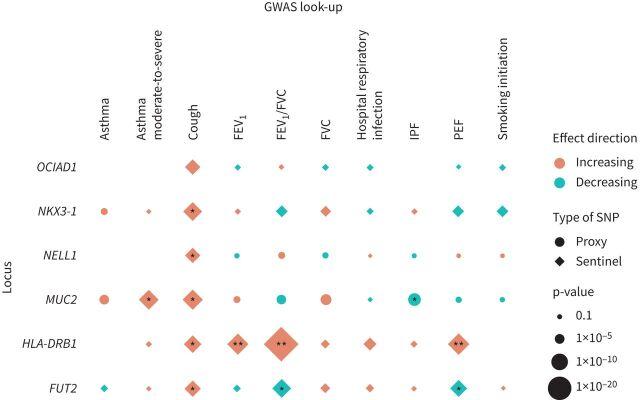
We conducted a genome-wide association study (GWAS) of chronic sputum production in UK Biobank. Signals meeting genome-wide significance (p<5×10) were investigated in additional independent studies, were fine-mapped and putative causal genes identified by gene expression analysis. GWASs of respiratory traits were interrogated to identify whether the signals were driven by existing respiratory disease among the cases and variants were further investigated for wider pleiotropic effects using phenome-wide association studies (PheWASs).
RESULTS
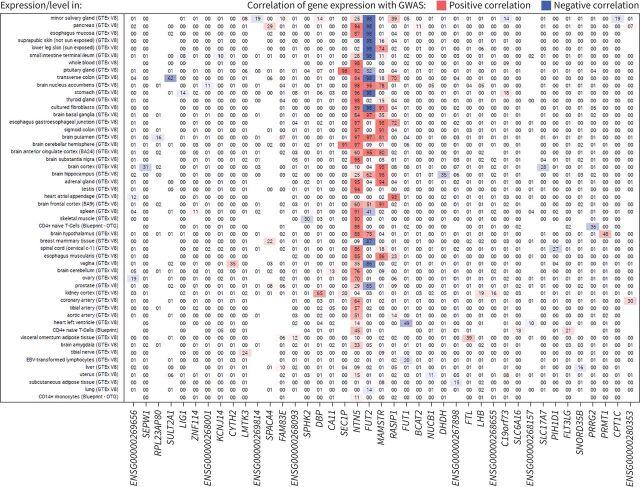
From a GWAS of 9714 cases and 48 471 controls, we identified six novel genome-wide significant signals for chronic sputum production including signals in the human leukocyte antigen (HLA) locus, chromosome 11 mucin locus (containing , and ) and locus. The four common variant associations were supported by independent studies with a combined sample size of up to 2203 cases and 17 627 controls. The mucin locus signal had previously been reported for association with moderate-to-severe asthma. The HLA signal was fine-mapped to an amino acid change of threonine to arginine (frequency 36.8%) in HLA-DRB1 (). The signal near was associated with expression of several genes including , for which the direction of effect was tissue dependent. Our PheWAS identified a wide range of associations including blood cell traits, liver biomarkers, infections, gastrointestinal and thyroid-associated diseases, and respiratory disease.
CONCLUSIONS
Novel signals at the and mucin loci suggest that mucin fucosylation may be a driver of chronic sputum production even in the absence of diagnosed respiratory disease and provide genetic support for this pathway as a target for therapeutic intervention.
背景
慢性痰生成会影响生活质量,是许多呼吸道疾病的特征。在无病种偏见的样本中鉴定与慢性痰生成相关的遗传变异,可增进对其病因的了解,并为治疗提供新的分子靶点。
方法
我们在英国生物库中开展了一项针对慢性痰生成的全基因组关联研究(GWAS)。在其他独立研究中对达到全基因组显著性(p<5×10)的信号进行了调查,通过基因表达分析对精细定位和推定的因果基因进行了鉴定。我们还对呼吸道性状的 GWAS 进行了探究,以确定这些信号是否是由病例中的现有呼吸道疾病驱动的,并通过表型全基因组关联研究(PheWAS)进一步调查了变体的更广泛多效性效应。
结果
从一项针对 9714 例病例和 48471 例对照的 GWAS 中,我们鉴定出了 6 个与慢性痰生成相关的全新全基因组显著信号,包括人类白细胞抗原(HLA)基因座、染色体 11 黏蛋白基因座(包含 、 和 )以及 基因座的信号。这 4 个常见变异关联在病例和对照的合并样本量高达 2203 例和 17627 例的独立研究中得到了支持。黏蛋白基因座的信号先前已被报道与中重度哮喘相关。HLA 信号被精细定位到 HLA-DRB1 中苏氨酸到精氨酸的氨基酸变化(频率 36.8%)()。位于 附近的信号与包括 在内的多个基因的表达相关,其效应的方向取决于组织。我们的 PheWAS 发现了广泛的关联,包括血细胞特征、肝脏生物标志物、感染、胃肠道和甲状腺相关疾病以及呼吸道疾病。
结论
在 和黏蛋白基因座的新信号表明,黏蛋白岩藻糖基化即使在没有诊断出呼吸道疾病的情况下也可能是慢性痰生成的驱动因素,并为该途径作为治疗干预的靶点提供了遗传支持。


 Zotero 插件