
不同组织病理确诊癌症和良性病变的[F]FAPI-74 PET 初步评估。
Initial Evaluation of [F]FAPI-74 PET for Various Histopathologically Confirmed Cancers and Benign Lesions.
机构信息
Department of Nuclear Medicine and Tracer Kinetics, Graduate School of Medicine, Osaka University, Osaka, Japan;
Institute for Radiation Sciences, Osaka University, Osaka, Japan.
出版信息
J Nucl Med. 2023 Aug;64(8):1225-1231. doi: 10.2967/jnumed.123.265486. Epub 2023 Jun 2.
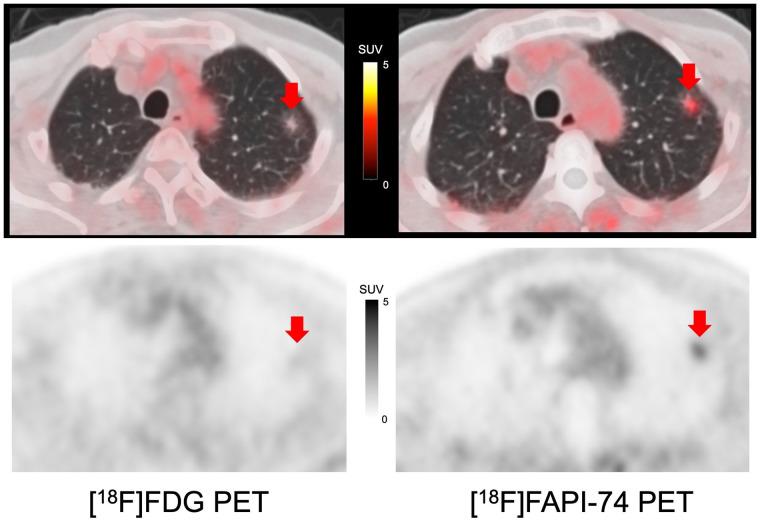
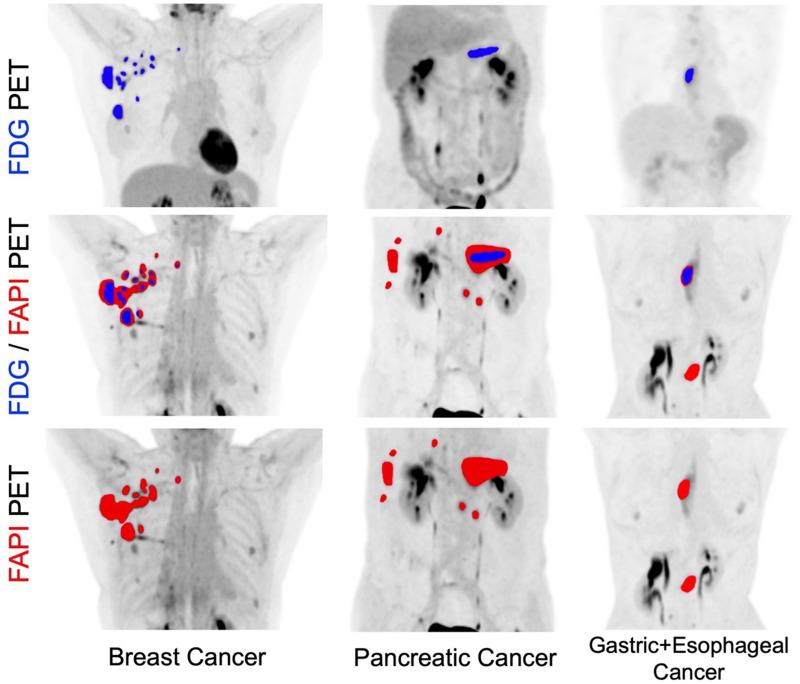
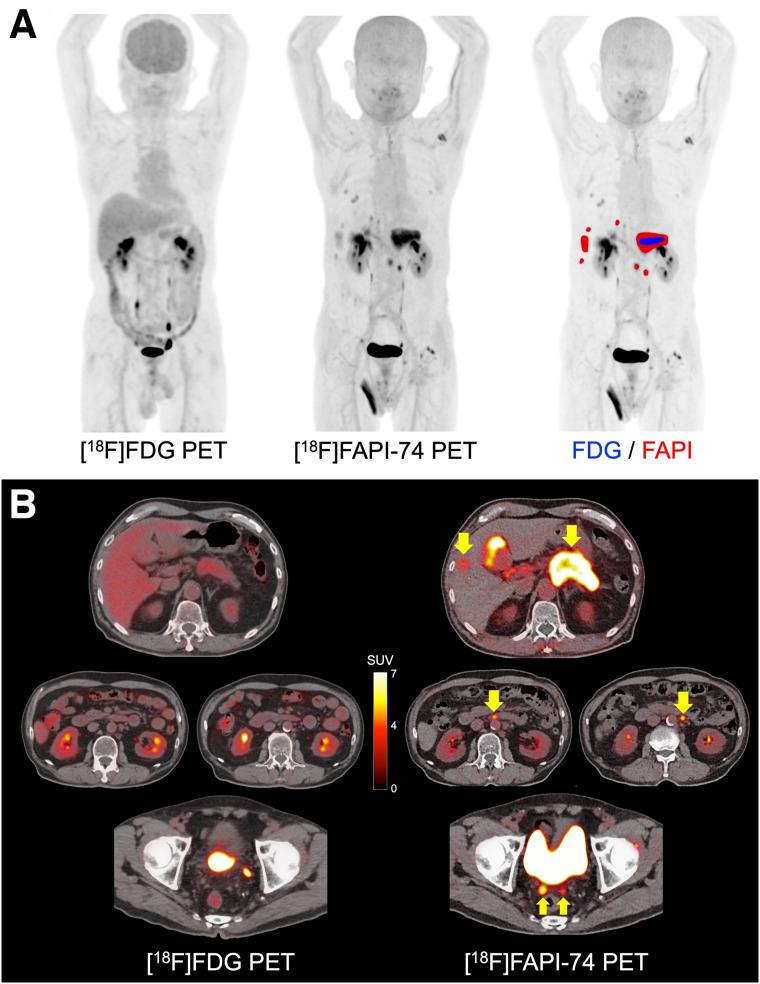
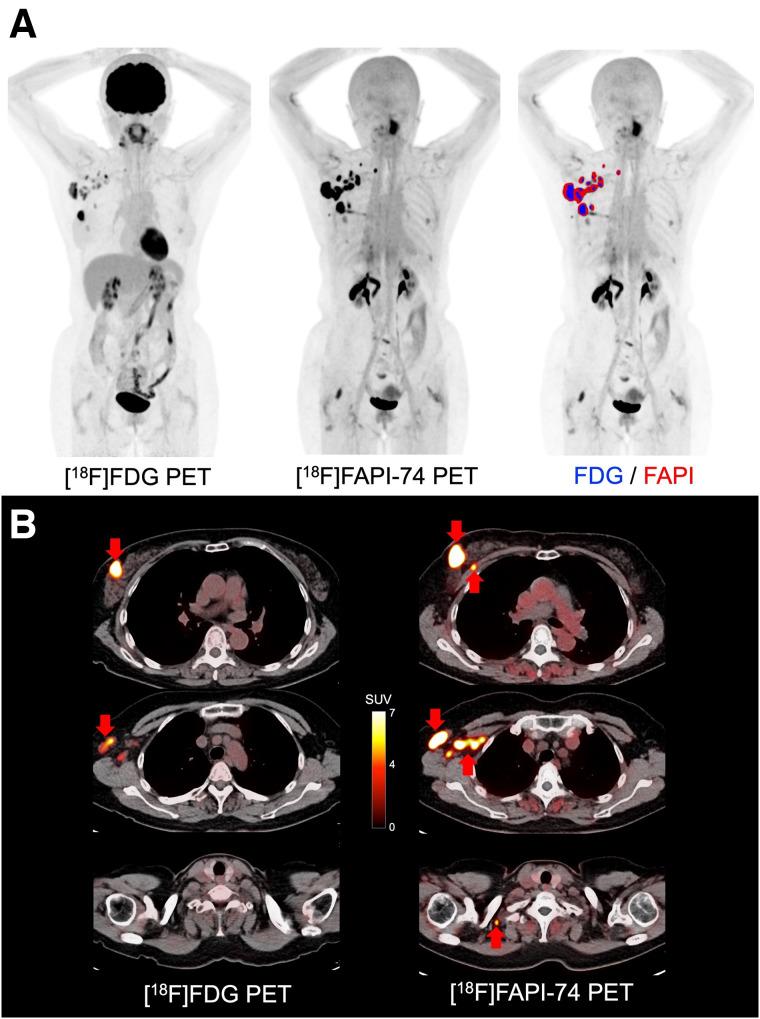
The F-labeled fibroblast activation protein inhibitor (FAPI) [F]FAPI-74 has the benefit of a higher synthetic yield and better image resolution than Ga-labeled FAPI. We preliminarily evaluated the diagnostic performance of [F]FAPI-74 PET in patients with various histopathologically confirmed cancers or suspected malignancies. We enrolled 31 patients (17 men and 14 women) with lung cancer ( = 7), breast cancer ( = 5), gastric cancer ( = 5), pancreatic cancer ( = 3), other cancers ( = 5), and benign tumors ( = 6). Twenty-seven of the 31 patients were treatment-naïve or preoperative, whereas recurrence was suspected in the remaining 4 patients. Histopathologic confirmation was obtained for the primary lesions of 29 of the 31 patients. In the remaining 2 patients, the final diagnosis was based on the clinical course. [F]FAPI-74 PET scanning was performed 60 min after the intravenous injection of [F]FAPI-74 (240 ± 31 MBq). The [F]FAPI-74 PET images were compared between the primary or local recurrent lesions of malignant tumors ( = 21) and nonmalignant lesions ( = 8: type-B1 thymomas, granuloma, solitary fibrous tumor, and postoperative or posttherapeutic changes). The uptake and number of detected lesions on [F]FAPI-74 PET were also compared with those on [F]FDG PET for available patients ( = 19). [F]FAPI-74 PET showed higher uptake in primary lesions of various cancers than in nonmalignant lesions (median SUV, 9.39 [range, 1.83-25.28] vs. 3.49 [range, 2.21-15.58]; = 0.053), but some of the nonmalignant lesions showed high uptake. [F]FAPI-74 PET also showed significantly higher uptake than [F]FDG PET (median SUV, 9.44 [range, 2.50-25.28] vs. 5.45 [range, 1.22-15.06] in primary lesions [ = 0.010], 8.86 [range, 3.51-23.33] vs. 3.84 [range, 1.01-9.75] in lymph node metastases [ = 0.002], and 6.39 [range, 0.55-12.78] vs. 1.88 [range, 0.73-8.35] in other metastases [ = 0.046], respectively). In 6 patients, [F]FAPI-74 PET detected more metastatic lesions than [F]FDG PET. [F]FAPI-74 PET showed higher uptake and detection rates in primary and metastatic lesions than did [F]FDG PET. [F]FAPI-74 PET is a promising novel diagnostic modality for various tumors, especially for precise staging before treatment, including characterization of tumor lesions before surgery. Moreover, F-labeled FAPI ligand might serve a higher demand in clinical care in the future.
F 标记的成纤维细胞激活蛋白抑制剂(FAPI)[F]FAPI-74 的合成产率和图像分辨率优于 Ga 标记的 FAPI。我们初步评估了 [F]FAPI-74 PET 在各种经组织病理学证实的癌症或疑似恶性肿瘤患者中的诊断性能。我们纳入了 31 名患者(男 17 名,女 14 名),其中肺癌(=7)、乳腺癌(=5)、胃癌(=5)、胰腺癌(=3)、其他癌症(=5)和良性肿瘤(=6)。31 名患者中有 27 名是初治或术前患者,其余 4 名患者怀疑复发。31 名患者中有 29 名获得了原发性病变的组织病理学证实。在另外 2 名患者中,最终诊断基于临床过程。在静脉注射 [F]FAPI-74 后 60 分钟进行 [F]FAPI-74 PET 扫描(240±31 MBq)。将恶性肿瘤(=21)和非恶性病变(=8:B1 型胸腺瘤、肉芽肿、孤立性纤维瘤、术后或治疗后改变)的原发性或局部复发性病变的 [F]FAPI-74 PET 图像进行比较。还比较了 [F]FAPI-74 PET 和 [F]FDG PET 对可获得患者(=19)的摄取和检测到的病变数量。[F]FAPI-74 PET 在各种癌症的原发性病变中的摄取高于非恶性病变(中位数 SUV,9.39[范围,1.83-25.28]与 3.49[范围,2.21-15.58];=0.053),但一些非恶性病变摄取较高。[F]FAPI-74 PET 在原发性病变中的摄取也明显高于 [F]FDG PET(中位数 SUV,9.44[范围,2.50-25.28]与 5.45[范围,1.22-15.06];=0.010)、淋巴结转移(8.86[范围,3.51-23.33]与 3.84[范围,1.01-9.75];=0.002)和其他转移(6.39[范围,0.55-12.78]与 1.88[范围,0.73-8.35];=0.046)。在 6 名患者中,[F]FAPI-74 PET 检测到的转移性病变多于 [F]FDG PET。[F]FAPI-74 PET 在原发性和转移性病变中的摄取和检出率均高于 [F]FDG PET。[F]FAPI-74 PET 是一种很有前途的新型诊断方法,适用于各种肿瘤,尤其是在治疗前进行精确分期,包括在手术前对肿瘤病变进行特征描述。此外,F 标记的 FAPI 配体在未来可能会有更高的临床需求。


 Zotero 插件