
使用 Mini-Balance Evaluation Systems Test(Mini-BESTest)评估双侧前庭病患者的平衡:可行性及与健康对照组数据的比较。
Assessing balance in people with bilateral vestibulopathy using the Mini-Balance Evaluation Systems Test (Mini-BESTest): feasibility and comparison with healthy control data.
机构信息
Division of Balance Disorders, Department of Otorhinolaryngology and Head and Neck Surgery, School for Mental Health and Neuroscience, Maastricht University Medical Center, Maastricht, The Netherlands.
Department of Nutrition and Movement Sciences, NUTRIM School of Nutrition and Translational Research in Metabolism, Maastricht University, Maastricht, The Netherlands.
出版信息
J Neurol. 2023 Sep;270(9):4423-4433. doi: 10.1007/s00415-023-11795-y. Epub 2023 Jun 3.
OBJECTIVES
Bilateral vestibulopathy (BVP) leads to unsteadiness when walking, which worsens in darkness or on uneven ground, as well as falls. Since simple balance tests struggle to distinguish between BVP and healthy participants, we aimed (1) to test if the Mini-BESTest is feasible in BVP, (2) how people with BVP perform on the Mini-BESTest and (3) to compare these scores with healthy reference data.
METHODS
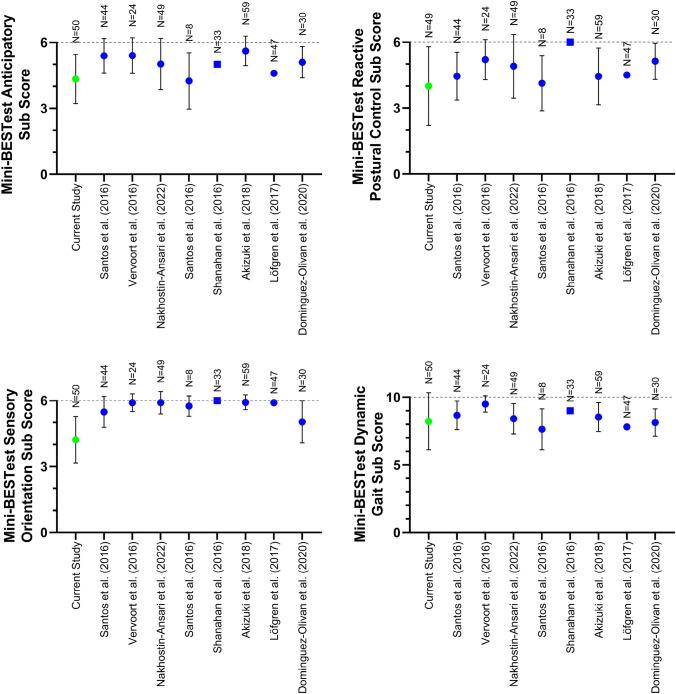
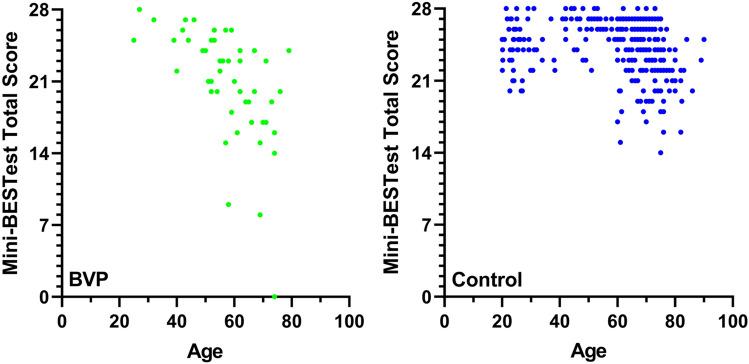
Fifty participants with BVP completed the Mini-BESTest. 12-month falls incidence was obtained by questionnaire. To compare the overall and sub-scores between our participants with BVP and those of healthy participants from the literature (n = 327; obtained via PubMed searches), Mann-Whitney U tests were used. Sub scores within the BVP group were also compared. Spearman correlations were used to investigate the relationships between Mini-BESTest score and age.
RESULTS
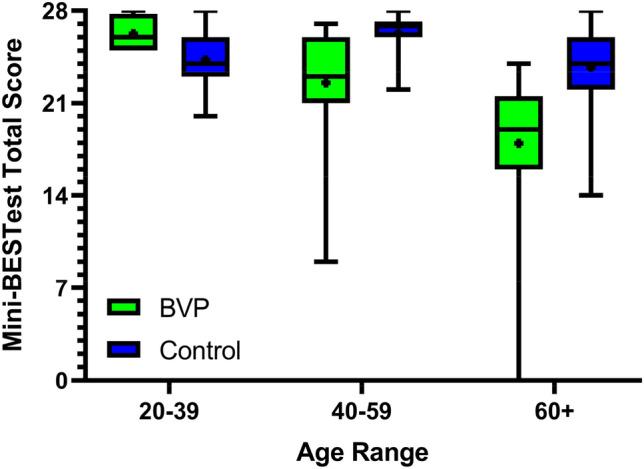
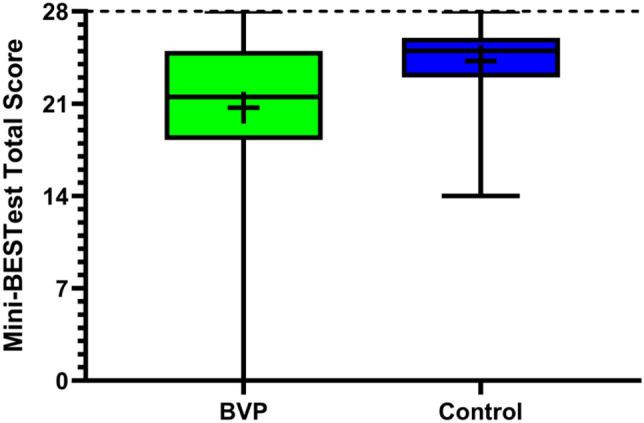
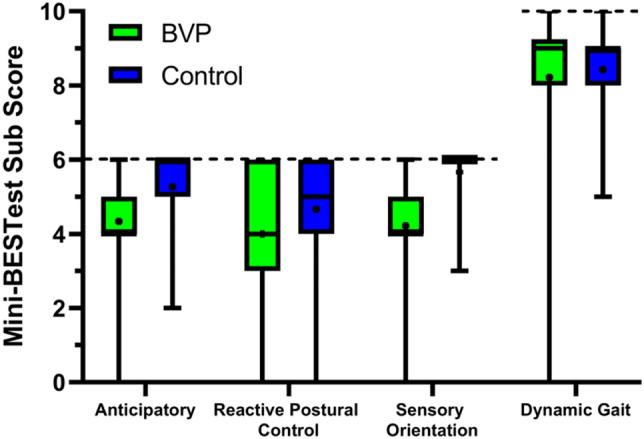
No floor or ceiling effects were observed. Participants with BVP had significantly lower Mini-BESTest total scores than the healthy group. Anticipatory, reactive postural control and sensory orientation sub scores of the Mini-BESTest were significantly lower in BVP, while dynamic gait sub scores were not significantly different. A stronger negative correlation between age and Mini-BESTest total score was found in BVP than in the healthy group. Scores did not differ between patients with different falls history.
CONCLUSION
The Mini-BESTest is feasible in BVP. Our results confirm the commonly reported balance deficits in BVP. The stronger negative association between age and balance in BVP might reflect the age-related decline in the remaining sensory systems with which people with BVP compensate.
目的
双侧前庭病变(BVP)可导致行走时不稳定,在黑暗或不平整的地面上以及跌倒时会加重。由于简单的平衡测试难以区分 BVP 和健康参与者,我们的目的是:(1)测试 Mini-BESTest 在 BVP 中的可行性;(2)BVP 患者在 Mini-BESTest 中的表现;(3)并将这些评分与健康参考数据进行比较。
方法
50 名 BVP 患者完成了 Mini-BESTest。通过问卷调查获得 12 个月的跌倒发生率。为了比较我们的 BVP 患者与文献中健康参与者(n=327;通过 PubMed 搜索获得)的总体和子评分,使用了 Mann-Whitney U 检验。还比较了 BVP 组内的子评分。使用 Spearman 相关系数来研究 Mini-BESTest 评分与年龄之间的关系。
结果
未观察到地板或天花板效应。BVP 患者的 Mini-BESTest 总分明显低于健康组。BVP 患者的预期性、反应性姿势控制和感觉定向子评分明显较低,而动态步态子评分则无显著差异。在 BVP 中,Mini-BESTest 总分与年龄之间的负相关性比健康组更强。具有不同跌倒史的患者之间的评分没有差异。
结论
Mini-BESTest 在 BVP 中是可行的。我们的结果证实了 BVP 中常见的平衡缺陷。BVP 中年龄与平衡之间的负相关性更强,可能反映了与年龄相关的剩余感觉系统的衰退,BVP 患者用这些系统进行代偿。

 Zotero 插件