
通过局部和非局部深度学习的协同作用来改进冷冻电镜图。
Improvement of cryo-EM maps by simultaneous local and non-local deep learning.
机构信息
School of Physics and Key Laboratory of Molecular Biophysics of MOE, Huazhong University of Science and Technology, Wuhan, China.
出版信息
Nat Commun. 2023 Jun 3;14(1):3217. doi: 10.1038/s41467-023-39031-1.
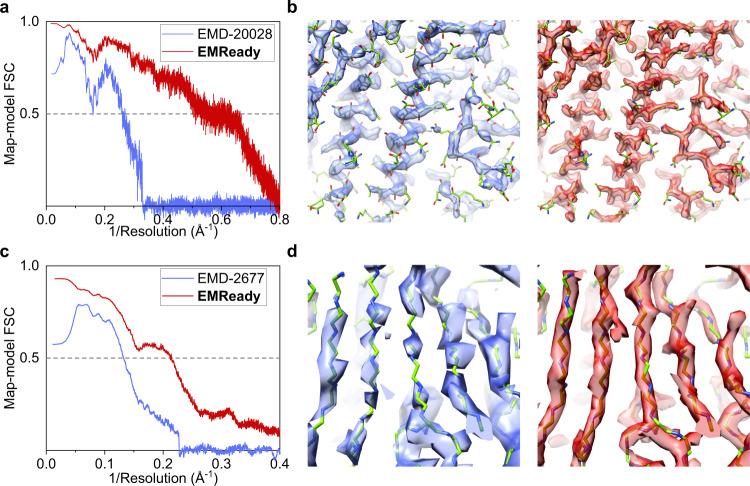
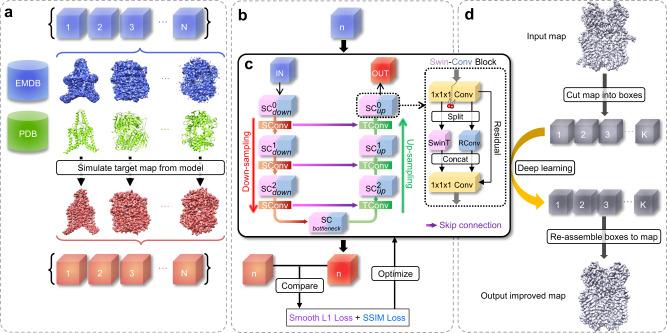
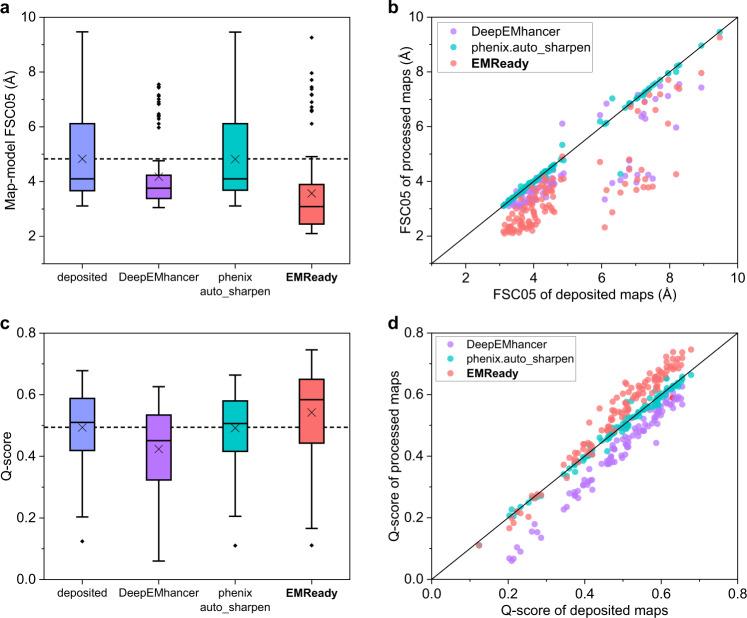
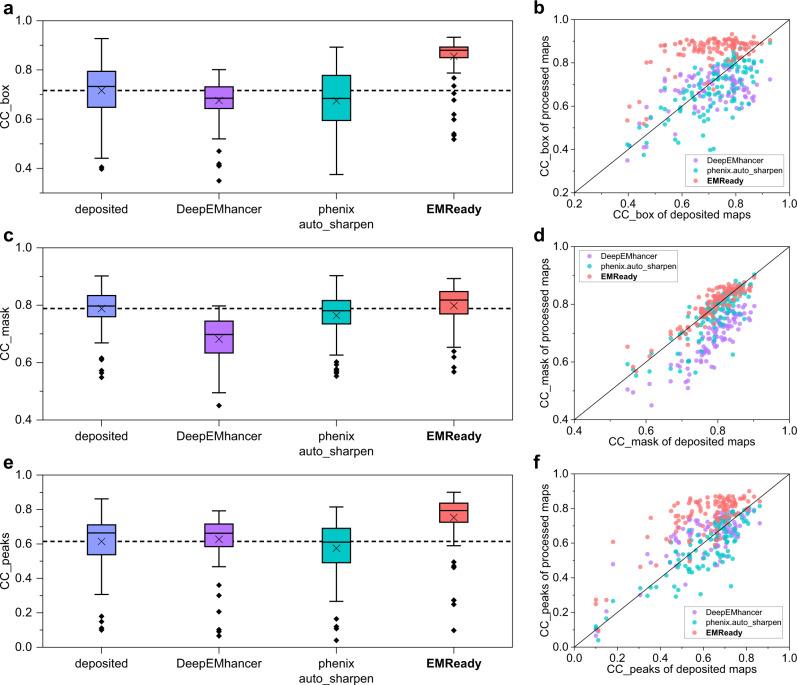
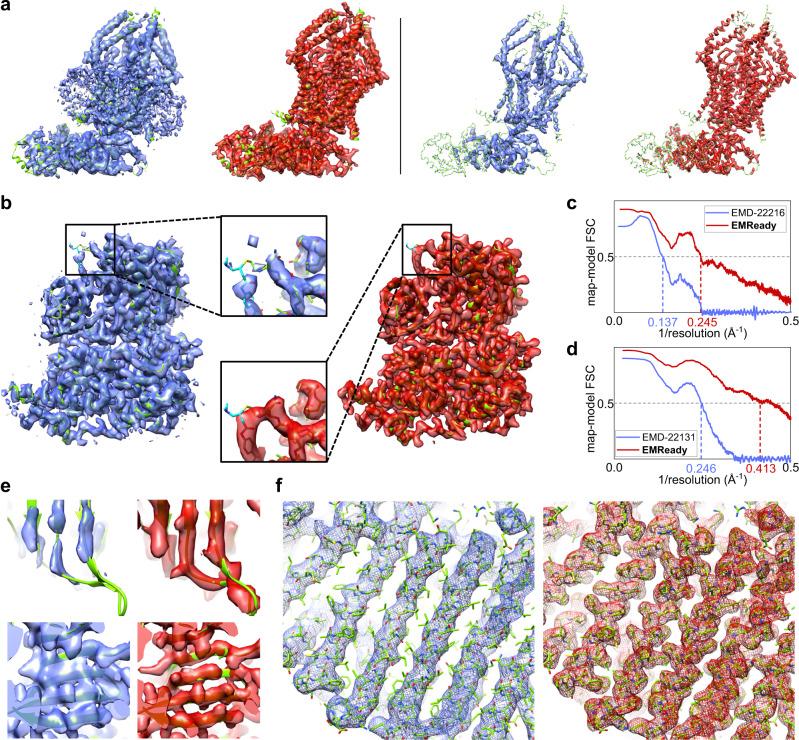
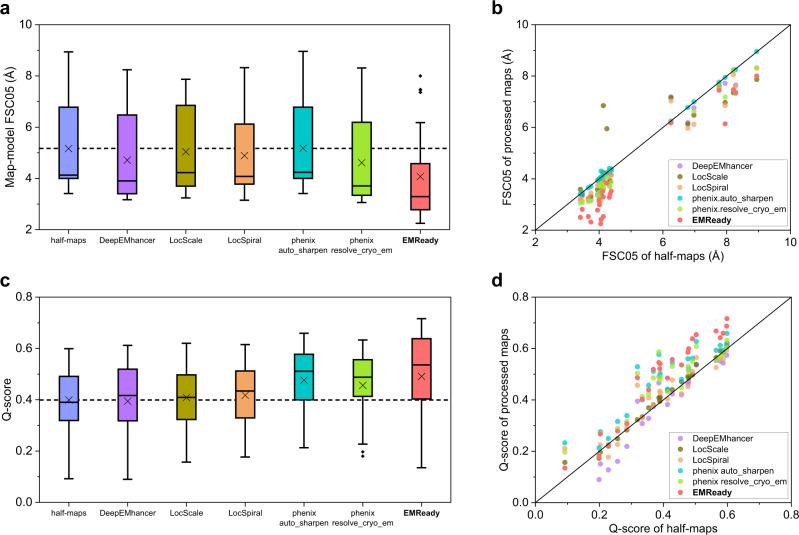
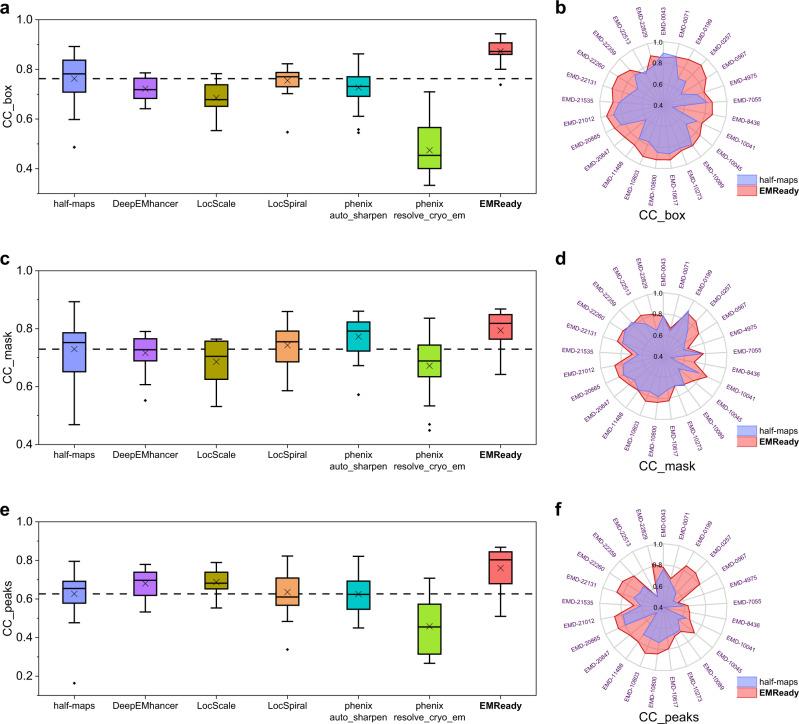
Cryo-EM has emerged as the most important technique for structure determination of macromolecular complexes. However, raw cryo-EM maps often exhibit loss of contrast at high resolution and heterogeneity over the entire map. As such, various post-processing methods have been proposed to improve cryo-EM maps. Nevertheless, it is still challenging to improve both the quality and interpretability of EM maps. Addressing the challenge, we present a three-dimensional Swin-Conv-UNet-based deep learning framework to improve cryo-EM maps, named EMReady, by not only implementing both local and non-local modeling modules in a multiscale UNet architecture but also simultaneously minimizing the local smooth L1 distance and maximizing the non-local structural similarity between processed experimental and simulated target maps in the loss function. EMReady was extensively evaluated on diverse test sets of 110 primary cryo-EM maps and 25 pairs of half-maps at 3.0-6.0 Å resolutions, and compared with five state-of-the-art map post-processing methods. It is shown that EMReady can not only robustly enhance the quality of cryo-EM maps in terms of map-model correlations, but also improve the interpretability of the maps in automatic de novo model building.
冷冻电镜(Cryo-EM)已成为确定大分子复合物结构的最重要技术。然而,原始的冷冻电镜图谱在高分辨率下经常会出现对比度损失,并且整个图谱上存在异质性。因此,已经提出了各种后处理方法来改善冷冻电镜图谱。然而,提高 EM 图谱的质量和可解释性仍然具有挑战性。为了解决这一挑战,我们提出了一个基于三维 Swin-Conv-UNet 的深度学习框架,名为 EMReady,通过在多尺度 UNet 架构中实现局部和非局部建模模块,同时在损失函数中最小化处理后的实验和模拟目标图谱之间的局部平滑 L1 距离和最大化非局部结构相似性,来改善冷冻电镜图谱。我们在 110 个原始冷冻电镜图谱和 25 对 3.0-6.0Å分辨率的半图谱的多个测试集中对 EMReady 进行了广泛评估,并与五种最先进的图谱后处理方法进行了比较。结果表明,EMReady 不仅可以在图谱-模型相关性方面稳健地提高冷冻电镜图谱的质量,还可以提高图谱在自动从头建模中的可解释性。

 Zotero 插件