
炎症性肠病中肿瘤坏死因子受体的研究。
Study of tumor necrosis factor receptor in the inflammatory bowel disease.
机构信息
Department of Anatomy, Institute of Biomedical Sciences, University of São Paulo, São Paulo 05508-000, Brazil.
Department of Surgery, School of Veterinary Medicine and Animal Sciences, University of São Paulo, São Paulo 05508-270, Brazil.
出版信息
World J Gastroenterol. 2023 May 14;29(18):2733-2746. doi: 10.3748/wjg.v29.i18.2733.
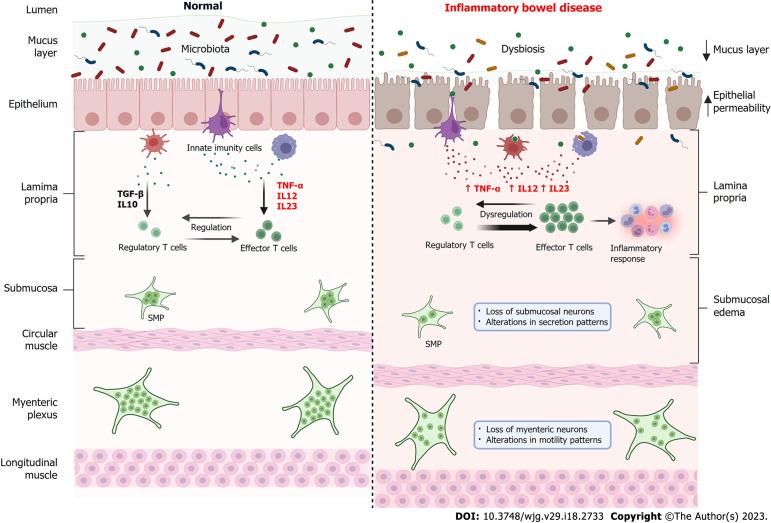
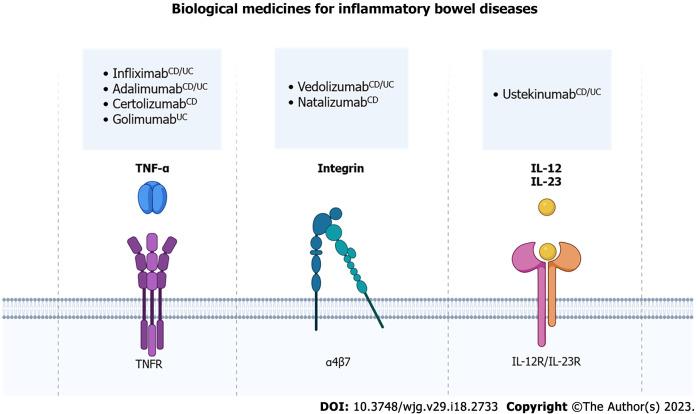
Ulcerative colitis (UC) and Crohn's disease (CD) are part of Inflammatory Bowel Diseases (IBD) and have pathophysiological processes such as bowel necrosis and enteric neurons and enteric glial cells. In addition, the main inflammatory mediator is related to the tumor necrosis factor-alpha (TNF-α). TNF-α is a me-diator of the intestinal inflammatory processes, thus being one of the main cytokines involved in the pathogenesis of IBD, however, its levels, when measured, are present in the serum of patients with IBD. In addition, TNF-α plays an important role in promoting inflammation, such as the production of interleukins (IL), for instance IL-1β and IL-6. There are two receptors for TNF as following: The tumor necrosis factor 1 receptor (TNFR1); and the tumor necrosis factor 2 receptor (TNFR2). They are involved in the pathogenesis of IBD and their receptors have been detected in IBD and their expression is correlated with disease activity. The soluble TNF form binds to the TNFR1 receptor with, and its activation results in a signaling cascade effects such as apoptosis, cell proliferation and cytokine secretion. In contrast, the transmembrane TNF form can bind both to TNFR1 and TNFR2. Recent studies have suggested that TNF-α is one of the main pro-inflammatory cytokines involved in the pathogenesis of IBD, since TNF levels are present in the serum of both patients with UC and CD. Intravenous and subcutaneous biologics targeting TNF-α have revolutionized the treatment of IBD, thus becoming the best available agents to induce and maintain IBD remission. The application of antibodies aimed at neutralizing TNF-α in patients with IBD that induce a satisfactory clinical response in up to 60% of patients, and also induced long-term maintenance of disease remission in most patients. It has been suggested that anti-TNF-α agents inactivate the pro-inflammatory cytokine TNF-α by direct neutralization, , resulting in suppression of inflammation. However, anti-TNF-α antibodies perform more complex functions than a simple blockade.
溃疡性结肠炎(UC)和克罗恩病(CD)是炎症性肠病(IBD)的一部分,具有肠坏死和肠神经元和肠神经胶质细胞等病理生理过程。此外,主要的炎症介质与肿瘤坏死因子-α(TNF-α)有关。TNF-α是肠道炎症过程的介质,因此是 IBD 发病机制中主要细胞因子之一,但其水平在 IBD 患者的血清中测量时存在。此外,TNF-α在促进炎症方面发挥着重要作用,例如白细胞介素(IL)的产生,例如 IL-1β和 IL-6。TNF 有两种受体,如下所述:肿瘤坏死因子 1 受体(TNFR1);和肿瘤坏死因子 2 受体(TNFR2)。它们参与 IBD 的发病机制,其受体已在 IBD 中检测到,其表达与疾病活动相关。可溶性 TNF 形式与 TNFR1 受体结合,其激活导致信号级联反应,例如细胞凋亡、细胞增殖和细胞因子分泌。相比之下,跨膜 TNF 形式可以与 TNFR1 和 TNFR2 结合。最近的研究表明,TNF-α是参与 IBD 发病机制的主要促炎细胞因子之一,因为 UC 和 CD 患者的血清中均存在 TNF 水平。针对 TNF-α的静脉内和皮下生物制剂彻底改变了 IBD 的治疗方法,因此成为诱导和维持 IBD 缓解的最佳可用药物。针对 TNF-α的抗体在 IBD 患者中的应用可诱导高达 60%的患者产生满意的临床反应,并诱导大多数患者长期维持疾病缓解。有人提出,抗 TNF-α 药物通过直接中和作用使促炎细胞因子 TNF-α失活,从而抑制炎症。然而,抗 TNF-α 抗体的作用比简单的阻断更为复杂。

 Zotero 插件