
原花青素中的没食子酸通过抑制自噬抑制非小细胞肺癌中的细胞增殖和迁移。
Gallic acid in theabrownin suppresses cell proliferation and migration in non‑small cell lung carcinoma via autophagy inhibition.
作者信息
Tian Xue, Xu Jiaan, Ye Yonghua, Xiao Xiujuan, Yan Li, Yu Shihui, Cai Jianyong, Du Quan, Dong Xiaoqiao, Zhou Li, Shan Letian, Yuan Qiang
机构信息
College of Pharmaceutical Sciences, Zhejiang Chinese Medical University, Hangzhou, Zhejiang 310053, P.R. China.
The First Affiliated Hospital, Zhejiang Chinese Medical University, Hangzhou, Zhejiang 310053, P.R. China.
出版信息
Oncol Lett. 2023 May 23;26(1):294. doi: 10.3892/ol.2023.13880. eCollection 2023 Jul.
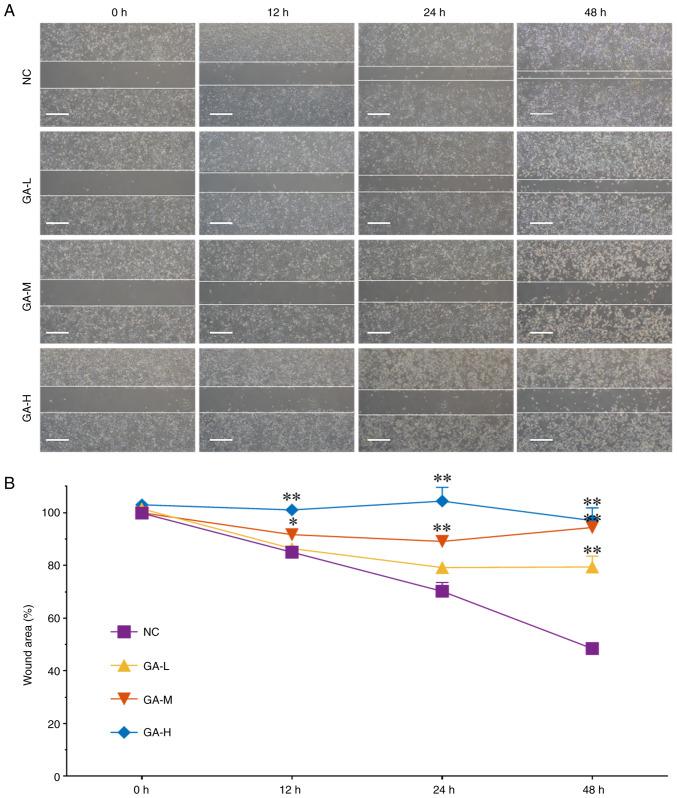
The bioactive extract of green tea, theabrownin (TB), is known to exhibit pro-apoptotic and antitumor effects on non-small cell lung cancer (NSCLC). Gallic acid (GA) is a crucial component of TB; however, its mechanism of action in NSCLC has been rarely studied. To date, little attention has been paid to the anti-NSCLC activity of GA. Therefore, the present study investigated the effects of GA and . Cell Counting Kit (CCK)-8 assay, DAPI staining and flow cytometry, wound-healing assay and western blotting were used to assess cell viability, apoptosis, migration and protein expression, respectively. In addition, a xenograft model was generated, and TUNEL assay and immunohistochemistry analysis were performed. The CCK-8 data showed that the viability of H1299 cells was significantly inhibited by GA in a dose- and time-dependent manner. DAPI staining, Annexin-V/PI staining and wound-healing data showed that GA exerted pro-apoptotic and anti-migratory effects on H1299 cells in a dose-dependent manner. Furthermore, the results of western blotting showed that GA significantly upregulated the levels of pro-apoptotic proteins [cleaved (c-)PARP, c-caspase8, c-caspase-9 and the ratio of γ-H2A.X/H2A.X]. data confirmed the antitumor effect of GA through apoptosis induction in an autophagy-dependent manner. In conclusion, the present study confirmed the anti-proliferative, pro-apoptotic and anti-migratory effects of GA against NSCLC and , providing considerable evidence for its potential as a novel candidate for the treatment of NSCLC.
绿茶的生物活性提取物茶褐素(TB)已知对非小细胞肺癌(NSCLC)具有促凋亡和抗肿瘤作用。没食子酸(GA)是TB的关键成分;然而,其在NSCLC中的作用机制鲜有研究。迄今为止,GA的抗NSCLC活性很少受到关注。因此,本研究调查了GA的作用效果。分别使用细胞计数试剂盒(CCK)-8法、DAPI染色、流式细胞术、伤口愈合试验和蛋白质免疫印迹法来评估细胞活力、凋亡、迁移和蛋白质表达。此外,建立了异种移植模型,并进行了TUNEL试验和免疫组织化学分析。CCK-8数据显示,GA以剂量和时间依赖性方式显著抑制H1299细胞的活力。DAPI染色、膜联蛋白V/碘化丙啶染色和伤口愈合数据显示,GA以剂量依赖性方式对H1299细胞发挥促凋亡和抗迁移作用。此外,蛋白质免疫印迹结果显示,GA显著上调促凋亡蛋白的水平[裂解的(c-)PARP、c-半胱天冬酶8、c-半胱天冬酶-9以及γ-H2A.X/H2A.X的比值]。数据证实GA通过自噬依赖性凋亡诱导发挥抗肿瘤作用。总之,本研究证实了GA对NSCLC的抗增殖、促凋亡和抗迁移作用,为其作为NSCLC治疗新候选药物的潜力提供了充分证据。




 Zotero 插件