
在 3 个中低收入国家的门诊儿童中,不适当的抗生素处方及其决定因素:一项多中心基于社区的队列研究。
Inappropriate antibiotic prescribing and its determinants among outpatient children in 3 low- and middle-income countries: A multicentric community-based cohort study.
机构信息
Université Paris-Saclay, UVSQ, Inserm, CESP, Anti-infective evasion and pharmacoepidemiology team, Montigny-Le-Bretonneux, France.
Institut Pasteur, Université Paris Cité, Epidemiology and Modelling of Antibiotic Evasion (EMAE), Paris, France.
出版信息
PLoS Med. 2023 Jun 6;20(6):e1004211. doi: 10.1371/journal.pmed.1004211. eCollection 2023 Jun.
BACKGROUND
Antibiotic resistance is a global public health issue, particularly in low- and middle-income countries (LMICs), where antibiotics required to treat resistant infections are not affordable. LMICs also bear a disproportionately high burden of bacterial diseases, particularly among children, and resistance jeopardizes progress made in these areas. Although outpatient antibiotic use is a major driver of antibiotic resistance, data on inappropriate antibiotic prescribing in LMICs are scarce at the community level, where the majority of prescribing occurs. Here, we aimed to characterize inappropriate antibiotic prescribing among young outpatient children and to identify its determinants in 3 LMICs.
METHODS AND FINDINGS
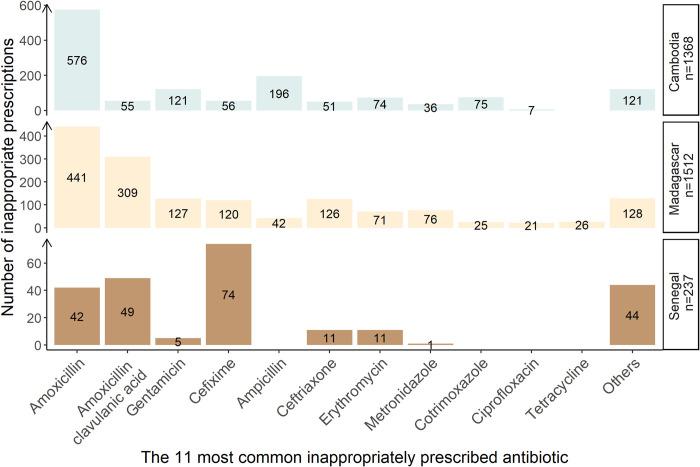
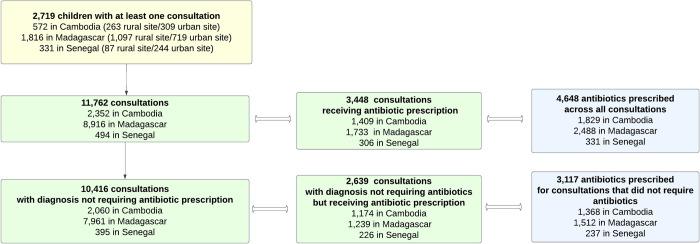
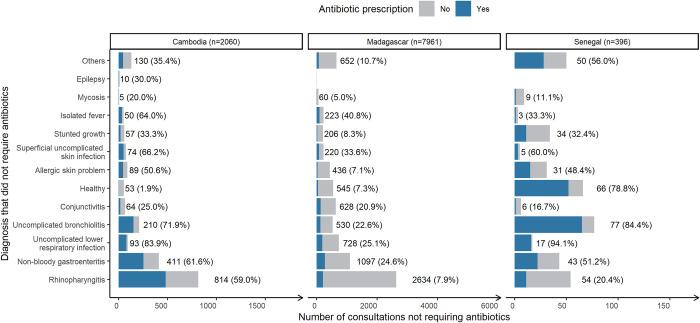
We used data from a prospective, community-based mother-and-child cohort (BIRDY, 2012 to 2018) conducted across urban and rural sites in Madagascar, Senegal, and Cambodia. Children were included at birth and followed-up for 3 to 24 months. Data from all outpatient consultations and antibiotics prescriptions were recorded. We defined inappropriate prescriptions as antibiotics prescribed for a health event determined not to require antibiotic therapy (antibiotic duration, dosage, and formulation were not considered). Antibiotic appropriateness was determined a posteriori using a classification algorithm developed according to international clinical guidelines. We used mixed logistic analyses to investigate risk factors for antibiotic prescription during consultations in which children were determined not to require antibiotics. Among the 2,719 children included in this analysis, there were 11,762 outpatient consultations over the follow-up period, of which 3,448 resulted in antibiotic prescription. Overall, 76.5% of consultations resulting in antibiotic prescription were determined not to require antibiotics, ranging from 71.5% in Madagascar to 83.3% in Cambodia. Among the 10,416 consultations (88.6%) determined not to require antibiotic therapy, 25.3% (n = 2,639) nonetheless resulted in antibiotic prescription. This proportion was much lower in Madagascar (15.6%) than in Cambodia (57.0%) or Senegal (57.2%) (p < 0.001). Among the consultations determined not to require antibiotics, in both Cambodia and Madagascar the diagnoses accounting for the greatest absolute share of inappropriate prescribing were rhinopharyngitis (59.0% of associated consultations in Cambodia, 7.9% in Madagascar) and gastroenteritis without evidence of blood in the stool (61.6% and 24.6%, respectively). In Senegal, uncomplicated bronchiolitis accounted for the greatest number of inappropriate prescriptions (84.4% of associated consultations). Across all inappropriate prescriptions, the most frequently prescribed antibiotic was amoxicillin in Cambodia and Madagascar (42.1% and 29.2%, respectively) and cefixime in Senegal (31.2%). Covariates associated with an increased risk of inappropriate prescription include patient age greater than 3 months (adjusted odds ratios (aOR) with 95% confidence interval (95% CI) ranged across countries from 1.91 [1.63, 2.25] to 5.25 [3.85, 7.15], p < 0.001) and living in rural as opposed to urban settings (aOR ranged across countries from 1.83 [1.57, 2.14] to 4.40 [2.34, 8.28], p < 0.001). Diagnosis with a higher severity score was also associated with an increased risk of inappropriate prescription (aOR = 2.00 [1.75, 2.30] for moderately severe, 3.10 [2.47, 3.91] for most severe, p < 0.001), as was consultation during the rainy season (aOR = 1.32 [1.19, 1.47], p < 0.001). The main limitation of our study is the lack of bacteriological documentation, which may have resulted in some diagnosis misclassification and possible overestimation of inappropriate antibiotic prescription.
CONCLUSION
In this study, we observed extensive inappropriate antibiotic prescribing among pediatric outpatients in Madagascar, Senegal, and Cambodia. Despite great intercountry heterogeneity in prescribing practices, we identified common risk factors for inappropriate prescription. This underscores the importance of implementing local programs to optimize antibiotic prescribing at the community level in LMICs.
背景
抗生素耐药性是一个全球性的公共卫生问题,特别是在中低收入国家(LMICs),这些国家的治疗耐药感染所需的抗生素价格昂贵,难以负担。LMICs 还承担着不成比例的严重细菌疾病负担,尤其是儿童,而耐药性危及这些地区所取得的进展。尽管门诊抗生素使用是抗生素耐药性的主要驱动因素,但关于 LMICs 社区层面(大多数处方发生在该层面)不适当抗生素处方的数据却很少。在这里,我们旨在描述门诊儿童中不适当的抗生素处方,并确定其在 3 个 LMICs 中的决定因素。
方法和发现
我们使用了来自马达加斯加、塞内加尔和柬埔寨的前瞻性社区为基础的母婴队列研究(BIRDY,2012 年至 2018 年)的数据。儿童在出生时被纳入研究,并随访 3 至 24 个月。记录了所有门诊咨询和抗生素处方的数据。我们将不适当的处方定义为针对确定不需要抗生素治疗的健康事件开具的抗生素(抗生素持续时间、剂量和制剂未被考虑)。抗生素的适当性是根据国际临床指南制定的分类算法来确定的。我们使用混合逻辑分析来调查在确定不需要抗生素的咨询中抗生素处方的风险因素。在这项分析中,共纳入了 2719 名儿童,在随访期间共进行了 11762 次门诊咨询,其中 3448 次开出了抗生素处方。总体而言,在确定不需要抗生素的 3448 次咨询中,有 76.5%的咨询开出了不需要的抗生素处方,从马达加斯加的 71.5%到柬埔寨的 83.3%不等。在确定不需要抗生素治疗的 10416 次咨询中(占 88.6%),仍有 25.3%(n=2639)开出了抗生素处方。在柬埔寨(57.0%)和塞内加尔(57.2%),这一比例远低于马达加斯加(15.6%)(p<0.001)。在确定不需要抗生素的咨询中,无论是在柬埔寨还是马达加斯加,导致不适当处方的最大绝对比例的诊断是鼻咽炎(柬埔寨相关咨询的 59.0%,马达加斯加的 7.9%)和无粪便血的胃肠炎(分别为 61.6%和 24.6%)。在塞内加尔,单纯细支气管炎导致的不适当处方数量最多(相关咨询的 84.4%)。在所有不适当的处方中,最常开的抗生素是柬埔寨和马达加斯加的阿莫西林(分别为 42.1%和 29.2%)和塞内加尔的头孢克肟(31.2%)。与不适当处方风险增加相关的协变量包括年龄大于 3 个月的患者(调整后的优势比(aOR)在各国的 95%置信区间(95%CI)范围从 1.91(1.63,2.25)至 5.25(3.85,7.15),p<0.001)和居住在农村地区而不是城市地区(各国的 aOR 范围从 1.83(1.57,2.14)至 4.40(2.34,8.28),p<0.001)。诊断的严重程度评分较高也与不适当处方的风险增加相关(中度严重程度的 aOR=2.00(1.75,2.30),最严重程度的 aOR=3.10(2.47,3.91),p<0.001),雨季咨询也与不适当处方风险增加相关(aOR=1.32(1.19,1.47),p<0.001)。我们研究的主要限制是缺乏细菌学文件,这可能导致一些诊断分类错误,并可能高估不适当的抗生素处方。
结论
在这项研究中,我们观察到马达加斯加、塞内加尔和柬埔寨的儿科门诊中存在广泛的不适当抗生素处方。尽管各国的处方实践存在很大的异质性,但我们确定了不适当处方的共同危险因素。这强调了在中低收入国家实施旨在优化社区层面抗生素处方的本地计划的重要性。
 Zotero 插件