
加拿大魁北克省 COVID-19 大流行的社会经济差异和传播集中程度。
Socioeconomic disparities and concentration of the spread of the COVID-19 pandemic in the province of Quebec, Canada.
机构信息
Direction de santé publique du CIUSSS-CN, Quebec City, QC, Canada.
Centre de Recherche en Santé Durable VITAM, Quebec City, QC, Canada.
出版信息
BMC Public Health. 2023 Jun 6;23(1):1096. doi: 10.1186/s12889-023-15983-3.
BACKGROUND
Recent studies suggest that the risk of SARS-CoV-2 infection may be greater in more densely populated areas and in cities with a higher proportion of persons who are poor, immigrant, or essential workers. This study examines spatial inequalities in SARS-CoV-2 exposure in a health region of the province of Quebec in Canada.
METHODS
The study was conducted on the 1206 Canadian census dissemination areas in the Capitale-Nationale region of the province of Quebec. The observation period was 21 months (March 2020 to November 2021). The number of cases reported daily in each dissemination area was identified from available administrative databases. The magnitude of inequalities was estimated using Gini and Foster-Greer-Thorbecke (FGT) indices. The association between transmission and socioeconomic deprivation was identified based on the concentration of transmission in socially disadvantaged areas and on nonparametric regressions relating the cumulative incidence rate by area to ecological indicators of spatial disadvantage. Quantification of the association between median family income and degree of exposure of dissemination areas was supplemented by an ordered probit multiple regression model.
RESULTS
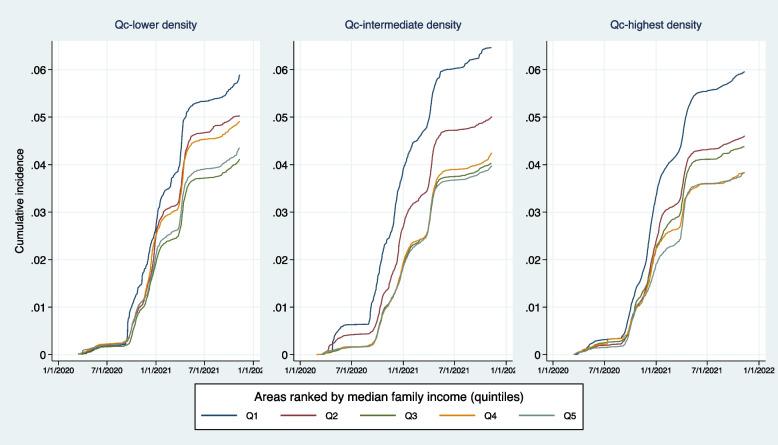
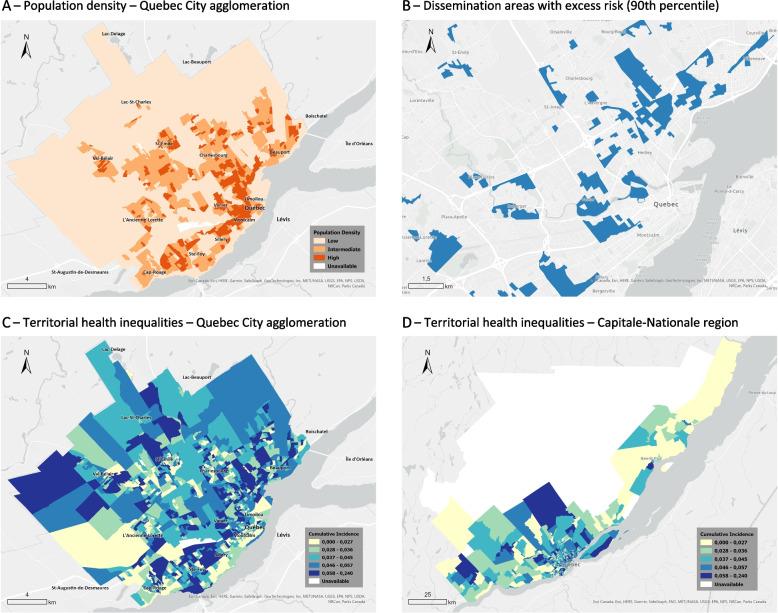
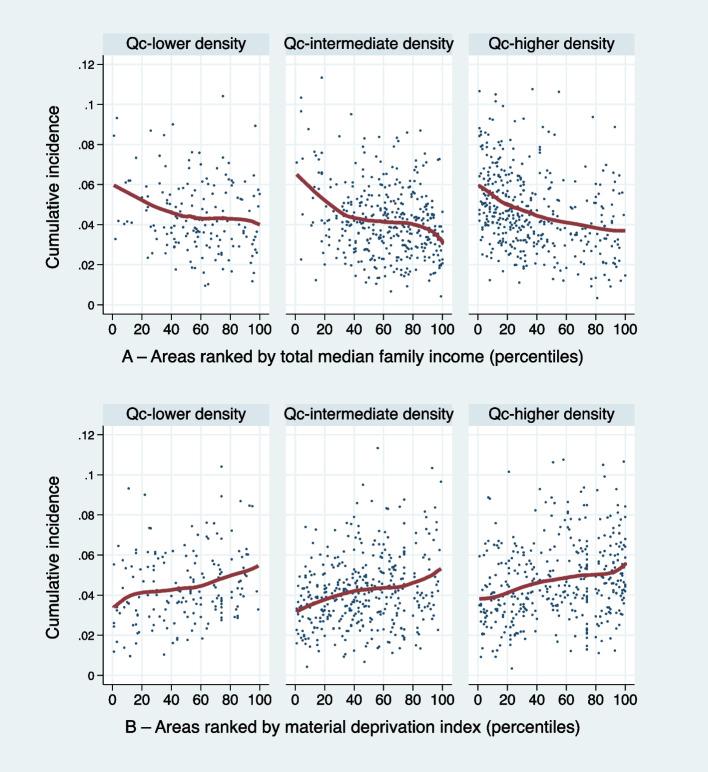
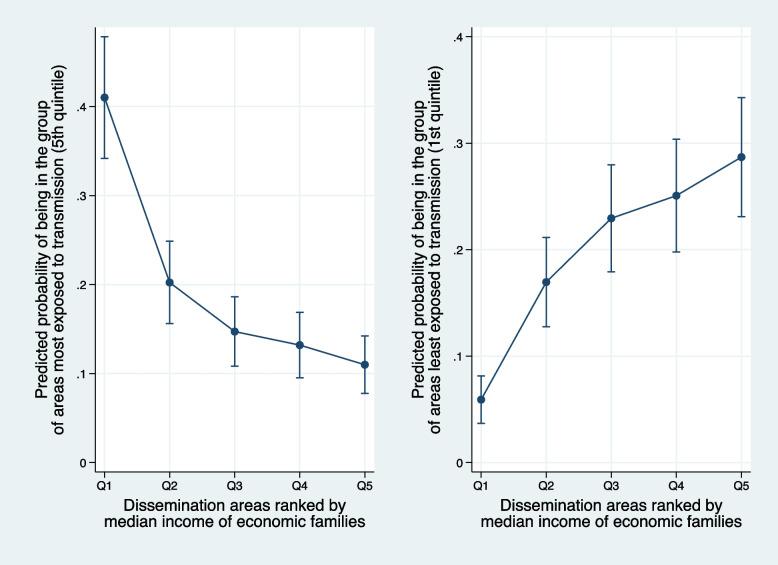
Spatial disparities were elevated (Gini = 0.265; 95% CI [0.251, 0.279]). The spread was more limited in the less densely populated areas of the Quebec City agglomeration and outlying municipalities. The mean cumulative incidence in the subsample made up of the areas most exposed to the pandemic was 0.093. The spread of the epidemic was concentrated in the most disadvantaged areas, especially in the densely populated areas. Socioeconomic inequality appeared early and increased with each successive pandemic wave. The models showed that areas with economically disadvantaged populations were three times more likely to be among the areas at highest risk for COVID-19 (RR = 3.55; 95% CI [2.02, 5.08]). In contrast, areas with a higher income population (fifth quintile) were two times less likely to be among the most exposed areas (RR = 0.52; 95% CI [0.32, 0.72]).
CONCLUSION
As with the H1N1 pandemics of 1918 and 2009, the SARS-CoV-2 pandemic revealed social vulnerabilities. Further research is needed to explore the various manifestations of social inequality in relation to the pandemic.
背景
最近的研究表明,在人口密度较高的地区以及贫困人口、移民或基本工人比例较高的城市,感染 SARS-CoV-2 的风险可能更大。本研究检查了加拿大魁北克省一个卫生区域内 SARS-CoV-2 暴露的空间不平等现象。
方法
该研究在魁北克省首都地区的 1206 个加拿大人口普查传播区进行。观察期为 21 个月(2020 年 3 月至 2021 年 11 月)。从可用的行政数据库中确定每个传播区每天报告的病例数。使用基尼和福斯特-格雷-索贝克(Foster-Greer-Thorbecke,FGT)指数估计不平等的程度。根据社会弱势群体地区的传播集中程度以及与区域生态劣势指标相关的区域累积发病率的非参数回归,确定传播与社会经济剥夺之间的关联。通过有序概率多项回归模型补充传播地区家庭收入中位数与暴露程度之间关联的量化。
结果
空间差异较大(基尼系数为 0.265;95%CI [0.251, 0.279])。在魁北克市城市群和外围城市人口密度较低的地区,传播范围较有限。由受大流行影响最大的地区组成的子样本中的平均累积发病率为 0.093。疫情传播集中在最弱势群体地区,特别是人口密集地区。社会经济不平等现象很早就出现了,并随着每一波大流行而增加。模型显示,经济弱势群体所在地区感染 COVID-19 的风险最高的地区的可能性是其他地区的三倍(RR=3.55;95%CI [2.02, 5.08])。相比之下,收入较高人群(第五五分位数)所在地区不太可能成为受影响最严重的地区(RR=0.52;95%CI [0.32, 0.72])。
结论
与 1918 年和 2009 年的 H1N1 大流行一样,SARS-CoV-2 大流行揭示了社会脆弱性。需要进一步研究以探讨与大流行相关的各种社会不平等表现。
 Zotero 插件