
社会和人口因素对尼斯镇 SARS-CoV-2 疫情传播的影响。
Impact of social and demographic factors on the spread of the SARS-CoV-2 epidemic in the town of Nice.
机构信息
Public Health Department, Université Côte d'Azur, Centre Hospitalier Universitaire de Nice, Route St Antoine de Ginestière. Niveau 1, CS23079, Nice cedex 3, 06202, France.
Université Côte d'Azur, UR2CA, Nice, France.
出版信息
BMC Public Health. 2023 Jun 6;23(1):1098. doi: 10.1186/s12889-023-15917-z.
INTRODUCTION
Socio-demographic factors are known to influence epidemic dynamics. The town of Nice, France, displays major socio-economic inequalities, according to the National Institute of Statistics and Economic Studies (INSEE), 10% of the population is considered to live below the poverty threshold, i.e. 60% of the median standard of living.
OBJECTIVE
To identify socio-economic factors related to the incidence of SARS-CoV-2 in Nice, France.
METHODS
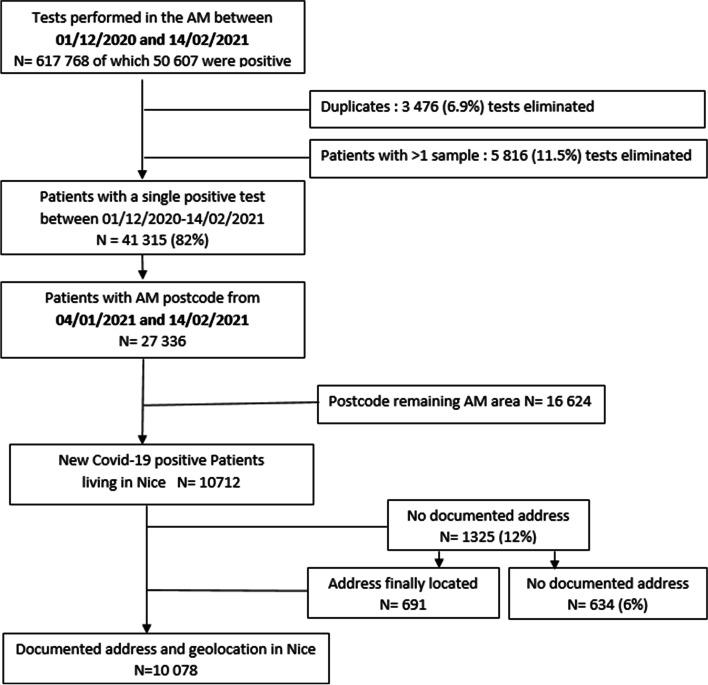
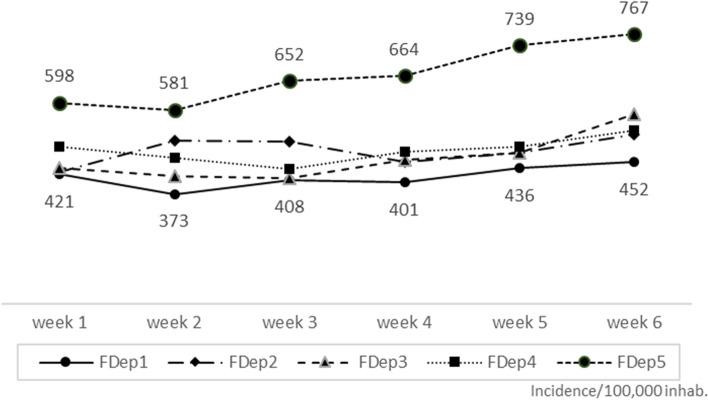
The study included residents of Nice with a first positive SARS-CoV-2 test (January 4-February 14, 2021). Laboratory data were provided by the National information system for Coronavirus Disease (COVID-19) screening (SIDEP) and socio-economic data were obtained from INSEE. Each case's address was allocated to a census block to which we assigned a social deprivation index (French Deprivation index, FDep) divided into 5 categories. For each category, we computed the incidence rate per age and per week and its mean weekly variation. A standardized incidence ratio (SIR) was calculated to investigate a potential excess of cases in the most deprived population category (FDep5), compared to the other categories. Pearson's correlation coefficient was computed and a Generalized Linear Model (GLM) applied to analyse the number of cases and socio-economic variables per census blocks.
RESULTS
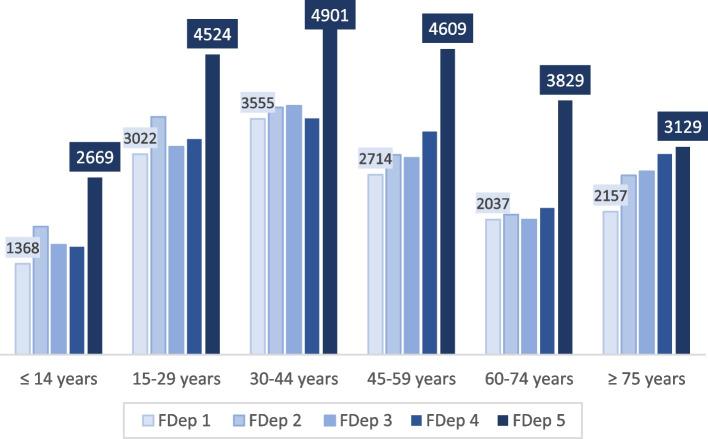
We included 10,078 cases. The highest incidence rate was observed in the most socially deprived category (4001/100,000 inhabitants vs 2782/100,000 inhabitants for the other categories of FDep). The number of observed cases in the most social deprivated category (FDep5: N = 2019) was significantly higher than in the others (N = 1384); SIR = 1.46 [95% CI:1.40-1.52; p < 0.001]. Socio-economic variables related to poor housing, harsh working conditions and low income were correlated with the new cases of SARS-CoV-2.
CONCLUSION
Social deprivation was correlated with a higher incidence of SARS-CoV-2 during the 2021 epidemic in Nice. Local surveillance of epidemics provides complementary data to national and regional surveillance. Mapping socio-economic vulnerability indicators at the census block level and correlating these with incidence could prove highly useful to guide political decisions in public health.
简介
社会人口因素会影响传染病的流行动态。根据法国国家统计与经济研究所(INSEE)的数据,尼斯镇存在严重的社会经济不平等现象,10%的人口被认为生活在贫困线以下,即低于中位数生活水平的 60%。
目的
确定与法国尼斯 SARS-CoV-2 发病率相关的社会经济因素。
方法
本研究纳入了 2021 年 1 月 4 日至 2 月 14 日期间在尼斯首次检测出 SARS-CoV-2 阳性的居民。实验室数据由国家冠状病毒疾病信息系统(SIDEP)提供,社会经济数据则由 INSEE 提供。每位病例的地址被分配到一个普查块,我们为其分配了一个社会剥夺指数(法国剥夺指数,FDep),分为 5 类。对于每一类,我们计算了每个年龄组和每周的发病率及其平均每周变化。计算了标准化发病率比(SIR),以调查最贫困人群(FDep5)中病例是否存在潜在过剩,与其他人群相比。计算了 Pearson 相关系数,并应用广义线性模型(GLM)分析了每个普查块的病例数和社会经济变量。
结果
共纳入 10078 例病例。发病率最高的是社会剥夺程度最高的类别(4001/100000 居民,而 FDep 的其他类别为 2782/100000 居民)。社会剥夺程度最高的类别(FDep5:N=2019)中观察到的病例数明显高于其他类别(N=1384);SIR=1.46 [95%CI:1.40-1.52;p<0.001]。与 SARS-CoV-2 新发病例相关的社会经济变量与恶劣的住房条件、艰苦的工作条件和低收入有关。
结论
社会剥夺与 2021 年尼斯 SARS-CoV-2 流行期间发病率的升高有关。对传染病的地方监测提供了国家和地区监测的补充数据。在普查块一级绘制社会经济脆弱性指标,并将这些指标与发病率相关联,可能对指导公共卫生领域的决策非常有用。


 Zotero 插件