
端粒长度与老年人轻度创伤性脑损伤后的症状严重程度相关。
Telomere Length Associates With Symptom Severity After Mild Traumatic Brain Injury in Older Adults.
作者信息
Martha Sarah R, Tolentino Ernesto J, Bugajski Andrew A, Thompson Hilaire J
机构信息
Biobehavioral Nursing Science Department, College of Nursing, University of Illinois at Chicago, Chicago, Illinois, USA University of Washington, Seattle, Washington, USA.
Office of Nursing Research, University of Washington, Seattle, Washington, USA.
出版信息
Neurotrauma Rep. 2023 May 23;4(1):350-358. doi: 10.1089/neur.2023.0012. eCollection 2023.
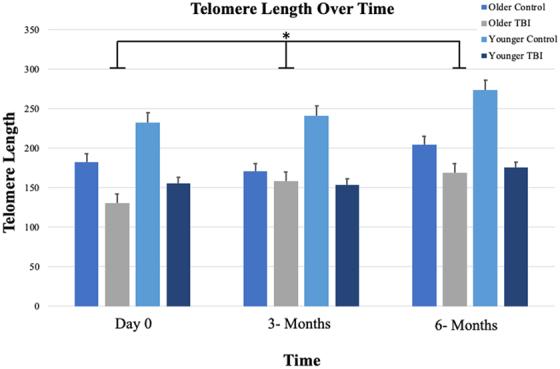
The objectives were to compare differences in telomere length (TL) among younger (21-54 years) and older adults (≥55) with mild traumatic brain injury (mTBI) to non-injured controls and to examine the association between TL and the severity of post-concussive symptoms over time. We performed a quantitative polymerase chain reaction to determine the TL (Kb/genome) of peripheral blood mononuclear cell samples (day 0, 3 months, and 6 months) from 31 subjects. The Rivermead Post-Concussion Symptoms Questionnaire was used to assess symptoms. Group-by-time comparisons of TL and symptom severity were evaluated with repeated-measures analysis of variance. Multiple linear regression examined the relationship between TL, group (mTBI and non-injured controls), and symptom severity total and subscale scores. Significant aging-related differences in TL were found within mTBI groups by time (day 0, 3 months, and 6 months; = 0.025). Older adults with mTBI experienced significant worsening of changes in total symptom severity scores over time (day 0, 3 months, and 6 months; = 0.016). Shorter TLs were associated with higher total symptom burden among each of the four groups at day 0 (baseline; = 0.035) and 3 months ( = 0.038). Shorter TL was also associated with higher cognitive symptom burden among the four groups at day 0 ( = 0.008) and 3 months ( = 0.008). Shorter TL was associated with higher post-injury symptom burden to 3 months in both older and younger persons with mTBI. Large-scale, longitudinal studies of factors associated with TL may be useful to delineate the mechanistic underpinnings of higher symptom burden in adults with mTBI.
本研究旨在比较轻度创伤性脑损伤(mTBI)的年轻人(21 - 54岁)和老年人(≥55岁)与未受伤对照组之间的端粒长度(TL)差异,并探讨TL与脑震荡后症状严重程度随时间的关联。我们采用定量聚合酶链反应来测定31名受试者外周血单个核细胞样本(第0天、3个月和6个月)的TL(千碱基/基因组)。使用Rivermead脑震荡后症状问卷评估症状。通过重复测量方差分析评估TL和症状严重程度的组间时间比较。多元线性回归分析TL、组别(mTBI组和未受伤对照组)与症状严重程度总分及各子量表得分之间的关系。在mTBI组中,随时间(第0天、3个月和6个月)发现了与年龄相关的TL显著差异(P = 0.025)。mTBI的老年人随时间推移(第0天、3个月和6个月)总症状严重程度得分变化显著恶化(P = 0.016)。在第0天(基线;P = 0.035)和3个月时(P = 0.038),四组中较短的TL均与较高的总症状负担相关。在第0天(P = 0.008)和3个月时(P = 0.008),四组中较短的TL也与较高的认知症状负担相关。在mTBI的老年人和年轻人中,较短的TL均与伤后3个月内较高的症状负担相关。对与TL相关因素进行大规模纵向研究,可能有助于阐明mTBI成年人症状负担较高的机制基础。

 Zotero 插件