
高浓度二十二碳六烯酸(DHA)补充对小儿囊性纤维化患者红细胞脂肪酸的影响:一项随机双盲对照试验
Changes of Erythrocyte Fatty Acids after Supplementation with Highly Concentrated Docosahexaenoic Acid (DHA) in Pediatric Cystic Fibrosis: A Randomized Double-Blind Controlled Trial.
作者信息
Ayats-Vidal Roser, Bosque-García Montserrat, Cordobilla Begoña, Asensio-De la Cruz Oscar, García-González Miguel, Castro-Marrero Jesús, López-Rico Irene, Domingo Joan Carles
机构信息
Pediatric Allergies, Immunology and Pneumology Unit, Pediatric Medicine Service, Institut d'Investigació i Innovació Parc Taulí (I3PT-CERCA), Parc Taulí Hospital Universitari, Universitat Autònoma de Barcelona, Parc Taulí 1, E-08208 Sabadell, Spain.
Department of Biochemistry and Molecular Biomedicine, Faculty of Biology, University of Barcelona, E-08028 Barcelona, Spain.
出版信息
J Clin Med. 2023 May 26;12(11):3704. doi: 10.3390/jcm12113704.
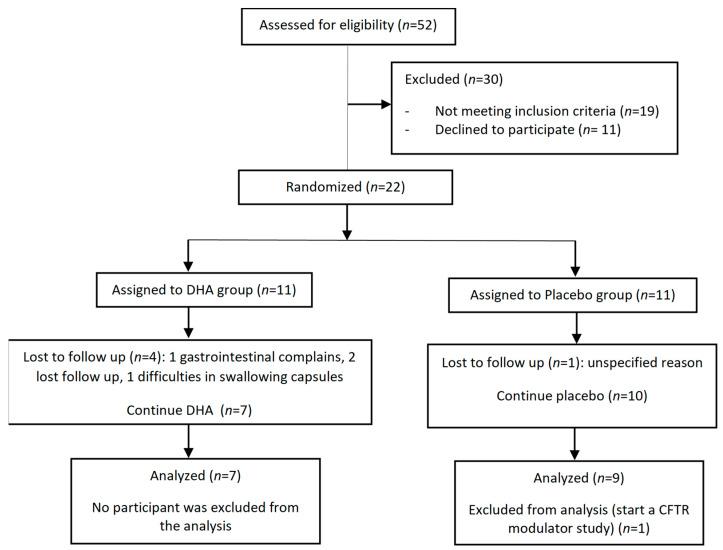
We characterized the fatty acid profiles in the erythrocyte membrane of pediatric patients with cystic fibrosis (CF) receiving highly concentrated docosahexaenoic acid (DHA) supplementation (Tridocosahexanoin-AOX 70%) at 50 mg/kg/day ( = 11) or matching placebo ( = 11) for 12 months. The mean age was 11.7 years. The DHA group showed a statistically significant improvement in n-3 polyunsaturated fatty acids (PUFAs), which was observed as early as 6 months and further increased at 12 months. Among the n-3 PUFAs, there was a significant increase in DHA and eicosapentaenoic acid (EPA). Additionally, a statistically significant decrease in n-6 PUFAs was found, primarily due to a decrease in arachidonic acid (AA) levels and elongase 5 activity. However, we did not observe any changes in linoleic acid levels. The long-term administration of DHA over one year was safe and well tolerated. In summary, the administration of a high-rich DHA supplement at a dose of 50 mg/kg/day for one year can correct erythrocyte AA/DHA imbalance and reduce fatty acid inflammatory markers. However, it is important to note that essential fatty acid alterations cannot be fully normalized with this treatment. These data provide timely information of essential fatty acid profile for future comparative research.
我们对患有囊性纤维化(CF)的儿科患者红细胞膜中的脂肪酸谱进行了特征分析。这些患者接受了浓度为70%的高浓缩二十二碳六烯酸(DHA)补充剂(Tridocosahexanoin-AOX),剂量为50mg/kg/天(n = 11),或匹配的安慰剂(n = 11),持续12个月。平均年龄为11.7岁。DHA组的n-3多不饱和脂肪酸(PUFA)有统计学显著改善,早在6个月时就已观察到,且在12个月时进一步增加。在n-3多不饱和脂肪酸中,DHA和二十碳五烯酸(EPA)显著增加。此外,发现n-6多不饱和脂肪酸有统计学显著下降,主要是由于花生四烯酸(AA)水平和延长酶5活性降低。然而,我们未观察到亚油酸水平有任何变化。一年的DHA长期给药是安全且耐受性良好的。总之,以50mg/kg/天的剂量给予高含量DHA补充剂一年可纠正红细胞中AA/DHA失衡并降低脂肪酸炎症标志物。然而,需要注意的是,这种治疗不能使必需脂肪酸改变完全正常化。这些数据为未来的比较研究提供了必需脂肪酸谱的及时信息。

 Zotero 插件