
一氧化氮和褪黑素的参与通过调节抗坏血酸-谷胱甘肽循环和 ROS 代谢增强了番茄幼苗的镉抗性。
Involvement of Nitric Oxide and Melatonin Enhances Cadmium Resistance of Tomato Seedlings through Regulation of the Ascorbate-Glutathione Cycle and ROS Metabolism.
机构信息
College of Agriculture, Guangxi University, Nanning 530004, China.
出版信息
Int J Mol Sci. 2023 May 31;24(11):9526. doi: 10.3390/ijms24119526.
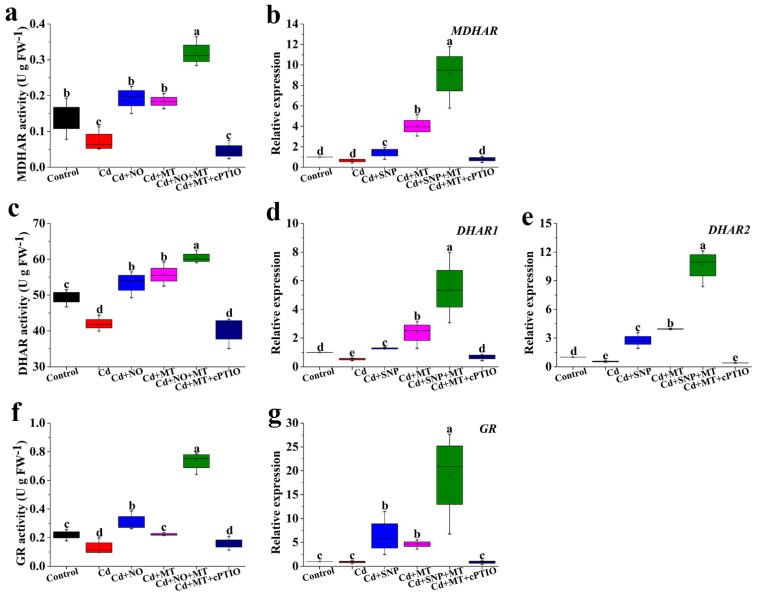
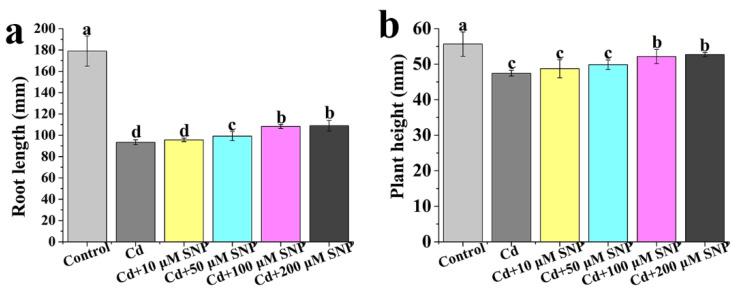
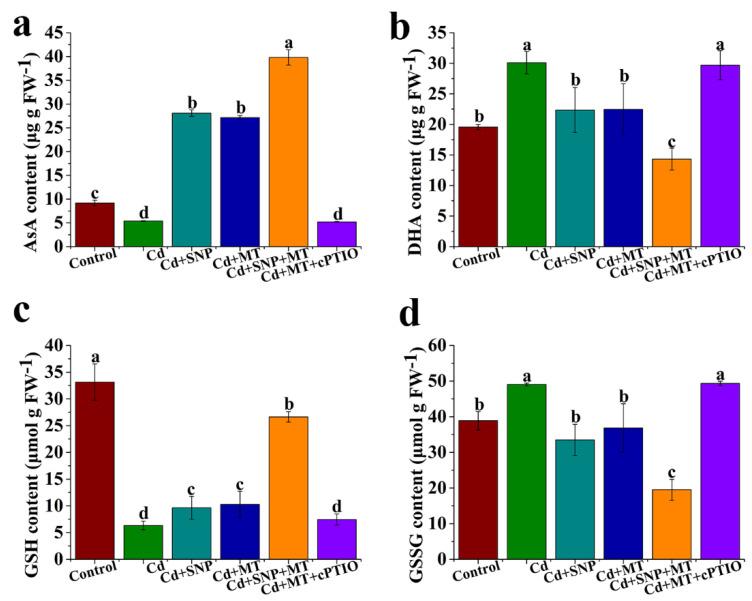
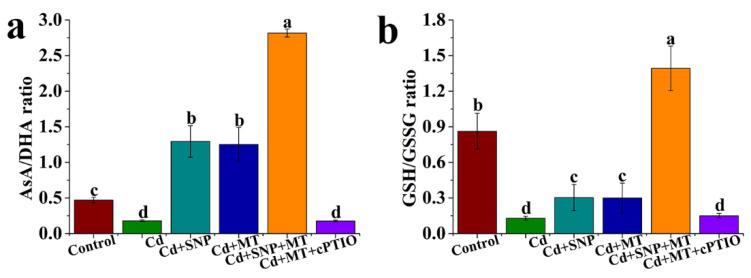
Melatonin (MT) and nitric oxide (NO) act as signaling molecules that can enhance cadmium (Cd) stress resistance in plants. However, little information is available about the relationship between MT and NO during seedling growth under Cd stress. We hypothesize that NO may be involved in how MT responds to Cd stress during seedling growth. The aim of this study is to evaluate the relationship and mechanism of response. The results indicate that different concentrations of Cd inhibit the growth of tomato seedlings. Exogenous MT or NO promotes seedling growth under Cd stress, with a maximal biological response at 100 μM MT or NO. The promotive effects of MT-induced seedling growth under Cd stress are suppressed by NO scavenger 2-4-carboxyphenyl-4,4,5,5-tetramethyl-imidazoline-1-oxyl-3-oxide (cPTIO), suggesting that NO may be involved in MT-induced seedling growth under Cd stress. MT or NO decreases the content of hydrogen peroxide (HO), malonaldehyde (MDA), dehydroascorbic acid (DHA), and oxidized glutathione (GSSG); improves the content of ascorbic acid (AsA) and glutathione (GSH) and the ratios of AsA/DHA and GSH/GSSG; and enhances the activities of glutathione reductase (GR), monodehydroascorbic acid reductase (MDHAR), dehydroascorbic acid reductase (DHAR), ascorbic acid oxidase (AAO), and ascorbate peroxidase (APX) to alleviate oxidative damage. Moreover, the expression of genes associated with the ascorbate-glutathione (AsA-GSH) cycle and reactive oxygen species (ROS) are up-regulated by MT or NO under Cd conditions, including , , , , , , , and . However, NO scavenger cPTIO reverses the positive effects regulated by MT. The results indicate that MT-mediated NO enhances Cd tolerance by regulating AsA-GSH cycle and ROS metabolism.
褪黑素 (MT) 和一氧化氮 (NO) 作为信号分子,可以增强植物对镉 (Cd) 胁迫的抗性。然而,关于 MT 和 NO 在 Cd 胁迫下幼苗生长过程中的关系知之甚少。我们假设 NO 可能参与了 MT 对 Cd 胁迫的响应机制。本研究旨在评估它们之间的关系和响应机制。结果表明,不同浓度的 Cd 抑制番茄幼苗的生长。外源性 MT 或 NO 促进 Cd 胁迫下幼苗的生长,在 100μM MT 或 NO 时具有最大的生物学响应。NO 清除剂 2-4-羧基苯基-4,4,5,5-四甲基-咪唑啉-1-氧-3-氧化物 (cPTIO) 抑制 MT 诱导的 Cd 胁迫下幼苗生长,表明 NO 可能参与 MT 诱导的 Cd 胁迫下幼苗生长。MT 或 NO 降低过氧化氢 (HO)、丙二醛 (MDA)、脱氢抗坏血酸 (DHA) 和氧化型谷胱甘肽 (GSSG) 的含量;提高抗坏血酸 (AsA) 和谷胱甘肽 (GSH) 的含量以及 AsA/DHA 和 GSH/GSSG 的比值;增强谷胱甘肽还原酶 (GR)、单脱氢抗坏血酸还原酶 (MDHAR)、脱氢抗坏血酸还原酶 (DHAR)、抗坏血酸氧化酶 (AAO) 和抗坏血酸过氧化物酶 (APX) 的活性,从而缓解氧化损伤。此外,MT 或 NO 在 Cd 条件下还上调与抗坏血酸-谷胱甘肽 (AsA-GSH) 循环和活性氧 (ROS) 相关的基因的表达,包括 、 、 、 、 、 、 和 。然而,NO 清除剂 cPTIO 逆转了 MT 调节的正向作用。结果表明,MT 介导的 NO 通过调节 AsA-GSH 循环和 ROS 代谢增强 Cd 耐受性。





 Zotero 插件