
可解释机器学习框架,用于预测个性化生理衰老。
Explainable machine learning framework to predict personalized physiological aging.
机构信息
RESTORE Research Center, Université de Toulouse, INSERM 1301, CNRS 5070, EFS, ENVT, France.
Université Toulouse 1 - Capitole, Institute of Research in Informatics (IRIT) of Toulouse, CNRS, Toulouse, France.
出版信息
Aging Cell. 2023 Aug;22(8):e13872. doi: 10.1111/acel.13872. Epub 2023 Jun 10.
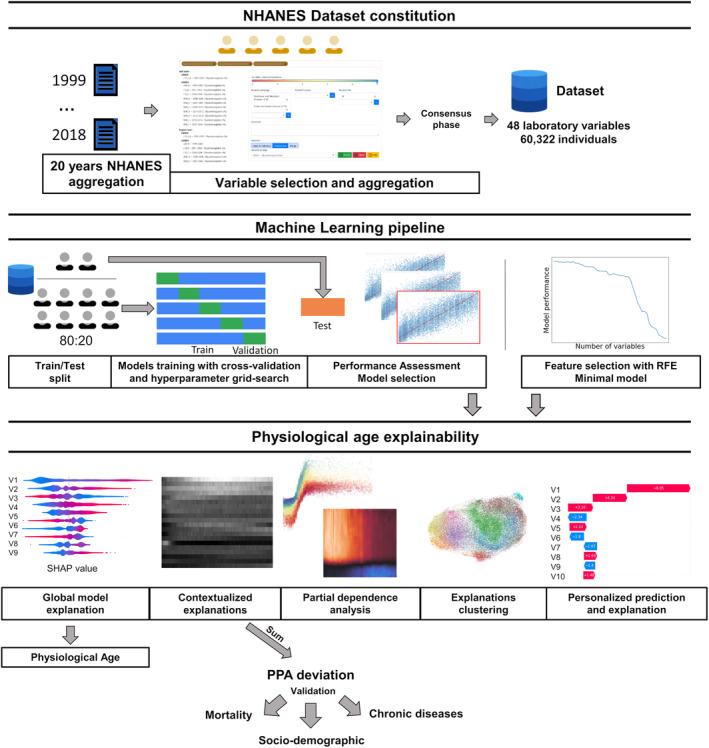
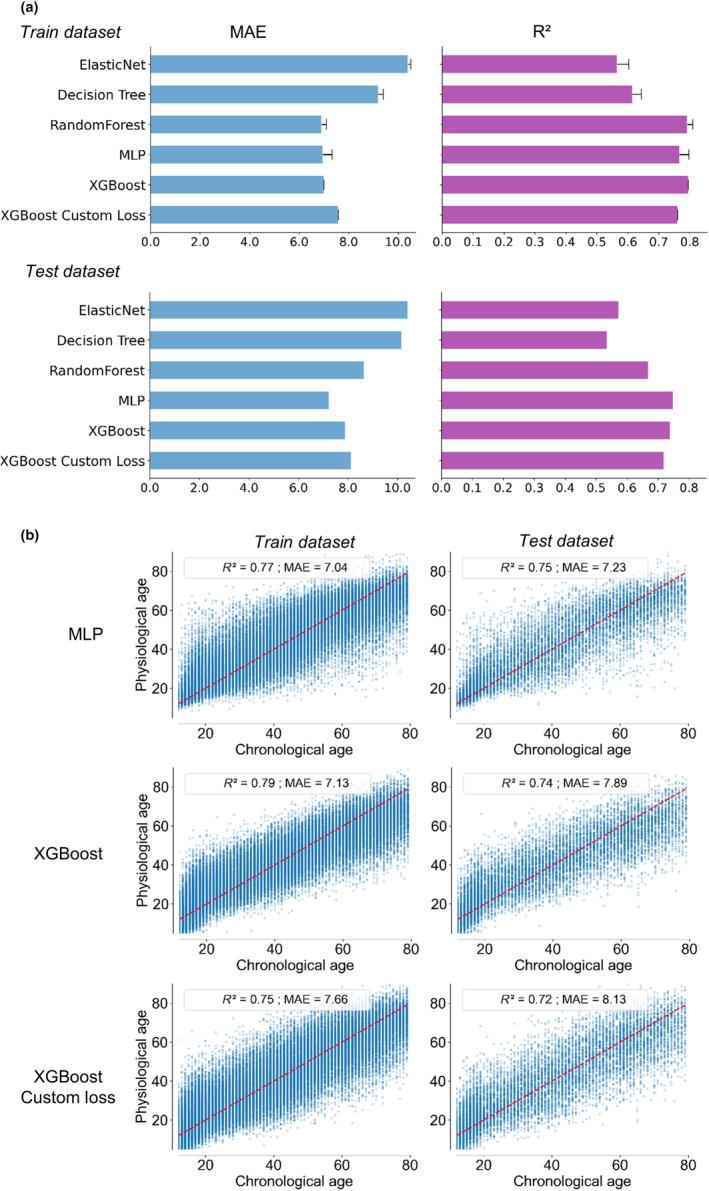
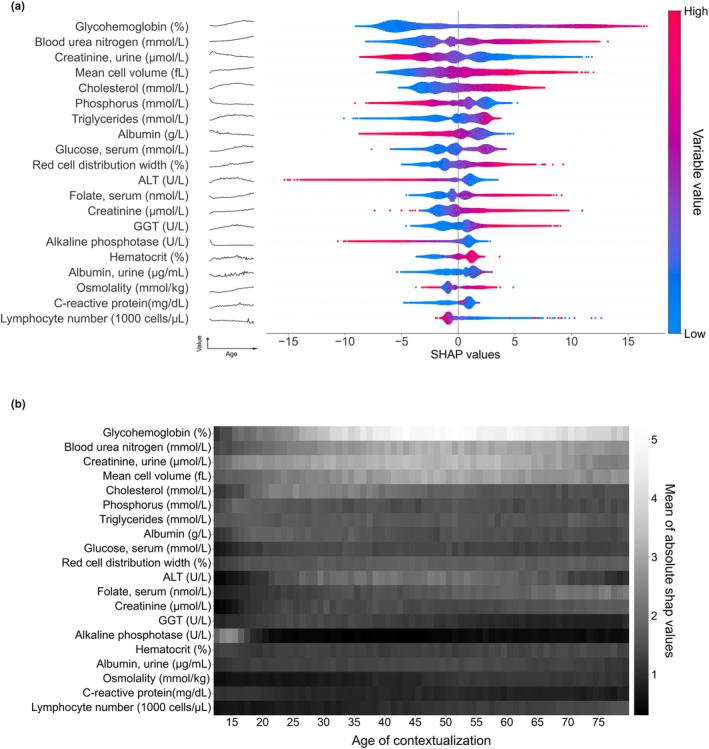
Attaining personalized healthy aging requires accurate monitoring of physiological changes and identifying subclinical markers that predict accelerated or delayed aging. Classic biostatistical methods most rely on supervised variables to estimate physiological aging and do not capture the full complexity of inter-parameter interactions. Machine learning (ML) is promising, but its black box nature eludes direct understanding, substantially limiting physician confidence and clinical usage. Using a broad population dataset from the National Health and Nutrition Examination Survey (NHANES) study including routine biological variables and after selection of XGBoost as the most appropriate algorithm, we created an innovative explainable ML framework to determine a Personalized physiological age (PPA). PPA predicted both chronic disease and mortality independently of chronological age. Twenty-six variables were sufficient to predict PPA. Using SHapley Additive exPlanations (SHAP), we implemented a precise quantitative associated metric for each variable explaining physiological (i.e., accelerated or delayed) deviations from age-specific normative data. Among the variables, glycated hemoglobin (HbA1c) displays a major relative weight in the estimation of PPA. Finally, clustering profiles of identical contextualized explanations reveal different aging trajectories opening opportunities to specific clinical follow-up. These data show that PPA is a robust, quantitative and explainable ML-based metric that monitors personalized health status. Our approach also provides a complete framework applicable to different datasets or variables, allowing precision physiological age estimation.
实现个性化的健康老龄化需要准确监测生理变化,并识别预测加速或延缓衰老的亚临床标志物。经典的生物统计学方法主要依赖于有监督变量来估计生理年龄,无法捕捉到参数之间相互作用的全部复杂性。机器学习(ML)很有前途,但它的黑盒性质使得无法直接理解,这大大限制了医生的信心和临床应用。我们使用了来自国家健康和营养检查调查(NHANES)研究的广泛人群数据集,其中包括常规生物学变量,并选择 XGBoost 作为最合适的算法,创建了一个创新的可解释的 ML 框架来确定个性化生理年龄(PPA)。PPA 独立于实际年龄预测慢性疾病和死亡率。仅需 26 个变量即可预测 PPA。我们使用 Shapley Additive exPlanations (SHAP) 为每个变量实施了一个精确的定量相关指标,用于解释生理上(即加速或延迟)偏离年龄特定正常数据的偏差。在这些变量中,糖化血红蛋白 (HbA1c) 在 PPA 的估计中显示出主要的相对权重。最后,聚类相同上下文解释的配置文件揭示了不同的衰老轨迹,为特定的临床随访提供了机会。这些数据表明,PPA 是一种稳健、定量和可解释的基于 ML 的指标,可以监测个性化的健康状况。我们的方法还提供了一个完整的框架,适用于不同的数据集或变量,允许精确的生理年龄估计。



 Zotero 插件