
童年期虐待、羞耻感、心理困扰与暴饮暴食:检验一个系列中介模型
Childhood maltreatment, shame, psychological distress, and binge eating: testing a serial mediational model.
作者信息
O'Loghlen Elyse, Galligan Roslyn, Grant Sharon
机构信息
Department of Psychological Sciences, Swinburne University of Technology, Hawthorn, VIC, 3122, Australia.
出版信息
J Eat Disord. 2023 Jun 13;11(1):96. doi: 10.1186/s40337-023-00819-7.
OBJECTIVE
Despite evidence of causal relationships between childhood maltreatment and the development of binge eating disorder (BED), research on mediating mechanisms is lacking. The present study sought to understand the childhood maltreatment-binge eating relationship more fully by examining three types of shame (internal, external, body) and psychological distress as mediators in this relationship. There is evidence that shame and psychological distress are associated with both childhood maltreatment and binge eating pathology. It was hypothesised that shame stemming from childhood maltreatment would contribute to psychological distress, and to binge eating as a dysfunctional emotion regulation strategy, in a serial mediational model.
METHOD
Five hundred and thirty adults with self-reported binge eating symptoms completed an online survey, which included measures of childhood maltreatment, internal shame, external shame, body shame, psychological distress, and binge eating and other eating disorder symptoms.
RESULTS
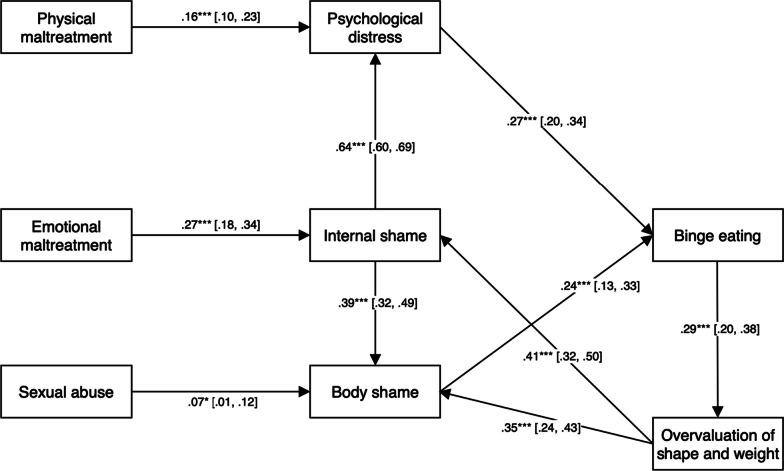
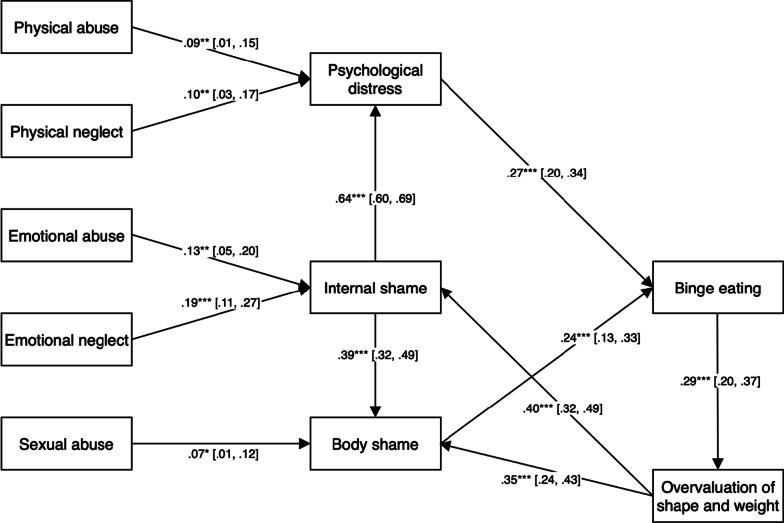
Path analyses showed three specific relationships: (1) a relationship between childhood emotional maltreatment and binge eating, which was serially mediated by internal shame and psychological distress; (2) a relationship between childhood sexual abuse and binge eating, which was mediated by body shame; and (3) a relationship between childhood physical maltreatment and binge eating, which was mediated by psychological distress. We also found a feedback loop, whereby binge eating might lead to increased overvaluation of body shape and weight (possibly due to increased weight) and then to an increase in internal shame and body shame. The final model showed excellent fit for the data.
DISCUSSION
Findings extend our understanding of the link between childhood maltreatment and BED. Future intervention research should focus on examining the efficacy of interventions for different forms of childhood maltreatment, based on the key mediating factors.
目的
尽管有证据表明童年期受虐与暴饮暴食症(BED)的发展之间存在因果关系,但关于中介机制的研究仍很缺乏。本研究试图通过考察三种羞耻感(内在羞耻感、外在羞耻感、身体羞耻感)和心理困扰作为这种关系的中介因素,来更全面地理解童年期受虐与暴饮暴食之间的关系。有证据表明,羞耻感和心理困扰与童年期受虐及暴饮暴食病理都有关联。研究假设,在一个系列中介模型中,童年期受虐产生的羞耻感会导致心理困扰,并导致暴饮暴食成为一种功能失调的情绪调节策略。
方法
530名自我报告有暴饮暴食症状的成年人完成了一项在线调查,其中包括童年期受虐、内在羞耻感、外在羞耻感、身体羞耻感、心理困扰以及暴饮暴食和其他饮食失调症状的测量。
结果
路径分析显示了三种特定关系:(1)童年期情感虐待与暴饮暴食之间的关系,由内在羞耻感和心理困扰进行系列中介;(2)童年期性虐待与暴饮暴食之间的关系,由身体羞耻感进行中介;(3)童年期身体虐待与暴饮暴食之间的关系,由心理困扰进行中介。我们还发现了一个反馈循环,即暴饮暴食可能导致对体型和体重的过度重视增加(可能由于体重增加),进而导致内在羞耻感和身体羞耻感增加。最终模型对数据显示出极佳的拟合度。
讨论
研究结果扩展了我们对童年期受虐与暴饮暴食症之间联系的理解。未来的干预研究应基于关键中介因素,专注于考察针对不同形式童年期受虐的干预措施的效果。
 Zotero 插件