
与单次芬太尼给药相比,连续酮咯酸输注联合患者自控芬太尼注射可减少腹腔镜妇科手术中的副作用并改善疼痛管理:一项随机、双盲、对照研究。
Reduced side effects and improved pain management by continuous ketorolac infusion with patient-controlled fentanyl injection compared with single fentanyl administration in pelviscopic gynecologic surgery: a randomized, double-blind, controlled study.
机构信息
Department of Anesthesiology and Pain Medicine, Seoul National University Bundang Hospital, Seongnam, Korea.
出版信息
Korean J Anesthesiol. 2024 Feb;77(1):77-84. doi: 10.4097/kja.23217. Epub 2023 Jun 14.
BACKGROUND
A combination of opioids and adjunctive drugs can be used for intravenous patient-controlled analgesia (PCA) to minimize opioid-related side effects. We investigated whether two different analgesics administered separately via a dual-chamber PCA have fewer side effects with adequate analgesia than a single fentanyl PCA in gynecologic pelviscopic surgery.
METHODS
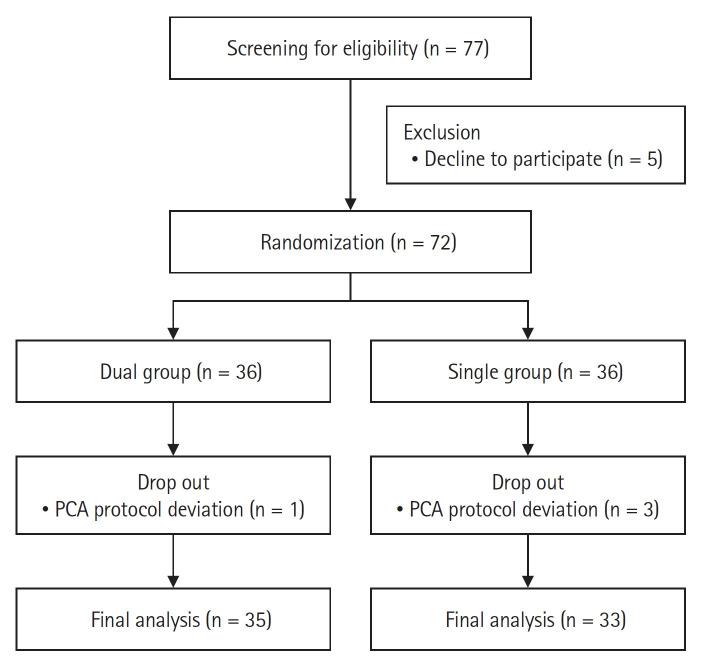
This prospective, double-blind, randomized, and controlled study included 68 patients who underwent pelviscopic gynecological surgery. Patients were allocated to either the dual (ketorolac and fentanyl delivered by a dual-chamber PCA) or the single (fentanyl alone) group. Postoperative nausea and vomiting (PONV) and analgesic quality were compared between the two groups at 2, 6, 12, and 24 h postoperatively.
RESULTS
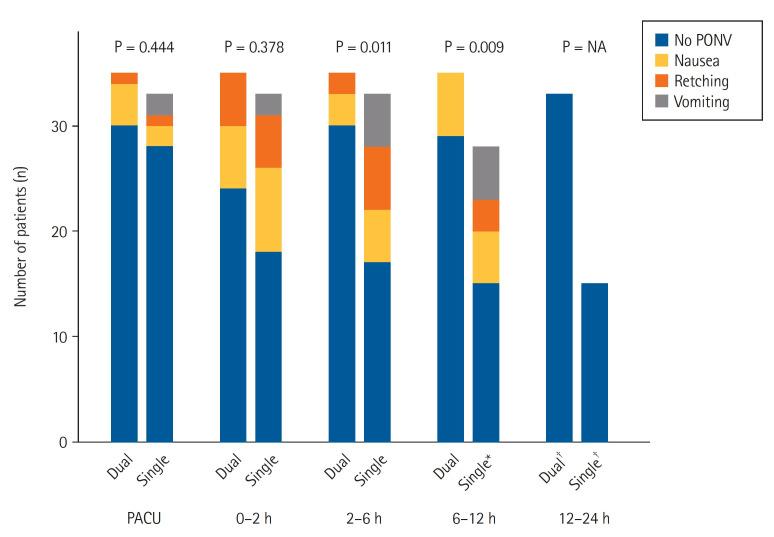
The dual group showed a significantly lower incidence of PONV during postoperative 2-6 h (P = 0.011) and 6-12 h (P = 0.009). Finally, only two patients (5.7%) in the dual group and 18 (54.5%) in the single group experienced PONV during the entire postoperative 24 h and could not maintain intravenous PCA (odds ratio: 0.056, 95% CI [0.007, 0.229], P < 0.001). Despite the administration of less fentanyl via intravenous PCA during the postoperative 24 h in the dual group than in the single group (66.0 ± 77.8 vs. 383.6 ± 70.1 μg, P < 0.001), postoperative pain had no significant intergroup difference.
CONCLUSIONS
Two different analgesics, continuous ketorolac and intermittent fentanyl bolus, administered via dual-chamber intravenous PCA, showed fewer side effects with adequate analgesia than conventional intravenous fentanyl PCA in gynecologic patients undergoing pelviscopic surgery.
背景
阿片类药物和辅助药物的联合应用可用于静脉患者自控镇痛(PCA),以最大限度地减少阿片类药物相关的副作用。我们研究了在妇科腹腔镜手术中,两种不同的镇痛药分别通过双腔 PCA 给药是否比单独使用芬太尼 PCA 具有更少的副作用和足够的镇痛效果。
方法
这是一项前瞻性、双盲、随机、对照研究,纳入了 68 例接受腹腔镜妇科手术的患者。患者被分配到双腔组(酮咯酸和芬太尼通过双腔 PCA 给药)或单腔组(单独使用芬太尼)。比较两组患者术后 2、6、12 和 24 小时的术后恶心和呕吐(PONV)及镇痛质量。
结果
双腔组患者在术后 2-6 小时(P=0.011)和 6-12 小时(P=0.009)期间 PONV 的发生率显著降低。最后,只有 2 例(5.7%)双腔组和 18 例(54.5%)单腔组患者在整个术后 24 小时内发生 PONV 且无法维持静脉 PCA(比值比:0.056,95%CI [0.007,0.229],P<0.001)。尽管双腔组患者在术后 24 小时内通过静脉 PCA 给予的芬太尼少于单腔组(66.0±77.8 与 383.6±70.1μg,P<0.001),但两组患者术后疼痛均无显著差异。
结论
在接受腹腔镜妇科手术的患者中,与传统的静脉芬太尼 PCA 相比,通过双腔静脉 PCA 给予两种不同的镇痛药(持续给予酮咯酸和间歇性给予芬太尼)具有更少的副作用和足够的镇痛效果。

 Zotero 插件