
部分脱细胞气管移植物中软骨细胞活力的优化。
Optimization of Chondrocyte Viability in Partially Decellularized Tracheal Grafts.
机构信息
Department of Otolaryngology-Head & Neck Surgery, The Ohio State University Medical Center, Columbus, Ohio, USA.
Department of Pediatric Otolaryngology, Nationwide Children's Hospital, Columbus, Ohio, USA.
出版信息
Otolaryngol Head Neck Surg. 2023 Nov;169(5):1241-1246. doi: 10.1002/ohn.404. Epub 2023 Jun 14.
OBJECTIVE
Advancements in tissue-engineered tracheal replacement (TETR) show promise for the use of partially decellularized tracheal grafts (PDTG) to address critical gaps in airway management and reconstruction. In this study, aiming to leverage the immunoprivileged nature of cartilage to preserve tracheal biomechanics, we optimize PDTG for retention of native chondrocytes.
STUDY DESIGN
Comparison in vivo murine study.
SETTING
Research Institute affiliated with Tertiary Pediatric Hospital.
METHODS
PDTG were created per a shortened decellularization protocol using sodium dodecyl sulfate, then biobanked via cryopreservation technique. Decellularization efficiency was characterized by DNA assay and histology. Viability and apoptosis of chondrocytes in preimplanted PDTG and biobanked native trachea (control) was assessed with live/dead and apoptosis assays. PDTG (N = 5) and native trachea (N = 6) were orthotopically implanted in syngeneic recipients for 1-month. At the endpoint, microcomputed tomography (micro-CT) was employed to interrogate graft patency and radiodensity in vivo. Vascularization and epithelialization were qualitatively analyzed using histology images following explant.
RESULTS
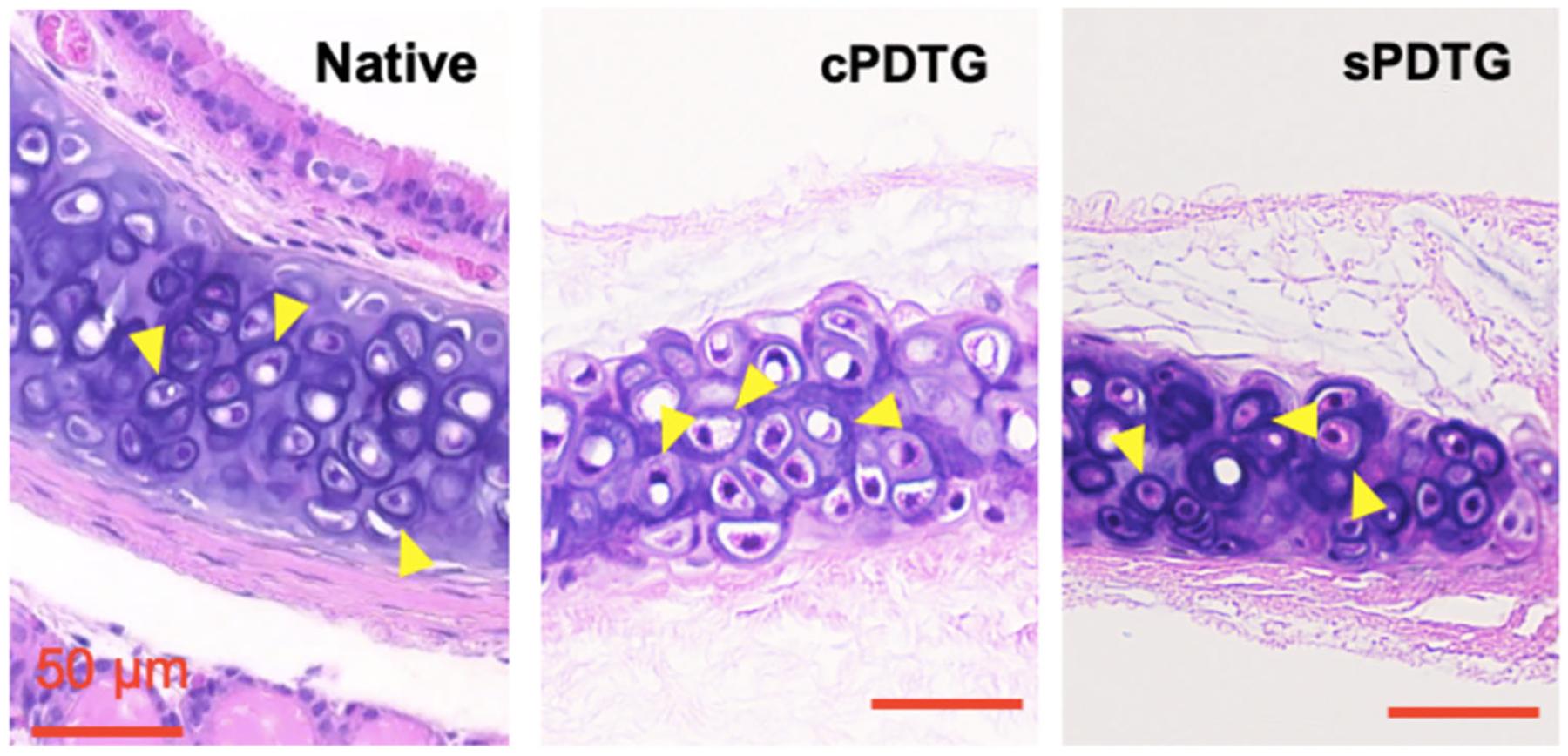
PDTG exhibited complete decellularization of all extra-cartilaginous cells and reduced DNA content compared to control. Chondrocyte viability and nonapoptotic cell populations were improved utilizing biobanking and shorter decellularization time. All grafts remained patent. Evaluation of graft radiodensity at 1 month revealed elevation of Hounsfield units in both PDTG and native compared to host, with PDTG showing higher radiodensity than native. PDTG supported complete epithelialization and functional reendothelialization 1-month postimplantation.
CONCLUSION
Optimizing PDTG chondrocyte viability is a key component to successful tracheal replacement. Ongoing research seeks to evaluate the acute and chronic immunogenicity of PDTG.
目的
组织工程气管重建(TETR)的进展表明,使用部分脱细胞气管移植物(PDTG)来解决气道管理和重建中的关键空白具有广阔前景。在这项研究中,我们旨在利用软骨的免疫豁免特性来保持气管生物力学,优化 PDGT 以保留天然软骨细胞。
研究设计
体内比较的小鼠研究。
设置
三级儿童医院附属医院的研究所。
方法
使用十二烷基硫酸钠(SDS)创建 PDGT,然后通过冷冻保存技术进行生物储存。通过 DNA 测定和组织学评估脱细胞效率。使用活/死和凋亡测定评估植入前 PDGT 和生物储存的天然气管(对照)中软骨细胞的活力和凋亡。将 PDGT(N=5)和天然气管(N=6)在同基因受体中进行原位移植 1 个月。在终点,使用 micro-CT 对体内移植物通畅性和放射密度进行检测。通过组织学图像对血管生成和上皮化进行定性分析。
结果
PDGT 显示出所有软骨外细胞的完全脱细胞化,与对照相比,DNA 含量降低。使用生物储存和更短的脱细胞时间可提高软骨细胞活力和非凋亡细胞群。所有移植物均保持通畅。1 个月时评估移植物的放射密度,发现 PDGT 和天然气管的 CT 值均高于宿主,而 PDGT 的 CT 值高于天然气管。PDGT 支持 1 个月后完全上皮化和功能再内皮化。
结论
优化 PDGT 软骨细胞活力是成功进行气管替代的关键因素。正在进行的研究旨在评估 PDGT 的急性和慢性免疫原性。



 Zotero 插件