
基于机器学习,联合循环环状RNA cZNF292与临床信息诊断急性心肌梗死
Diagnosis of acute myocardial infarction using a combination of circulating circular RNA cZNF292 and clinical information based on machine learning.
作者信息
Zhou Qiulian, Boeckel Jes-Niels, Yao Jianhua, Zhao Juan, Bai Yuzheng, Lv Yicheng, Hu Meiyu, Meng Danni, Xie Yuan, Yu Pujiao, Xi Peng, Xu Jiahong, Zhang Yi, Dimmeler Stefanie, Xiao Junjie
机构信息
Institute of Geriatrics (Shanghai University) Affiliated Nantong Hospital of Shanghai University (The Sixth People's Hospital of Nantong) and School of Life Science Shanghai University Nantong China.
Cardiac Regeneration and Ageing Lab Institute of Cardiovascular Sciences Shanghai Engineering Research Center of Organ Repair, School of Medicine Shanghai University Shanghai China.
出版信息
MedComm (2020). 2023 Jun 13;4(3):e299. doi: 10.1002/mco2.299. eCollection 2023 Jun.
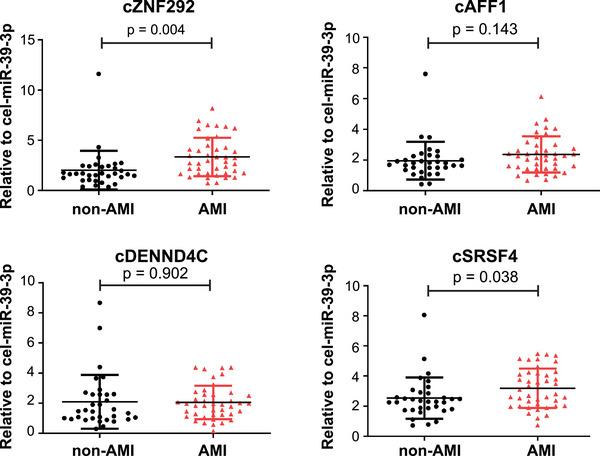
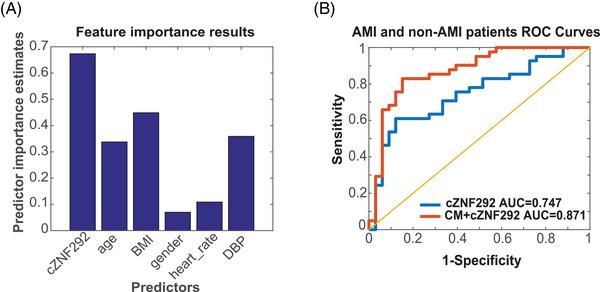
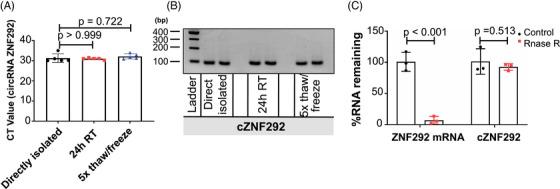
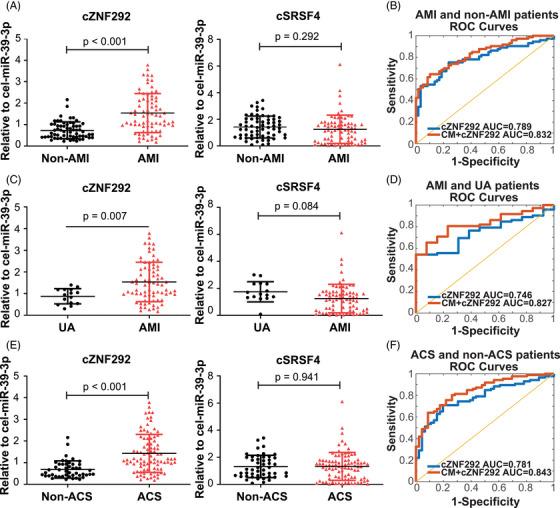
Circulating circular RNAs (circRNAs) are emerging as novel biomarkers for cardiovascular diseases (CVDs). Machine learning can provide optimal predictions on the diagnosis of diseases. Here we performed a proof-of-concept study to determine if combining circRNAs with an artificial intelligence approach works in diagnosing CVD. We used acute myocardial infarction (AMI) as a model setup to prove the claim. We determined the expression level of five hypoxia-induced circRNAs, including cZNF292, cAFF1, cDENND4C, cTHSD1, and cSRSF4, in the whole blood of coronary angiography positive AMI and negative non-AMI patients. Based on feature selection by using lasso with 10-fold cross validation, prediction model by logistic regression, and ROC curve analysis, we found that cZNF292 combined with clinical information (CM), including age, gender, body mass index, heart rate, and diastolic blood pressure, can predict AMI effectively. In a validation cohort, CM + cZNF292 can separate AMI and non-AMI patients, unstable angina and AMI patients, acute coronary syndromes (ACS), and non-ACS patients. RNA stability study demonstrated that cZNF292 was stable. Knockdown of cZNF292 in endothelial cells or cardiomyocytes showed anti-apoptosis effects in oxygen glucose deprivation/reoxygenation. Thus, we identify circulating cZNF292 as a potential biomarker for AMI and construct a prediction model "CM + cZNF292."
循环环状RNA(circRNAs)正逐渐成为心血管疾病(CVDs)的新型生物标志物。机器学习能够为疾病诊断提供最优预测。在此,我们开展了一项概念验证研究,以确定将circRNAs与人工智能方法相结合是否有助于诊断CVD。我们以急性心肌梗死(AMI)作为模型设置来验证这一说法。我们测定了冠状动脉造影阳性AMI患者和阴性非AMI患者全血中5种缺氧诱导的circRNAs的表达水平,包括cZNF292、cAFF1、cDENND4C、cTHSD1和cSRSF4。通过使用带10折交叉验证的套索进行特征选择、逻辑回归预测模型以及ROC曲线分析,我们发现cZNF292与包括年龄、性别、体重指数、心率和舒张压在内的临床信息(CM)相结合能够有效预测AMI。在一个验证队列中,CM + cZNF292能够区分AMI和非AMI患者、不稳定型心绞痛和AMI患者、急性冠状动脉综合征(ACS)以及非ACS患者。RNA稳定性研究表明cZNF292是稳定的。在内皮细胞或心肌细胞中敲低cZNF292显示出在氧糖剥夺/复氧过程中的抗凋亡作用。因此,我们将循环cZNF292鉴定为AMI的潜在生物标志物,并构建了一个预测模型“CM + cZNF292”。

 Zotero 插件