
重复经颅磁刺激通过抑制 HMGB1/TLR4 通路缓解帕金森病大鼠模型中的神经胶质细胞激活。
Repetitive transcranial magnetic stimulation alleviates glial activation through suppressing HMGB1/TLR4 pathway in a rat model of Parkinson's disease.
机构信息
Department of Neurology, Affiliated Hospital of Qingdao University, No.16 Jiangsu Road, Qingdao, 266003, Shandong Province, People's Republic of China.
Department of Physical Medicine and Rehabilitation, Affiliated Hospital of Qingdao University, Qingdao, People's Republic of China.
出版信息
Mol Biol Rep. 2023 Aug;50(8):6481-6492. doi: 10.1007/s11033-023-08561-8. Epub 2023 Jun 16.
BACKGROUND
Repetitive transcranial magnetic stimulation (rTMS) has been demonstrated to be effective in Parkinson's disease (PD), but whether rTMS treatment has a relieving effect on neuroinflammation remains to be investigated. In this article, we explored the effects of rTMS on forelimb use asymmetry and neuroinflammation-related mechanisms in a 6-hydroxydopamine (6-OHDA)-induced PD rat model.
METHODS AND RESULTS
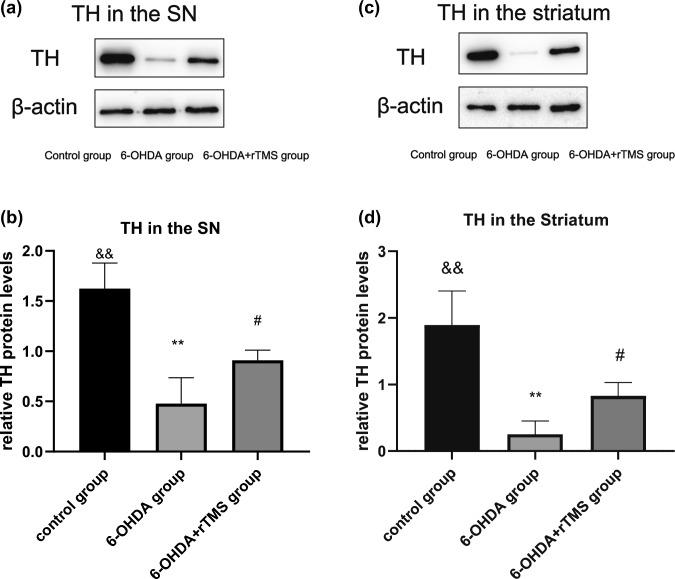
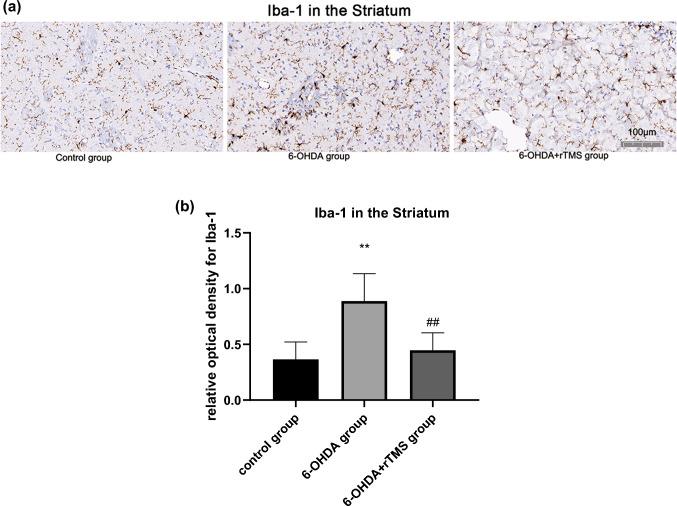
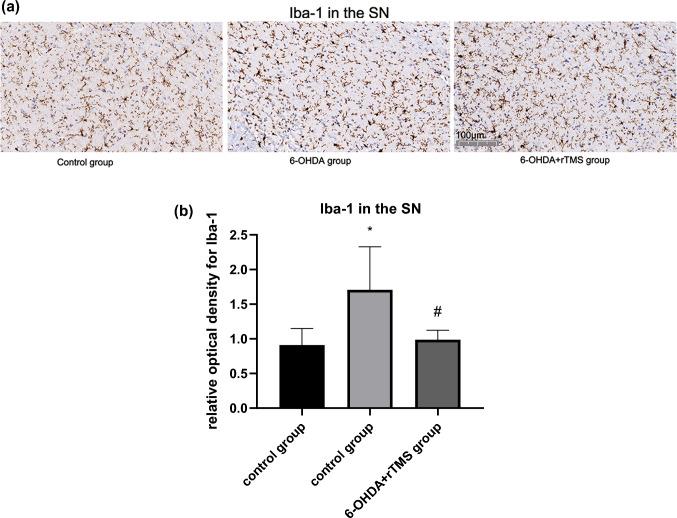
Rats in the 6-OHDA+rTMS group received 10 Hz rTMS daily for 4 weeks. Behavioral tests (the cylinder test) were performed at the 3rd and 7th weeks after the operation. Astrocyte and microglia activation and protein levels of tyrosine hydroxylase(TH), high-mobility group box 1(HMGB1) and toll-like receptors 4(TLR4) were investigated by immunohistochemistry and Western blot analyses, respectively. After 4 weeks of treatment, forelimb use asymmetry was ameliorated in the 6-OHDA+rTMS group. Consistent with the behavioral tests, rTMS increased TH in the substantia nigra (SN) and the striatum of PD rats. High glial activation and HMGB1/TLR4 expression in the SN and the striatum were observed in the 6-OHDA group, while rTMS alleviated these changes.
CONCLUSIONS
This study showed that rTMS might be a promising method for alleviating neuroinflammation in PD rat models, and the effects might be mediated through the downregulation of the HMGB1/TLR4 pathway.
背景
重复经颅磁刺激(rTMS)已被证明对帕金森病(PD)有效,但 rTMS 治疗是否对神经炎症有缓解作用仍需研究。在本文中,我们探讨了 rTMS 对 6-羟多巴胺(6-OHDA)诱导的 PD 大鼠模型前肢使用不对称和神经炎症相关机制的影响。
方法和结果
6-OHDA+rTMS 组大鼠接受 10 Hz rTMS 治疗,每天 1 次,持续 4 周。在手术后第 3 周和第 7 周进行行为测试(圆筒测试)。通过免疫组织化学和 Western blot 分析分别研究星形胶质细胞和小胶质细胞激活以及酪氨酸羟化酶(TH)、高迁移率族蛋白 1(HMGB1)和 Toll 样受体 4(TLR4)的蛋白水平。经过 4 周的治疗,6-OHDA+rTMS 组大鼠的前肢使用不对称得到改善。与行为测试一致,rTMS 增加了 PD 大鼠黑质(SN)和纹状体中的 TH。在 6-OHDA 组中观察到 SN 和纹状体中的高神经胶质激活和 HMGB1/TLR4 表达增加,而 rTMS 减轻了这些变化。
结论
本研究表明,rTMS 可能是一种有前途的缓解 PD 大鼠模型神经炎症的方法,其作用可能通过下调 HMGB1/TLR4 通路介导。





 Zotero 插件