
基于单细胞转录组学的多模式热疗与射频消融对肝脏恶性肿瘤 CD8 T 效应细胞影响的探索。
Exploration of the impact of multimode thermal therapy versus radiofrequency ablation on CD8 T effector cells of liver malignancies based on single cell transcriptomics.
机构信息
Department of Interventional Radiology, Fudan University Shanghai Cancer Center, Shanghai, China.
Department of Medical Oncology, Fudan University Shanghai Cancer Center, Shanghai, China.
出版信息
Front Immunol. 2023 Jun 2;14:1172362. doi: 10.3389/fimmu.2023.1172362. eCollection 2023.
INTRODUCTION
Multimode thermal therapy (MTT) is an innovative interventional therapy developed for the treatment of liver malignancies. When compared to the conventional radiofrequency ablation (RFA), MTT typically offers improved prognosis for patients. However, the effect of MTT on the peripheral immune environment and the mechanisms underlying the enhanced prognosis have yet to be explored. The aim of this study was to further investigate the mechanisms responsible for the difference in prognosis between the two therapies.
METHODS
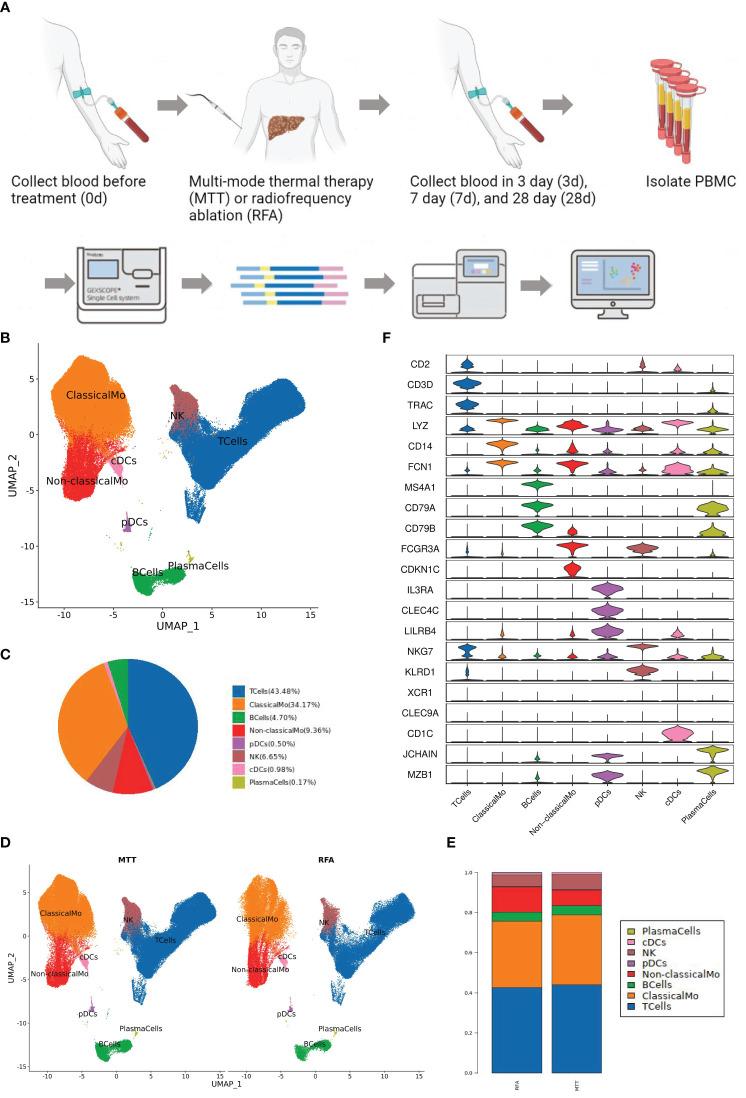
In this study, peripheral blood samples were collected from four patients treated with MTT and two patients treated with RFA for liver malignancies at different time points before and after the treatment. Single cell sequencing was performed on the blood samples to compare and analyze the activation pathways of peripheral immune cells following the MTT and RFA treatment.
RESULTS
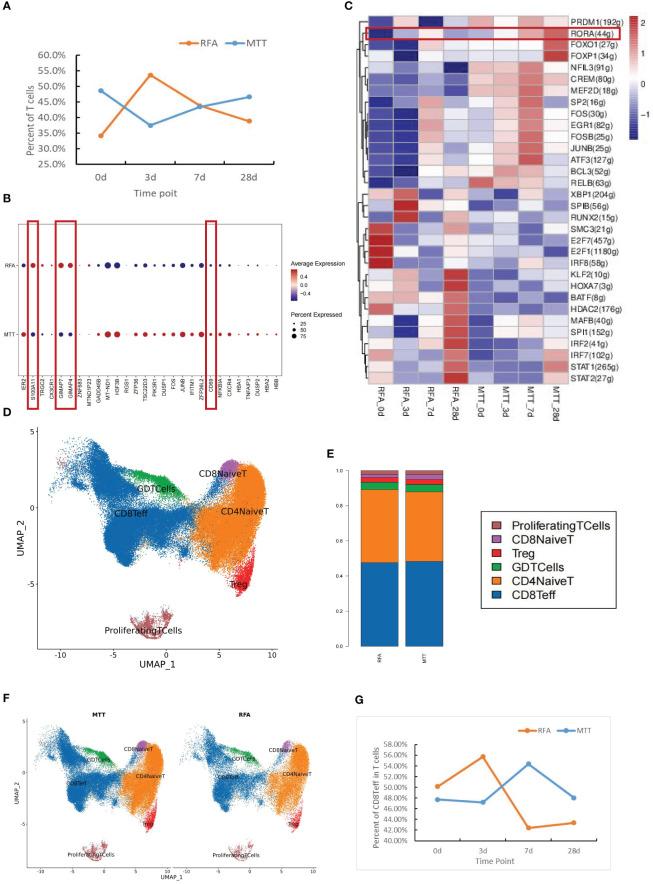
There was no significant effect of either therapy on the composition of immune cells in peripheral blood. However, the differential gene expression and pathway enrichment analysis demonstrated enhanced activation of T cells in the MTT group compared to the RFA group. In particular, there was a remarkable increase in TNF-α signaling via NF-κB, as well as the expression of IFN-α and IFN-γ in the CD8 effector T (CD8 Teff) cells subpopulation, when compared to the RFA group. This may be related to the upregulation of PI3KR1 expression after MTT, which promotes the activation of PI3K-AKT-mTOR pathway.
CONCLUSION
This study confirmed that MTT could more effectively activate peripheral CD8 Teff cells in patients compared with RFA and promote the effector function, thus resulting in a better prognosis. These results provide a theoretical basis for the clinical application of MTT therapy.
简介
多模态热疗(MTT)是一种创新性的介入治疗方法,用于治疗肝脏恶性肿瘤。与传统的射频消融(RFA)相比,MTT 通常为患者提供更好的预后。然而,MTT 对周围免疫环境的影响及其增强预后的机制尚未得到探索。本研究旨在进一步探讨两种治疗方法预后差异的机制。
方法
本研究在治疗前后的不同时间点,从 4 名接受 MTT 治疗和 2 名接受 RFA 治疗的肝脏恶性肿瘤患者中采集外周血样本。对血液样本进行单细胞测序,比较和分析 MTT 和 RFA 治疗后外周免疫细胞的激活途径。
结果
两种治疗方法均未对外周血免疫细胞的组成产生显著影响。然而,差异基因表达和通路富集分析表明,与 RFA 组相比,MTT 组 T 细胞的激活增强。特别是在 CD8 效应 T(CD8 Teff)细胞亚群中,TNF-α 信号通过 NF-κB 以及 IFN-α 和 IFN-γ 的表达显著增加,与 RFA 组相比。这可能与 MTT 后 PI3KR1 表达上调有关,上调促进了 PI3K-AKT-mTOR 通路的激活。
结论
本研究证实,与 RFA 相比,MTT 能更有效地激活患者外周血中的 CD8 Teff 细胞,并促进其效应功能,从而获得更好的预后。这些结果为 MTT 治疗的临床应用提供了理论依据。



 Zotero 插件