
中国和巴基斯坦区域及国家层面上,饮食风险和高体重指数所致心血管疾病死亡率及伤残调整生命年的流行病学趋势和年龄-时期-队列效应
Epidemiological trend and age-period-cohort effects on cardiovascular disease mortality and disability-adjusted life years attributable to dietary risks and high body mass index at the regional and country level across China and Pakistan.
作者信息
Yan Wu, Yan Xiuzhen, Mubarik Sumaira
机构信息
Department of Information, Zhongshan Hospital of Xiamen University, School of Medicine, Xiamen University, Xiamen, China.
Department of Epidemiology and Biostatistics, School of Public Health, Wuhan University, Wuhan, Hubei, China.
出版信息
Front Nutr. 2023 Jun 6;10:1158769. doi: 10.3389/fnut.2023.1158769. eCollection 2023.
BACKGROUND
Modifiable risk factors are major drivers of cardiovascular disease (CVD). We aimed to determine the epidemiological trend and age-period-cohort effects on CVD burden attributable to dietary risks and high body mass index (BMI) across China and Pakistan from 1990 to 2019.
METHODS
Data on the all-ages and age-specific CVD burden, age-standardized CVD mortality and disability-adjusted life years (DALYs) rates were obtained from the Global Burden of Disease Study 2019. Joinpoint regression analysis was conducted to find temporal trends and age-period-cohort (APC) modeling was used to estimate age, period, and cohort effects on CVD burden.
RESULTS
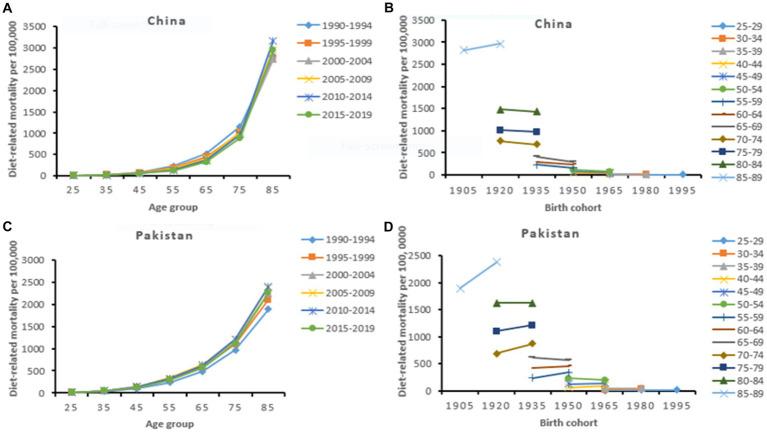
Between 1990 and 2019, the all-ages CVD burden attributable to dietary risks and high BMI increased by ~2-3-fold in China and by 3-5-fold in Pakistan. The diet-related CVD age-standardized mortality rate (ASMR) and age-standardized disability-adjusted life years (DALYs) rate significantly decreased in China but increased in Pakistan. Both countries showed a marked increasing trend of CVD ASMR and the age-standardized DALYs rate attributable to high BMI. Taiwan in China showed a remarkable reduction in CVD burden. However, in Pakistan, all regions observed a significantly increasing trend of CVD burden attributable to modifiable risk factors. A higher risk ratio of premature CVD mortality (<70 years) was observed among Chinese attributable to high BMI and among Pakistani attributable to dietary risks. In China, early birth cohorts showed a higher risk ratio and recent birth cohorts experienced a lower risk ratio of CVD burden compared with Pakistan.
CONCLUSION
In conclusion, dietary risks and high BMI caused a huge CVD burden across China and Pakistan.
背景
可改变的风险因素是心血管疾病(CVD)的主要驱动因素。我们旨在确定1990年至2019年期间中国和巴基斯坦因饮食风险和高体重指数(BMI)导致的心血管疾病负担的流行病学趋势以及年龄-时期-队列效应。
方法
从《2019年全球疾病负担研究》中获取了各年龄段和特定年龄的心血管疾病负担、年龄标准化心血管疾病死亡率和伤残调整生命年(DALYs)率的数据。进行了Joinpoint回归分析以发现时间趋势,并使用年龄-时期-队列(APC)模型来估计年龄、时期和队列对心血管疾病负担的影响。
结果
1990年至2019年期间,中国因饮食风险和高BMI导致的各年龄段心血管疾病负担增加了约2至3倍,巴基斯坦增加了3至5倍。中国与饮食相关的心血管疾病年龄标准化死亡率(ASMR)和年龄标准化伤残调整生命年(DALYs)率显著下降,而巴基斯坦则上升。两国因高BMI导致的心血管疾病ASMR和年龄标准化DALYs率均呈现明显上升趋势。中国台湾地区的心血管疾病负担显著降低。然而,在巴基斯坦,所有地区因可改变风险因素导致的心血管疾病负担均呈现显著上升趋势。在中国,归因于高BMI的过早心血管疾病死亡率(<70岁)风险比更高,在巴基斯坦,归因于饮食风险的风险比更高。在中国,与巴基斯坦相比,早期出生队列的心血管疾病负担风险比更高,而近期出生队列的风险比更低。
结论
总之,饮食风险和高BMI在中国和巴基斯坦造成了巨大的心血管疾病负担。


 Zotero 插件