
仓鼠中奥密克戎变异株 XBB.1.5 的传播和再感染。
Transmission and re-infection of Omicron variant XBB.1.5 in hamsters.
机构信息
Influenza Research Institute, Department of Pathobiological Sciences, School of Veterinary Medicine, University of Wisconsin-Madison, Madison, WI 53711, USA.
Division of Virology, Institute of Medical Science, University of Tokyo, Tokyo 108-8639, Japan; The Research Center for Global Viral Diseases, National Center for Global Health and Medicine Research Institute, Tokyo 162-8655, Japan.
出版信息
EBioMedicine. 2023 Jul;93:104677. doi: 10.1016/j.ebiom.2023.104677. Epub 2023 Jun 21.
BACKGROUND
Like its predecessors in the XBB family, XBB.1.5 is highly immune evasive from therapeutic monoclonal antibodies and neutralizing antibodies generated by vaccination and/or infection. However, there is a lack of in vivo data on XBB.1.5 in animal models such as Syrian hamsters.
METHODS
Syrian hamsters (females) were used to examine airborne transmission along with virus replication of XBB.1.5 in naïve animals and human ACE2 hamsters with pre-existing immunity from a previous infection with Omicron BA.1. Assays were performed to determine neutralizing antibody responses, and virus titers were determined by standard plaque assays.
FINDINGS
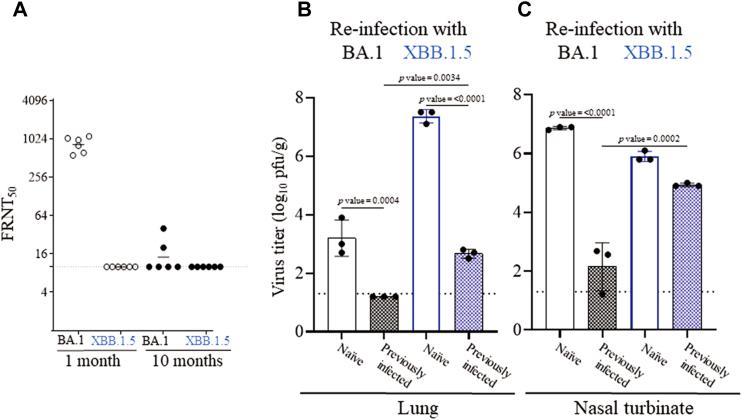
Unlike earlier Omicron subvariants, such as BA.1 and BA.2, XBB.1.5 transmitted more efficiently in the hamster model. In addition, XBB.1.5 partially escaped BA.1-immunity from a previous infection with XBB.1.5 replicating in the nasal turbinate tissues and to a lesser extend in the lung tissues of previously infected hamsters.
INTERPRETATION
Our in vivo data showing better airborne transmissibility of the Omicron subvariant XBB.1.5 than its predecessor, BA.2, in Syrian hamsters will allow researchers to further investigate amino acid substitutions that give XBB.1.5 a fitness advantage over BA.2 in transmission, data that may be important in studies of SARS-CoV-2 transmission in humans.
FUNDING
This research is supported by grants from the Center for Research on Influenza Pathogenesis and Transmission (CRIPT; 75N93021C00014), funded by the National Institute of Allergy and Infectious Diseases and by a Research Program on Emerging and Reemerging Infectious Diseases (JP21fk0108552 and JP21fk0108615), a Project Promoting Support for Drug Discovery (JP21nf0101632), the Japan Program for Infectious Diseases Research and Infrastructure (JP22wm0125002), and The University of Tokyo Pandemic Preparedness, Infection and Advanced Research Center (UTOPIA) grant (JP223fa627001) from the Japan Agency for Medical Research and Development.
背景
与 XBB 家族的前代病毒一样,XBB.1.5 对治疗性单克隆抗体和疫苗接种及/或感染产生的中和抗体具有高度免疫逃逸能力。然而,目前缺乏 XBB.1.5 在叙利亚仓鼠等动物模型中的体内数据。
方法
本研究使用叙利亚仓鼠(雌性),检测了 XBB.1.5 在无感染史的动物以及此前感染过奥密克戎 BA.1 并具有预先存在免疫力的人类 ACE2 仓鼠中的空气传播能力以及病毒复制能力。进行了中和抗体反应测定,并通过标准蚀斑法测定病毒滴度。
发现
与早期的奥密克戎亚变种(如 BA.1 和 BA.2)不同,XBB.1.5 在仓鼠模型中的传播效率更高。此外,与之前感染 XBB.1.5 的仓鼠相比,XBB.1.5 部分逃避了 BA.1 感染产生的免疫,XBB.1.5 在鼻甲骨组织中复制,而在之前感染的仓鼠的肺部组织中复制的程度较小。
解释
我们的体内数据表明,与前代病毒 BA.2 相比,奥密克戎亚变种 XBB.1.5 在叙利亚仓鼠中的空气传播能力更强,这将使研究人员能够进一步研究赋予 XBB.1.5 相对于 BA.2 在传播方面优势的氨基酸取代,这些数据对于研究 SARS-CoV-2 在人类中的传播可能很重要。
资金
这项研究得到了过敏和传染病研究所(NIAID)资助的流感发病机制和传播研究中心(CRIPT;75N93021C00014)、新发和再发传染病研究计划(JP21fk0108552 和 JP21fk0108615)、药物发现促进支持项目(JP21nf0101632)、日本传染病研究与基础设施计划(JP22wm0125002)和日本医药品医疗器械综合机构(PMDA)资助的东京大学大流行准备、感染和高级研究中心(UTOPIA)项目(JP223fa627001)的资助。


 Zotero 插件