
全球、区域和国家哮喘负担及其归因风险因素:2019 年全球疾病负担研究的系统分析。
Global, regional, and national burden of asthma and its attributable risk factors from 1990 to 2019: a systematic analysis for the Global Burden of Disease Study 2019.
机构信息
National Clinical Research Center for Respiratory Disease, State Key Laboratory of Respiratory Disease, Guangzhou Institute of Respiratory Health, The First Affiliated Hospital of Guangzhou Medical University, 151 Yanjiang Road, Guangzhou, 510120, Guangdong, China.
Department of Allergy and Clinical Immunology, National Clinical Research Center for Respiratory Disease, State Key Laboratory of Respiratory Disease, Guangzhou Institute of Respiratory Health, The First Affiliated Hospital of Guangzhou Medical University, Guangzhou, Guangdong, China.
出版信息
Respir Res. 2023 Jun 23;24(1):169. doi: 10.1186/s12931-023-02475-6.
BACKGROUND
The burden of asthma in terms of premature death or reduced quality of life remains a huge issue. It is of great importance to evaluate asthma burden geographically and time trends from 1990 to 2019 and to assess the contributions of age, period, and cohort effects at global level.
METHODS
Asthma prevalence, deaths, and disability adjusted life years (DALYs) as well as risk-attributable burden were collected from the Global Burden of Diseases, Injuries, and Risk Factors Study (GBD) 2019 database and were compared by age and sex. The Smoothing Splines models were used to estimate the relationship between asthma DALYs and the sociodemographic index (SDI). The Age-Period-Cohort model was used to determine effects of ages, periods, and birth cohorts on disease rates.
RESULTS
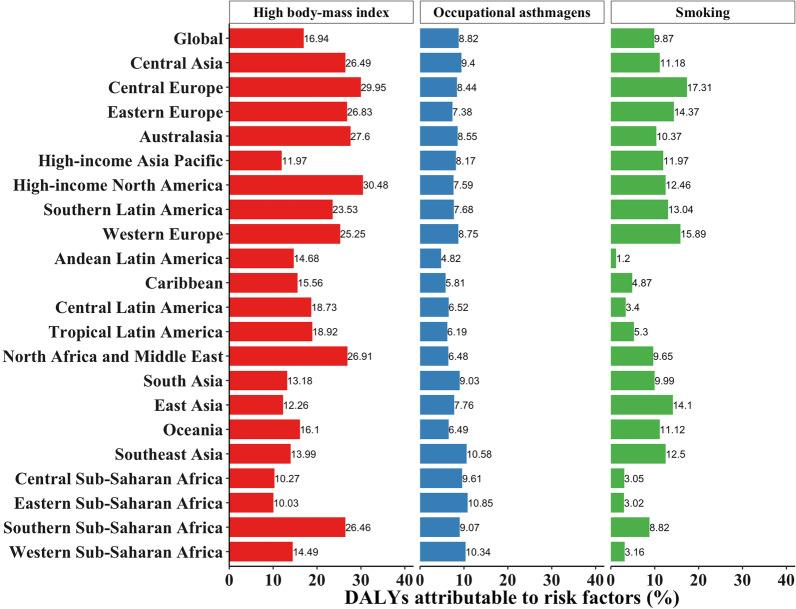
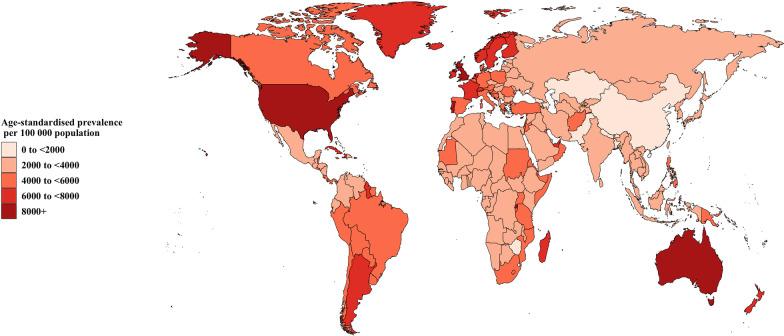
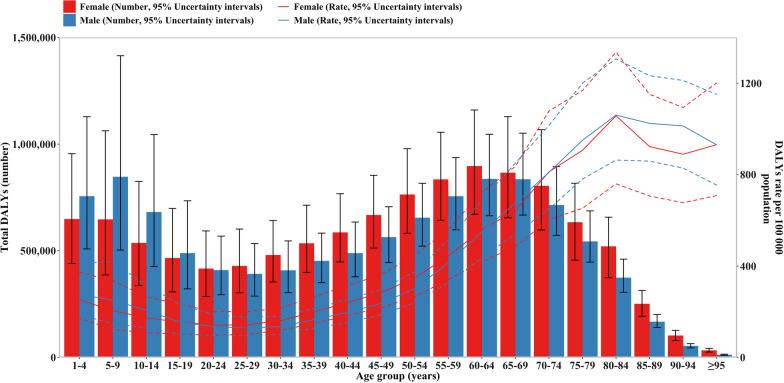
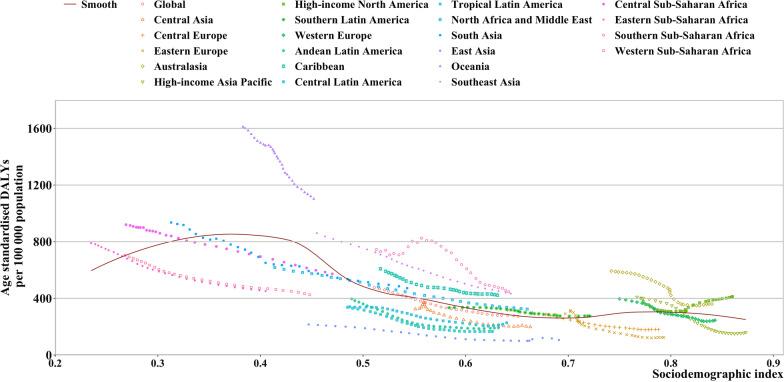
Between 1990 and 2019, the declines were 24.05% (95% uncertainty interval [UI] - 27.24 to - 20.82) in age-standardized asthma prevalence, 51.3% (- 59.08 to - 43.71) in mortality, and 42.55% (- 48.48 to - 36.61) in DALYs rate. However, the burden of asthma continued to rise, with an estimated 262.41 million prevalent cases globally (95% UI 224.05 to 309.45). Asthma caused greater DALYs in females than in males among people aged 20 years and older. The lowest age-standardized DALYs rate was observed at a SDI of approximately 0.70. The Longitudinal age curves showed an approximate W-shaped pattern for asthma prevalence and a likely J-shaped pattern for asthma mortality. The period effect on prevalence and mortality of asthma decreased from 1990 to 2019. Compared with the 1955-1959 birth cohort, the prevalence relative risk (RR) of asthma was highest in the 1905-1909 birth cohort, whereas the mortality RR continued to decline. At the global level, the percentages of high body-mass index, occupational asthmagens, and smoking contributing to DALYs due to asthma were 16.94%, 8.82%, and 9.87%, respectively.
CONCLUSIONS
Although the age-standardized rates of asthma burden declined in the past 30 years, the overall burden of asthma remains severe. High body mass index becomes the most important risk factor for DALYs due to asthma at the global level.
背景
哮喘导致的过早死亡或生活质量下降仍然是一个巨大的问题。因此,评估 1990 年至 2019 年期间哮喘负担的地域差异和时间趋势,并评估全球范围内年龄、时期和队列效应对哮喘负担的影响非常重要。
方法
我们从全球疾病、伤害和危险因素研究(GBD)2019 年数据库中收集了哮喘患病率、死亡人数和残疾调整生命年(DALYs)以及归因于风险的负担,并按年龄和性别进行了比较。我们使用平滑样条模型来估计哮喘 DALYs 与社会人口指数(SDI)之间的关系。我们使用年龄-时期-队列模型来确定年龄、时期和出生队列对疾病发生率的影响。
结果
1990 年至 2019 年间,年龄标准化哮喘患病率下降了 24.05%(95%不确定区间[UI]为-27.24%至-20.82%),死亡率下降了 51.3%(-59.08%至-43.71%),DALYs 率下降了 42.55%(-48.48%至-36.61%)。然而,哮喘负担仍在继续增加,全球估计有 2.6241 亿例现患病例(95%UI 为 2.2405 亿至 3.0945 亿)。在 20 岁及以上人群中,女性的哮喘 DALYs 高于男性。SDI 约为 0.70 时,哮喘的年龄标准化 DALYs 率最低。纵向年龄曲线显示哮喘患病率呈近似 W 型,哮喘死亡率呈近似 J 型。1990 年至 2019 年期间,哮喘的流行和死亡率的时期效应呈下降趋势。与 1955-1959 年出生队列相比,1905-1909 年出生队列的哮喘现患率相对风险(RR)最高,而死亡率 RR 持续下降。在全球范围内,高身体质量指数、职业性变应原和吸烟对哮喘导致的 DALYs 的贡献率分别为 16.94%、8.82%和 9.87%。
结论
尽管过去 30 年来哮喘的年龄标准化负担率有所下降,但哮喘的总体负担仍然严重。高身体质量指数成为全球范围内导致哮喘 DALYs 的最重要的危险因素。

 Zotero 插件