
HHV-7 在重症肺炎患者下呼吸道中的检出率及临床特征:一项多中心、回顾性研究。
Incidence and clinical features of HHV-7 detection in lower respiratory tract in patients with severe pneumonia: a multicenter, retrospective study.
机构信息
Department of Critical Care Medicine, The First Affiliated Hospital of Zhejiang University, Hangzhou, China.
Department of Critical Care Medicine, The First People's Hospital of Pinghu, Pinghu, China.
出版信息
Crit Care. 2023 Jun 23;27(1):248. doi: 10.1186/s13054-023-04530-6.
PURPOSE
The significance of detecting human herpesvirus 7 (HHV-7) in the lower respiratory tract of patients with severe pneumonia is unclear. This study aims to evaluate the clinical characteristics and prognosis of detecting HHV-7 in the lower respiratory tract of patients with severe pneumonia.
METHODS
Patients with severe pneumonia requiring invasive mechanical ventilation and underwent commercial metagenomic next-generation sequencing (mNGS) testing of bronchoalveolar lavage fluid from January 2019 to March 2023 were enrolled in 12 medical centers. Clinical data of patients were collected retrospectively, and propensity score matching was used for subgroup analysis and mortality assessment.
RESULTS
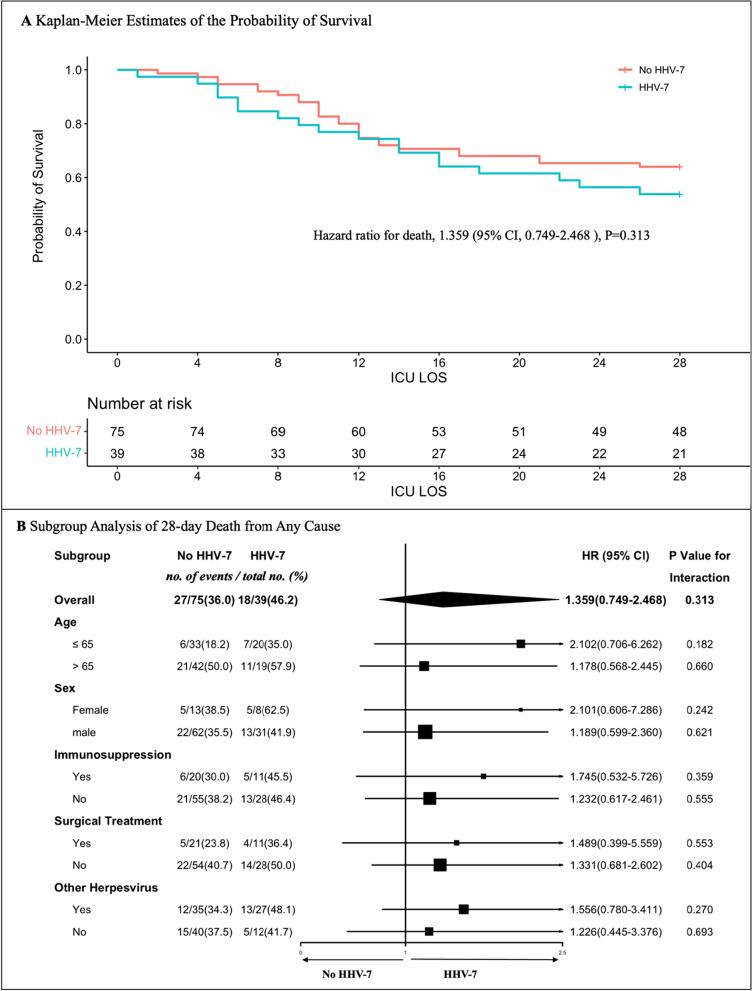
In a total number of 721 patients, 45 cases (6.24%) were identified with HHV-7 positive in lower respiratory tract. HHV-7 positive patients were younger (59.2 vs 64.4, p = 0.032) and had a higher rate of co-detection with Cytomegalovirus (42.2% vs 20.7%, p = 0.001) and Epstein-Barr virus (35.6% vs 18.2%, p = 0.008). After propensity score matching for gender, age, SOFA score at ICU admission, and days from ICU admission to mNGS assay, there was no statistically significant difference in the 28-day mortality rate between HHV-7 positive and negative patients (46.2% vs 36.0%, p = 0.395). Multivariate Cox regression analysis adjusting for gender, age, and SOFA score showed that HHV-7 positive was not an independent risk factor for 28-day mortality (HR 1.783, 95%CI 0.936-3.400, p = 0.079).
CONCLUSION
HHV-7 was detected in the lungs of 6.24% of patients with severe pneumonia. The presence of HHV-7 in patients with severe pneumonia requiring invasive mechanical ventilation is associated with a younger age and co-detected of Cytomegalovirus and Epstein-Barr virus. While HHV-7 positivity was not found to be an independent risk factor for mortality in this cohort, this result may have been influenced by the relatively small sample size of the study.
目的
检测人类疱疹病毒 7(HHV-7)在重症肺炎患者下呼吸道中的意义尚不清楚。本研究旨在评估检测重症肺炎患者下呼吸道中 HHV-7 的临床特征和预后。
方法
2019 年 1 月至 2023 年 3 月,12 家医疗中心纳入了因重症肺炎需要接受有创机械通气并进行商业宏基因组下一代测序(mNGS)检测的患者。回顾性收集患者的临床数据,并进行倾向评分匹配进行亚组分析和死亡率评估。
结果
在总共 721 例患者中,有 45 例(6.24%)在下呼吸道中检测到 HHV-7 阳性。HHV-7 阳性患者年龄更小(59.2 岁 vs 64.4 岁,p=0.032),更常与巨细胞病毒(42.2% vs 20.7%,p=0.001)和 Epstein-Barr 病毒(35.6% vs 18.2%,p=0.008)共同检出。对性别、入 ICU 时 SOFA 评分、入 ICU 到 mNGS 检测的天数进行倾向评分匹配后,HHV-7 阳性和阴性患者 28 天死亡率无统计学差异(46.2% vs 36.0%,p=0.395)。调整性别、年龄和 SOFA 评分的多变量 Cox 回归分析表明,HHV-7 阳性不是 28 天死亡率的独立危险因素(HR 1.783,95%CI 0.936-3.400,p=0.079)。
结论
在 6.24%的重症肺炎患者的肺部中检测到 HHV-7。需要有创机械通气的重症肺炎患者中存在 HHV-7 与年龄较小以及巨细胞病毒和 Epstein-Barr 病毒共同检出有关。虽然在本队列中,HHV-7 阳性未被发现是死亡率的独立危险因素,但这一结果可能受到研究样本量较小的影响。
 Zotero 插件