
富含甘油三酯的脂蛋白残粒、低密度脂蛋白与冠心病风险:英国生物库研究。
Triglyceride-rich lipoprotein remnants, low-density lipoproteins, and risk of coronary heart disease: a UK Biobank study.
机构信息
Department of Molecular and Clinical Medicine, University of Gothenburg, Sahlgrenska University Hospital, 41345 Gothenburg, Sweden.
School of Public Health and Community Medicine, University of Gothenburg, Medicinaregatan 18A, 41390 Gothenburg, Sweden.
出版信息
Eur Heart J. 2023 Oct 14;44(39):4186-4195. doi: 10.1093/eurheartj/ehad337.
AIMS
The strength of the relationship of triglyceride-rich lipoproteins (TRL) with risk of coronary heart disease (CHD) compared with low-density lipoprotein (LDL) is yet to be resolved.
METHODS AND RESULTS
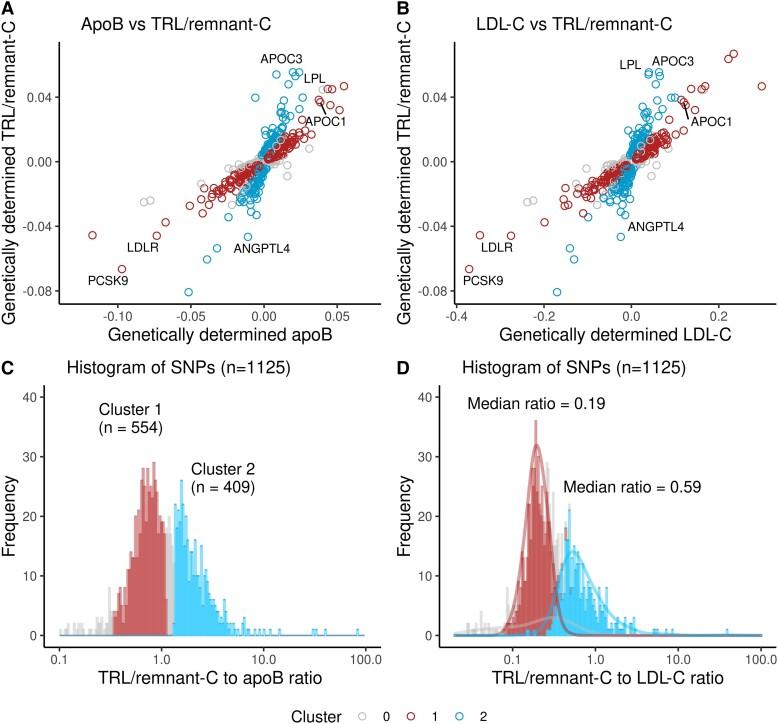
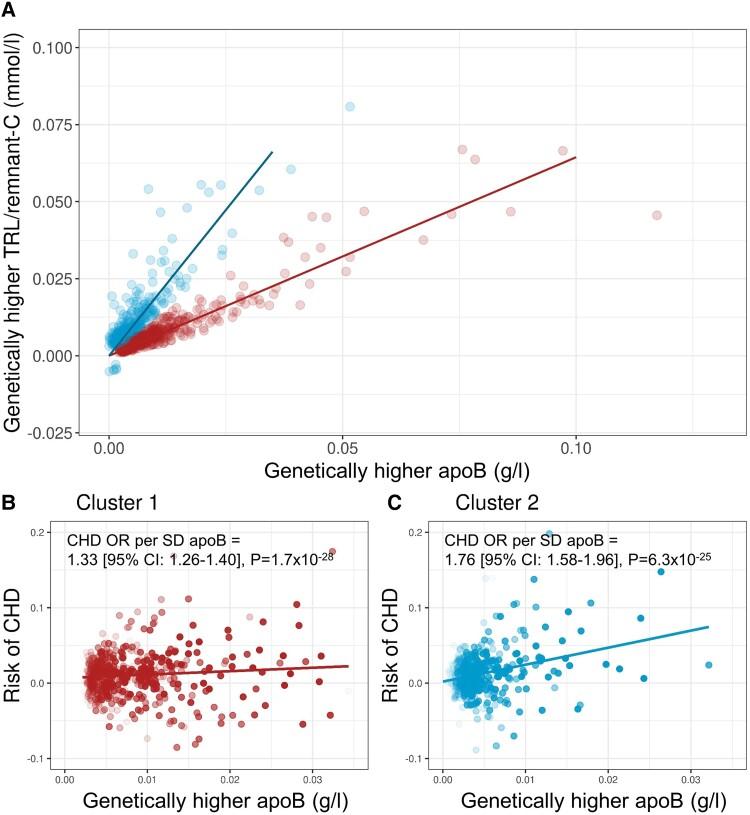
Single-nucleotide polymorphisms (SNPs) associated with TRL/remnant cholesterol (TRL/remnant-C) and LDL cholesterol (LDL-C) were identified in the UK Biobank population. In a multivariable Mendelian randomization analysis, TRL/remnant-C was strongly and independently associated with CHD in a model adjusted for apolipoprotein B (apoB). Likewise, in a multivariable model, TRL/remnant-C and LDL-C also exhibited independent associations with CHD with odds ratios per 1 mmol/L higher cholesterol of 2.59 [95% confidence interval (CI): 1.99-3.36] and 1.37 [95% CI: 1.27-1.48], respectively. To examine the per-particle atherogenicity of TRL/remnants and LDL, SNPs were categorized into two clusters with differing effects on TRL/remnant-C and LDL-C. Cluster 1 contained SNPs in genes related to receptor-mediated lipoprotein removal that affected LDL-C more than TRL/remnant-C, whereas cluster 2 contained SNPs in genes related to lipolysis that had a much greater effect on TRL/remnant-C. The CHD odds ratio per standard deviation (Sd) higher apoB for cluster 2 (with the higher TRL/remnant to LDL ratio) was 1.76 (95% CI: 1.58-1.96), which was significantly greater than the CHD odds ratio per Sd higher apoB in cluster 1 [1.33 (95% CI: 1.26-1.40)]. A concordant result was obtained by using polygenic scores for each cluster to relate apoB to CHD risk.
CONCLUSION
Distinct SNP clusters appear to impact differentially on remnant particles and LDL. Our findings are consistent with TRL/remnants having a substantially greater atherogenicity per particle than LDL.
目的
与低密度脂蛋白(LDL)相比,富含甘油三酯的脂蛋白(TRL)与冠心病(CHD)风险的关系强度仍有待解决。
方法和结果
在英国生物库人群中鉴定出与 TRL/残粒胆固醇(TRL/remnant-C)和 LDL 胆固醇(LDL-C)相关的单核苷酸多态性(SNP)。在多变量孟德尔随机分析中,在调整载脂蛋白 B(apoB)的模型中,TRL/残粒-C 与 CHD 强烈且独立相关。同样,在多变量模型中,TRL/残粒-C 和 LDL-C 也与 CHD 具有独立相关性,胆固醇每升高 1mmol/L 的比值比分别为 2.59(95%置信区间:1.99-3.36)和 1.37(95%置信区间:1.27-1.48)。为了研究 TRL/残粒和 LDL 的每个颗粒的动脉粥样硬化性,将 SNP 分为两个具有不同影响的簇,即 TRL/残粒-C 和 LDL-C。簇 1 包含与受体介导的脂蛋白清除相关的基因中的 SNP,这些 SNP 对 LDL-C 的影响大于 TRL/残粒-C,而簇 2 包含与脂肪分解相关的基因中的 SNP,这些 SNP 对 TRL/残粒-C 的影响要大得多。簇 2(具有更高的 TRL/残粒与 LDL 比值)中每个标准偏差(Sd)较高 apoB 的 CHD 比值比为 1.76(95%置信区间:1.58-1.96),明显高于簇 1 中每个 Sd 较高 apoB 的 CHD 比值比[1.33(95%置信区间:1.26-1.40)]。通过使用每个簇的多基因评分将 apoB 与 CHD 风险相关联,得到了一个一致的结果。
结论
不同的 SNP 簇似乎对残粒颗粒和 LDL 有不同的影响。我们的发现与 TRL/残粒每颗粒的动脉粥样硬化性明显大于 LDL 一致。



 Zotero 插件