
具有功能编码肽的合成细胞外基质。
Synthetic extracellular matrices with function-encoding peptides.
作者信息
Ligorio Cosimo, Mata Alvaro
机构信息
Biodiscovery Institute, University of Nottingham, Nottingham, UK.
Department of Chemical and Environmental Engineering, University of Nottingham, Nottingham, UK.
出版信息
Nat Rev Bioeng. 2023 Apr 25:1-19. doi: 10.1038/s44222-023-00055-3.
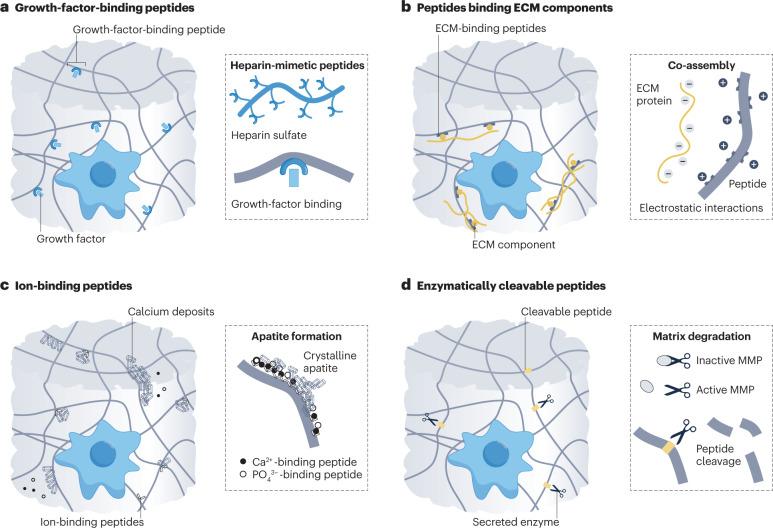
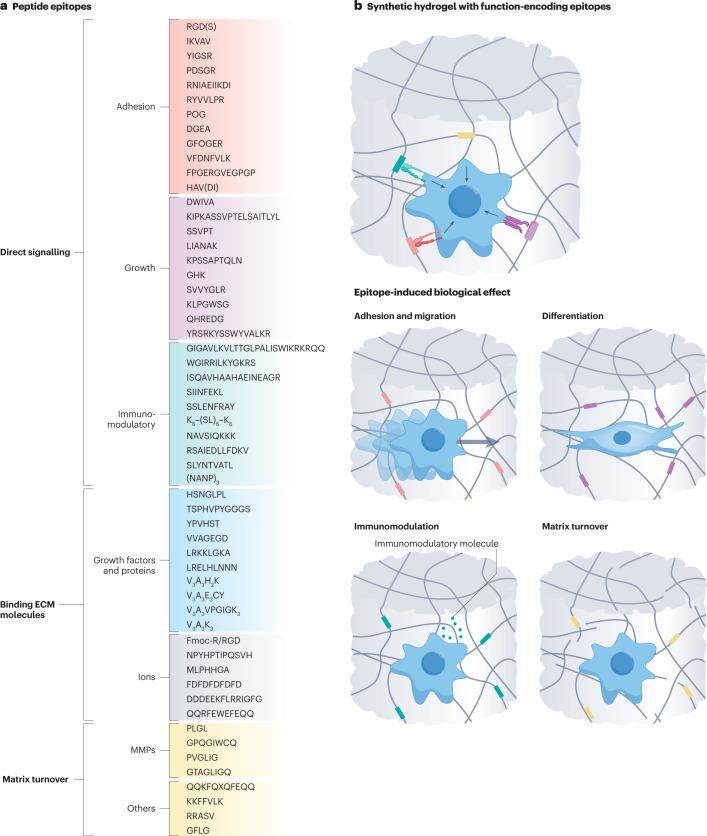
The communication of cells with their surroundings is mostly encoded in the epitopes of structural and signalling proteins present in the extracellular matrix (ECM). These peptide epitopes can be incorporated in biomaterials to serve as function-encoding molecules to modulate cell-cell and cell-ECM interactions. In this Review, we discuss natural and synthetic peptide epitopes as molecular tools to bioengineer bioactive hydrogel materials. We present a library of functional peptide sequences that selectively communicate with cells and the ECM to coordinate biological processes, including epitopes that directly signal to cells, that bind ECM components that subsequently signal to cells, and that regulate ECM turnover. We highlight how these epitopes can be incorporated in different biomaterials as individual or multiple signals, working synergistically or additively. This molecular toolbox can be applied in the design of biomaterials aimed at regulating or controlling cellular and tissue function, repair and regeneration.
细胞与其周围环境的通讯大多编码于细胞外基质(ECM)中结构蛋白和信号蛋白的表位。这些肽表位可整合到生物材料中,作为功能编码分子来调节细胞-细胞和细胞-ECM相互作用。在本综述中,我们讨论天然和合成肽表位作为生物工程生物活性水凝胶材料的分子工具。我们展示了一个功能性肽序列库,这些序列可与细胞和ECM选择性通讯以协调生物学过程,包括直接向细胞发出信号的表位、结合随后向细胞发出信号的ECM成分的表位以及调节ECM周转的表位。我们强调这些表位如何作为单个或多个信号整合到不同生物材料中,协同或相加发挥作用。这个分子工具箱可应用于旨在调节或控制细胞和组织功能、修复和再生的生物材料设计。

 Zotero 插件