
新冠疫情对晚期慢性肾脏病患者疾病自我管理的影响:一项定性研究
Impact of COVID-19 on Disease Self-management Among Patients With Advanced CKD: A Qualitative Study.
作者信息
Ng Jia H, Halinski Candice, Nair Devika, Diefenbach Michael A
机构信息
Donald and Barbara School of Medicine at Hofstra/Northwell.
Division of Kidney Diseases and Hypertension, Northwell Health.
出版信息
Kidney Med. 2023 Jun 15;5(8):100689. doi: 10.1016/j.xkme.2023.100689.
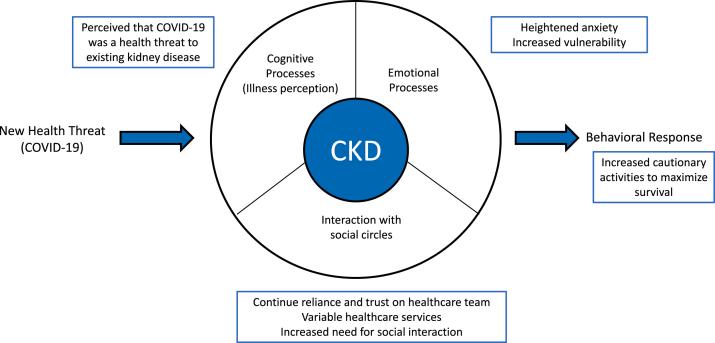
RATIONALE & OBJECTIVE: Patients with advanced chronic kidney disease (CKD) and their care partners experienced decreased access to care, and worse physical and emotional health during the Coronavirus Disease-19 (COVID-19) pandemic. Few studies have explored how COVID-19-related challenges affected disease self-management among those with advanced chronic kidney disease (CKD) and their care partners. Leventhal's self-regulation model offers a comprehensive framework for understanding disease self-management through the interplay of cognitive beliefs, emotional reactions and social influences. The study aims to examine the impact of COVID-19 on self-management activities among patients with CKD and care partners.
STUDY DESIGN
Qualitative study.
SETTING & PARTICIPANTS: Adults with advanced CKD, including dialysis and transplant recipients, and their carepartners.
ANALYTICAL APPROACH
Thematic Analysis.
RESULTS
Among 42 participants, 12 had stage 4 CKD, 5 had stage 5 CKD, 6 were receiving in-center hemodialysis, 5 had a kidney transplant, and 14 were care partners. We identified 4 patient-related themes with corresponding subthemes related to the impact of COVID-19 on self-management: 1) cognitive understanding that COVID-19 is an additional health threat to existing kidney disease, 2) heightened anxiety and vulnerability driven by perceived risk, 3) coping with isolation through virtual interactions with healthcare services and social circles, 4) increased protective behaviors to maximize survival. Three care partner-related themes emerged: 1) hypervigilance in family care and protection, 2) interaction with health system and adaptations to self-management, and 3) increased intensity in caregiving role to facilitate patient self-management.
LIMITATIONS
The qualitative study design limits the ability to generate generalizable data. Grouping patients with Stage 3 and 4 CKD, in-center hemodialysis, and kidney transplants together limited our ability to examine self-management challenges specific to each treatment requirement.
CONCLUSIONS
When faced with the COVID-19 pandemic, patients with CKD and their care partners experienced heightened vulnerability and thus increased cautionary activities to maximize survival. Our study provides the groundwork for future interventions to help patients and care partners live with kidney disease during future crises.
原理与目的
在冠状病毒病2019(COVID-19)大流行期间,晚期慢性肾脏病(CKD)患者及其护理伙伴获得医疗服务的机会减少,身心健康状况更差。很少有研究探讨与COVID-19相关的挑战如何影响晚期慢性肾脏病(CKD)患者及其护理伙伴的疾病自我管理。莱文索尔的自我调节模型提供了一个全面的框架,通过认知信念、情绪反应和社会影响的相互作用来理解疾病自我管理。本研究旨在探讨COVID-19对CKD患者及其护理伙伴自我管理活动的影响。
研究设计
定性研究。
设置与参与者
晚期CKD成人患者,包括透析患者和移植受者及其护理伙伴。
分析方法
主题分析。
结果
在42名参与者中,12人患有4期CKD,5人患有5期CKD,6人接受中心血液透析,5人接受肾移植,14人是护理伙伴。我们确定了4个与患者相关的主题以及与COVID-19对自我管理影响相关的相应子主题:1)认识到COVID-19是对现有肾脏疾病的额外健康威胁;2)感知风险导致焦虑和脆弱性加剧;3)通过与医疗服务和社交圈的虚拟互动应对隔离;4)增加保护行为以最大化生存几率。出现了3个与护理伙伴相关的主题:1)家庭护理和保护中的过度警惕;2)与卫生系统的互动及对自我管理的调整;3)护理角色强度增加以促进患者自我管理。
局限性
定性研究设计限制了生成可推广数据的能力。将3期和4期CKD患者、中心血液透析患者和肾移植患者归为一组限制了我们检查每种治疗需求特有的自我管理挑战的能力。
结论
面对COVID-19大流行时,CKD患者及其护理伙伴经历了更高的脆弱性,因此增加了谨慎行为以最大化生存几率。我们的研究为未来干预措施奠定了基础,以帮助患者和护理伙伴在未来危机期间应对肾脏疾病。
 Zotero 插件