
用于mRNA递送的位点特异性脂质纳米颗粒的最新进展
Recent Advances in Site-Specific Lipid Nanoparticles for mRNA Delivery.
作者信息
Xu Xiao, Xia Tian
机构信息
Division of NanoMedicine, Department of Medicine, University of California, Los Angeles, California 90095, United States.
California NanoSystems Institute, University of California, Los Angeles, California 90095, United States.
出版信息
ACS Nanosci Au. 2023 Mar 30;3(3):192-203. doi: 10.1021/acsnanoscienceau.2c00062. eCollection 2023 Jun 21.
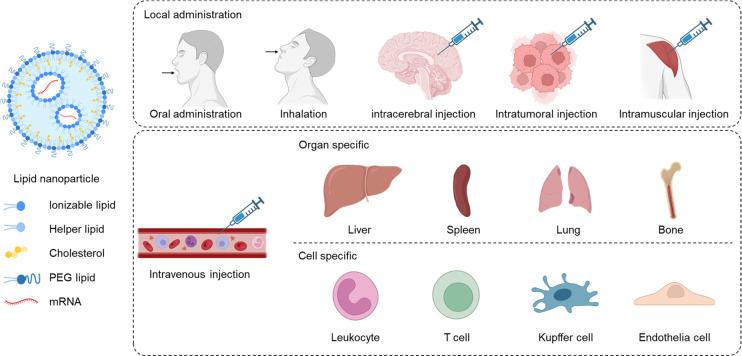
The success of mRNA vaccines during the COVID-19 pandemic has greatly accelerated the development of mRNA therapy. mRNA is a negatively charged nucleic acid that serves as a template for protein synthesis in the ribosome. Despite its utility, the instability of mRNA requires suitable carriers for delivery. Lipid nanoparticles (LNPs) are employed to protect mRNA from degradation and enhance its intracellular delivery. To further optimize the therapeutic efficacy of mRNA, site-specific LNPs have been developed. Through local or systemic administration, these site-specific LNPs can accumulate in specific organs, tissues, or cells, allowing for the intracellular delivery of mRNA to specific cells and enabling the exertion of local or systemic therapeutic effects. This not only improves the efficiency of mRNA therapy but also reduces off-target adverse effects. In this review, we summarize recent site-specific mRNA delivery strategies, including different organ- or tissue-specific LNP after local injection, and organ-specific or cell-specific LNP after intravenous injection. We also provide an outlook on the prospects of mRNA therapy.
mRNA疫苗在新冠疫情期间的成功极大地加速了mRNA疗法的发展。mRNA是一种带负电荷的核酸,在核糖体中作为蛋白质合成的模板。尽管mRNA有其用途,但其不稳定性需要合适的载体来进行递送。脂质纳米颗粒(LNPs)被用于保护mRNA不被降解并增强其细胞内递送。为了进一步优化mRNA的治疗效果,已经开发出了位点特异性脂质纳米颗粒。通过局部或全身给药,这些位点特异性脂质纳米颗粒可以在特定器官、组织或细胞中积累,从而实现mRNA向特定细胞的细胞内递送,并发挥局部或全身治疗作用。这不仅提高了mRNA疗法的效率,还减少了脱靶副作用。在这篇综述中,我们总结了近期的位点特异性mRNA递送策略,包括局部注射后不同的器官或组织特异性脂质纳米颗粒,以及静脉注射后器官特异性或细胞特异性脂质纳米颗粒。我们还对mRNA疗法的前景进行了展望。




 Zotero 插件