
美国印第安人群体中的金属混合物和生物老化的 DNA 甲基化测量。
Metal mixtures and DNA methylation measures of biological aging in American Indian populations.
机构信息
Department of Environmental Health Sciences, Mailman School of Public Health, Columbia University, New York, NY, USA.
Department of Environmental Health Sciences, Mailman School of Public Health, Columbia University, New York, NY, USA; Department of Chronic Diseases Epidemiology, National Center for Epidemiology, Carlos III Health Institute, Madrid, Spain; Department of Statistics and Operations Research, University of Valencia, Spain.
出版信息
Environ Int. 2023 Aug;178:108064. doi: 10.1016/j.envint.2023.108064. Epub 2023 Jun 24.
INTRODUCTION
Native American communities suffer disproportionately from elevated metal exposures and increased risk for cardiovascular diseases and diabetes. DNA methylation is a sensitive biomarker of aging-related processes and novel epigenetic-based "clocks" can be used to estimate accelerated biological aging that may underlie increased risk. Metals alter DNA methylation, yet little is known about their individual and combined impact on epigenetic age acceleration. Our objective was to investigate the associations of metals on several DNA methylation-based aging measures in the Strong Heart Study (SHS) cohort.
METHODS
Blood DNA methylation data from 2,301 SHS participants was used to calculate age acceleration of epigenetic clocks (PhenoAge, GrimAge, DunedinPACE, Hannum, Horvath). Urinary metals [arsenic (As), cadmium (Cd), tungsten (W), zinc (Zn), selenium (Se), molybdenum (Mo)] were creatinine-adjusted and categorized into quartiles. We examined associations of individual metals through linear regression models and used Bayesian Kernel Machine Regression (BKMR) for the impact of the total metal mixture on epigenetic age acceleration.
RESULTS
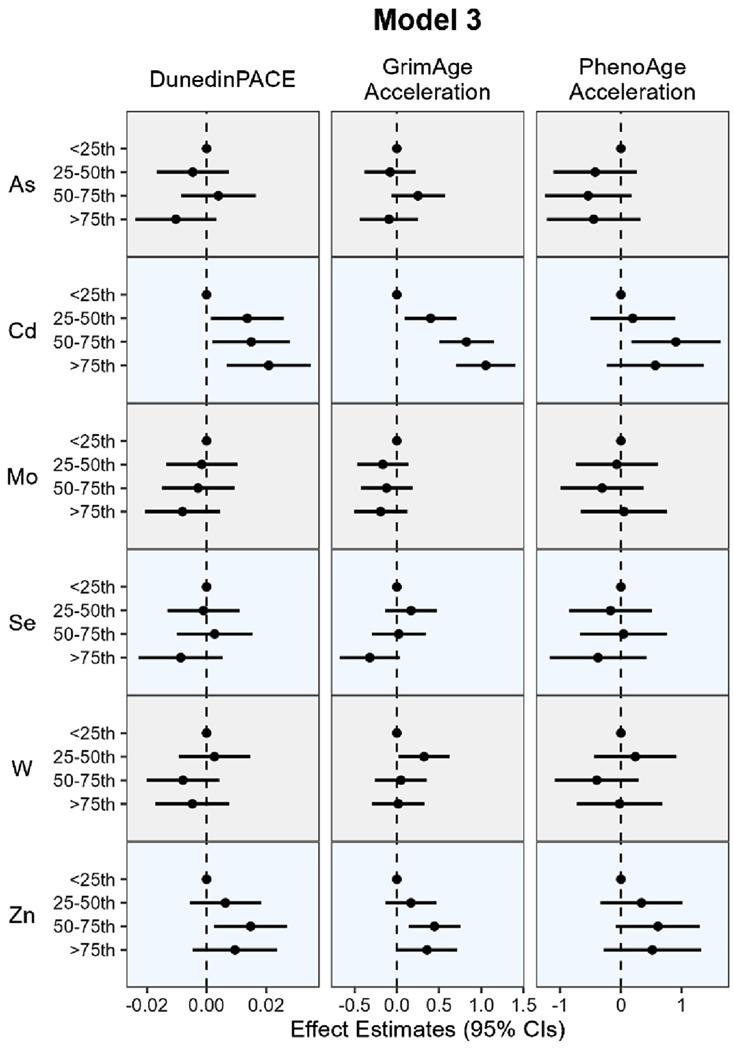
The mixture of nonessential metals (W, As, Cd) was associated with greater GrimAge acceleration and DunedinPACE, while the essential metal mixture (Se, Zn, Mo) was associated with lower epigenetic age acceleration. Cd was associated with increased epigenetic age acceleration across all clocks and BKMR analysis suggested nonlinear associations between Se and DunedinPACE, GrimAge, and PhenoAge acceleration. No interactions between individual metals were observed. The associations between Cd, Zn, and epigenetic age acceleration were greater in never smokers in comparison to current/former smokers.
CONCLUSION
Nonessential metals were positively associated with greater epigenetic age acceleration, with strongest associations observed between Cd and DunedinPACE and GrimAge acceleration. In contrast, essential metals were associated with lower epigenetic aging. Examining the influence of metal mixtures on epigenetic age acceleration can provide insight into metals and aging-related diseases.
简介
美洲原住民社区不成比例地受到金属暴露增加的影响,并且面临更高的心血管疾病和糖尿病风险。DNA 甲基化是与衰老相关过程的敏感生物标志物,新的基于表观遗传的“时钟”可用于估计加速的生物学衰老,而加速的生物学衰老可能是增加风险的基础。金属会改变 DNA 甲基化,但人们对它们对表观遗传年龄加速的单独和联合影响知之甚少。我们的目标是调查 Strong Heart 研究(SHS)队列中几种基于 DNA 甲基化的衰老测量指标与金属的关联。
方法
利用 2301 名 SHS 参与者的血液 DNA 甲基化数据,计算表观遗传时钟(PhenoAge、GrimAge、DunedinPACE、Hannum、Horvath)的年龄加速。尿金属(砷[As]、镉[Cd]、钨[W]、锌[Zn]、硒[Se]、钼[Mo])按肌酐进行调整并分为四分位数。我们通过线性回归模型检查了单个金属的关联,并使用贝叶斯核机器回归(BKMR)来评估金属混合物对表观遗传年龄加速的影响。
结果
非必需金属(W、As、Cd)混合物与 GrimAge 加速和 DunedinPACE 增加有关,而必需金属混合物(Se、Zn、Mo)与表观遗传年龄加速降低有关。Cd 与所有时钟的表观遗传年龄加速增加有关,BKMR 分析表明 Se 与 DunedinPACE、GrimAge 和 PhenoAge 加速之间存在非线性关联。未观察到单个金属之间的相互作用。与表观遗传年龄加速的关联在从不吸烟者中比在当前/前吸烟者中更强。
结论
非必需金属与更大的表观遗传年龄加速呈正相关,在 Cd 与 DunedinPACE 和 GrimAge 加速之间观察到最强的关联。相比之下,必需金属与更低的表观遗传衰老有关。研究金属混合物对表观遗传年龄加速的影响可以深入了解金属与衰老相关疾病。


 Zotero 插件