
年龄相关性黄斑变性中遗传学和生活方式框架下的系统代谢组学
Systemic Metabolomics in a Framework of Genetics and Lifestyle in Age-Related Macular Degeneration.
作者信息
Thee Eric F, Acar İlhan E, Colijn Johanna M, Meester-Smoor Magda A, Verzijden Timo, Baart Sara J, Jarboui Mohamed A, Fauser Sascha, Hoyng Carel B, Ueffing Marius, den Hollander Anneke I, Klaver Caroline C W
机构信息
Department of Ophthalmology, Erasmus University Medical Center, 3015 GD Rotterdam, The Netherlands.
Department of Epidemiology, Erasmus University Medical Center, 3015 GD Rotterdam, The Netherlands.
出版信息
Metabolites. 2023 May 27;13(6):701. doi: 10.3390/metabo13060701.
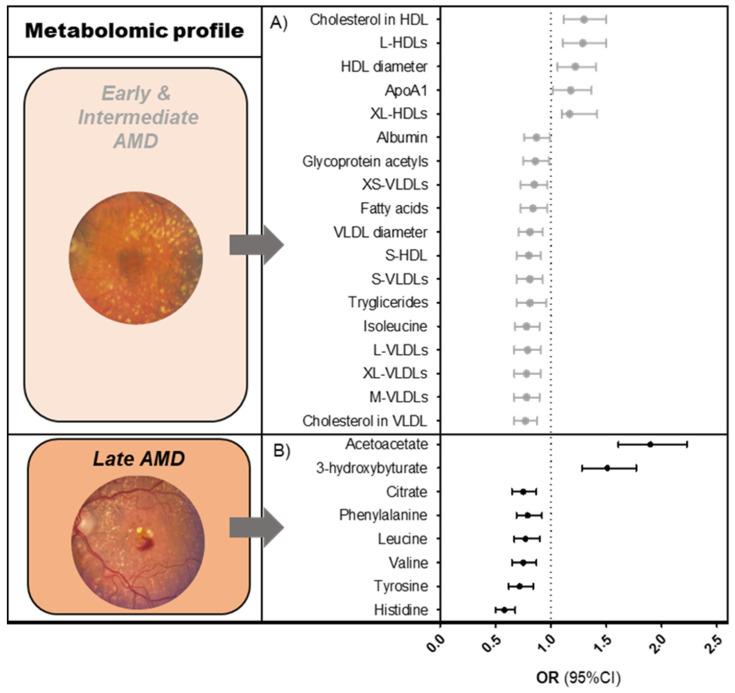
Insights into the pathogenesis of age-related macular degeneration (AMD), a leading cause of blindness, point towards a complex interplay of genetic and lifestyle factors triggering various systemic pathways. This study aimed to characterize metabolomic profiles for AMD and to evaluate their position in the trias with genetics and lifestyle. This study included 5923 individuals from five European studies. Blood metabolomics were assessed using a nuclear magnetic resonance platform of 146 metabolites. Associations were studied using regression analyses. A genetic risk score (GRS) was calculated using β-values of 49 AMD variants, a lifestyle risk score (LRS) using smoking and diet data, and a metabolite risk score (MRS) using metabolite values. We identified 61 metabolites associated with early-intermediate AMD, of which 94% were lipid-related, with higher levels of HDL-subparticles and apolipoprotein-A1, and lower levels of VLDL-subparticles, triglycerides, and fatty acids (false discovery rate (FDR) -value < 1.4 × 10). Late AMD was associated with lower levels of the amino acids histidine, leucine, valine, tyrosine, and phenylalanine, and higher levels of the ketone bodies acetoacetate and 3-hydroxybutyrate (FDR -value < 1.5 × 10). A favorable lifestyle characterized by a healthy diet was associated with higher levels of amino acids and lower levels of ketone bodies, while an unfavorable lifestyle, including smoking, showed opposite effects (FDR -value < 2.7 × 10). The MRS mediated 5% of the effect of the GRS and 20% of that of the LRS on late AMD. Our findings show that metabolomic profiles differ between AMD stages and show that blood metabolites mostly reflect lifestyle. The severity-specific profiles spur further interest into the systemic effects related to disease conversion.
年龄相关性黄斑变性(AMD)是导致失明的主要原因,对其发病机制的深入研究表明,遗传因素与生活方式因素之间存在复杂的相互作用,从而触发各种全身通路。本研究旨在描述AMD的代谢组学特征,并评估它们在与遗传学和生活方式构成的三元组中的地位。本研究纳入了来自五项欧洲研究的5923名个体。使用包含146种代谢物的核磁共振平台评估血液代谢组学。通过回归分析研究关联性。使用49个AMD变异体的β值计算遗传风险评分(GRS),使用吸烟和饮食数据计算生活方式风险评分(LRS),使用代谢物值计算代谢物风险评分(MRS)。我们鉴定出61种与早期至中期AMD相关的代谢物,其中94%与脂质相关,高密度脂蛋白亚颗粒和载脂蛋白A1水平较高,极低密度脂蛋白亚颗粒、甘油三酯和脂肪酸水平较低(错误发现率(FDR)值<1.4×10)。晚期AMD与组氨酸、亮氨酸、缬氨酸、酪氨酸和苯丙氨酸等氨基酸水平较低以及酮体乙酰乙酸和3-羟基丁酸水平较高相关(FDR值<1.5×10)。以健康饮食为特征的良好生活方式与较高的氨基酸水平和较低的酮体水平相关,而包括吸烟在内的不良生活方式则显示出相反的效果(FDR值<2.7×10)。MRS介导了GRS对晚期AMD作用的5%以及LRS对晚期AMD作用的20%。我们的研究结果表明,代谢组学特征在AMD各阶段有所不同,并且血液代谢物大多反映生活方式。特定严重程度的特征激发了对与疾病转化相关的全身效应的进一步关注。

 Zotero 插件