
腰椎间盘显微切除术治疗坐骨神经痛后恢复的预测因素:一项观察性研究的系统评价和荟萃分析
Predictors of Recovery Following Lumbar Microdiscectomy for Sciatica: A Systematic Review and Meta-Analysis of Observational Studies.
作者信息
Rehman Yasir, Bala Malgorzata, Rehman Nadia, Agarwal Arnav, Koperny Magdalena, Crandon Holly, Abdullah Ream, Hull Alexandra, Makhdami Nima, Grodecki Savannah, Wrzosek Anna, Lesniak Wiktoria, Evaniew Nathan, Ashoorion Vahid, Wang Li, Couban Rachel, Drew Brian, Busse Jason W
机构信息
Health Research Methodology, McMaster University, Hamilton, CAN.
Epidemiology and Preventive Medicine, Jagiellonian University Medical College, Krakow, POL.
出版信息
Cureus. 2023 May 29;15(5):e39664. doi: 10.7759/cureus.39664. eCollection 2023 May.
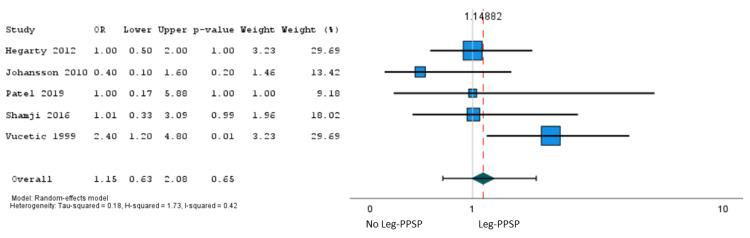
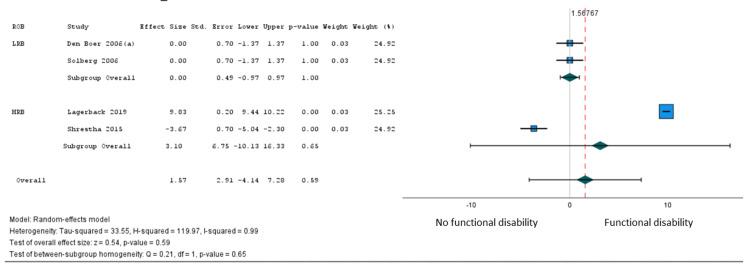
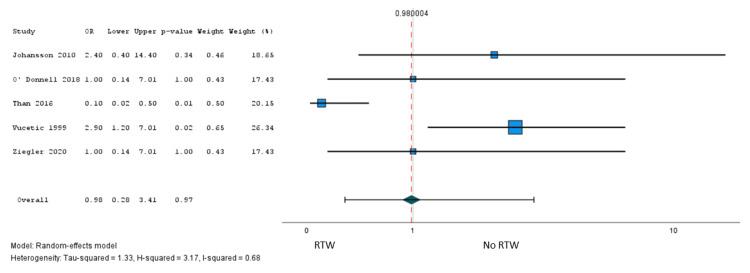
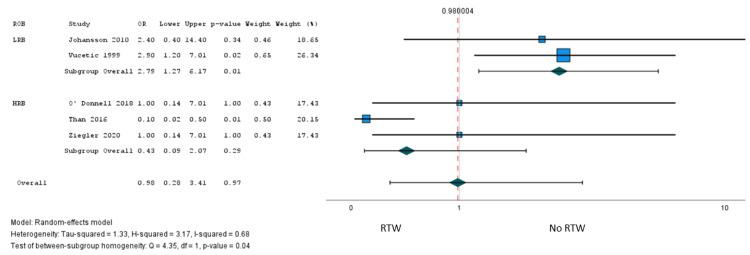
Chronic post-surgical pain is reported by up to 40% of patients after lumbar microdiscectomy for sciatica, a complaint associated with disability and loss of productivity. We conducted a systematic review of observational studies to explore factors associated with persistent leg pain and impairments after microdiscectomy for sciatica. We searched eligible studies in MEDLINE, Embase, and CINAHL that explored, in an adjusted model, predictors of persistent leg pain, physical impairment, or failure to return to work after microdiscectomy for sciatica. When possible, we pooled estimates of association using random-effects models using the Grading of Recommendations Assessment, Development, and Evaluation approach. Moderate-certainty evidence showed that the female sex probably has a small association with persistent post-surgical leg pain (odds ratio (OR) = 1.15, 95% confidence interval (CI) = 0.63 to 2.08; absolute risk increase (ARI) = 1.8%, 95% CI = -4.7% to 11.3%), large association with failure to return to work (OR = 2.79, 95% CI = 1.27 to 6.17; ARI = 10.6%, 95% CI = 1.8% to 25.2%), and older age is probably associated with greater postoperative disability (β = 1.47 points on the 100-point Oswestry Disability Index for every 10-year increase from age (>/=18 years), 95% CI = -4.14 to 7.28). Among factors that were not possible to pool, two factors showed promise for future study, namely, legal representation and preoperative opioid use, which showed large associations with worse outcomes after surgery. The moderate-certainty evidence showed female sex is probably associated with persistent leg pain and failure to return to work and that older age is probably associated with greater post-surgical impairment after a microdiscectomy. Future research should explore the association between legal representation and preoperative opioid use with persistent pain and impairment after microdiscectomy for sciatica.
高达40%的坐骨神经痛患者在接受腰椎间盘显微切除术后会出现慢性术后疼痛,这种症状与残疾和生产力下降有关。我们对观察性研究进行了系统综述,以探究与坐骨神经痛患者接受显微切除术后持续性腿痛和功能障碍相关的因素。我们在MEDLINE、Embase和CINAHL中检索了符合条件的研究,这些研究在调整模型中探讨了坐骨神经痛患者接受显微切除术后持续性腿痛、身体功能障碍或无法恢复工作的预测因素。在可能的情况下,我们使用推荐分级评估、制定和评价方法,通过随机效应模型汇总关联估计值。中等确定性证据表明,女性可能与术后持续性腿痛存在较小关联(优势比(OR)=1.15,95%置信区间(CI)=0.63至2.08;绝对风险增加(ARI)=1.8%,95%CI=-4.7%至11.3%),与无法恢复工作存在较大关联(OR=2.79,95%CI=1.27至6.17;ARI=10.6%,95%CI=1.8%至25.2%),年龄较大可能与术后残疾程度更高相关(在100分的Oswestry残疾指数上,每增加10岁(≥18岁)β值增加1.47分,95%CI=-4.14至7.28)。在无法汇总的因素中,有两个因素显示出未来研究的前景,即法律代理和术前使用阿片类药物,它们与术后更差的结果存在较大关联。中等确定性证据表明,女性可能与持续性腿痛和无法恢复工作有关,年龄较大可能与腰椎间盘显微切除术后更大的术后功能障碍有关。未来的研究应探索法律代理和术前使用阿片类药物与坐骨神经痛患者接受显微切除术后持续性疼痛和功能障碍之间的关联。



 Zotero 插件