
原发性心脏肉瘤:单中心 25 年经验的临床病理研究,重点关注 MDM2 表达和辅助治疗的预后价值。
Primary cardiac sarcomas: A clinicopathologic study in a single institution with 25 years of experience with an emphasis on MDM2 expression and adjuvant therapy for prognosis.
机构信息
Department of Pathology, University of Ulsan College of Medicine, Asan Medical Center, Seoul, Republic of Korea.
Department of Radiology and Research Institute of Radiology, University of Ulsan College of Medicine, Asan Medical Center, Seoul, Republic of Korea.
出版信息
Cancer Med. 2023 Aug;12(16):16815-16828. doi: 10.1002/cam4.6303. Epub 2023 Jul 3.
BACKGROUND
Primary cardiac sarcomas are rare and their clinicopathologic features are heterogeneous. Among them, particularly intimal sarcoma is a diagnostic challenge due to nonspecific histologic features. Recently, MDM2 amplification reported to be a characteristic genetic event in the intimal sarcoma. In this study, we aimed to identify the types and incidence of primary cardiac sarcomas that occurred over 25 years in tertiary medical institutions, and to find clinicopatholgical significance through reclassification of diagnoses using additional immunohistochemistry (IHC).
METHODS
We reviewed the primary cardiac sarcoma cases between January 1993 and June 2018 at Asan Medical Center, South Korea, with their clinicopathologic findings, and reclassified the subtypes, especially using IHC for MDM2 and then, analyzed the significance of prognosis.
RESULTS
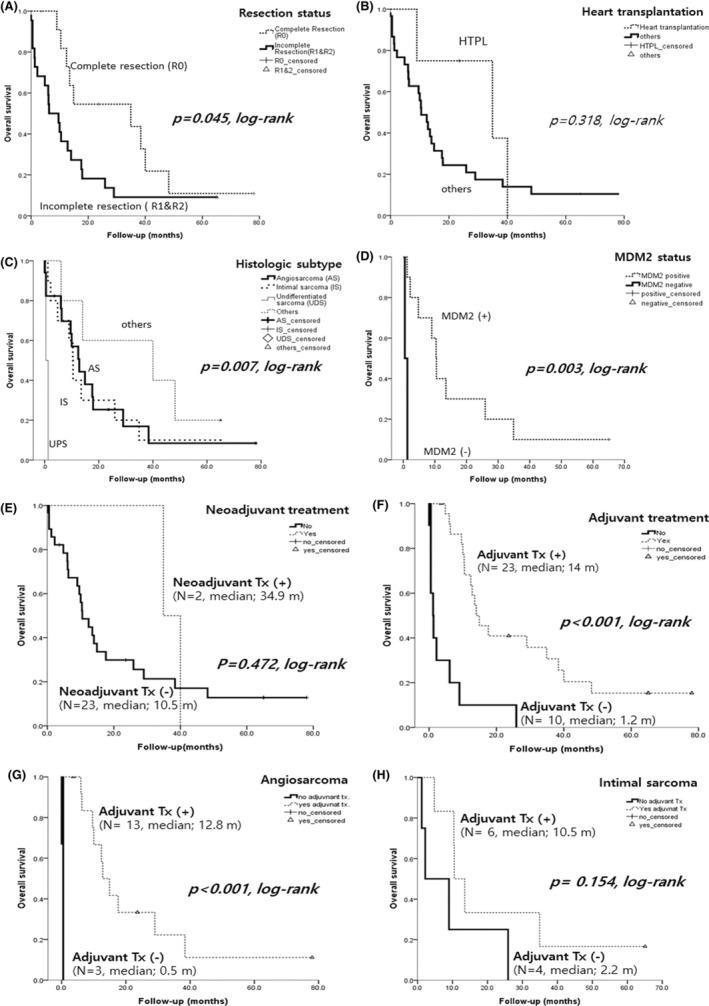
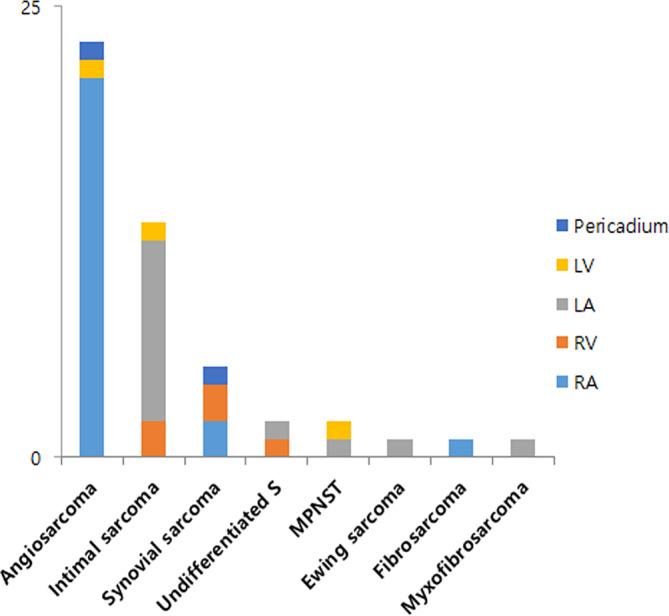
Forty-eight (6.8%) cases of a primary cardiac sarcoma were retrieved. The tumors most frequently involved the right atrium (n = 25, 52.1%), and the most frequent tumor subtype was angiosarcoma (n = 23, 47.9%). Seven cases (53.8%) were newly reclassified as an intimal sarcoma by IHC for MDM2. Twenty-nine (60.4%) patients died of disease (mean, 19.8 months). Four patients underwent a heart transplantation and had a median survival of 26.8 months. This transplantation group tended to show good clinical outcomes in the earlier stages, but this was not statistically significant (p = 0.318). MDM2 positive intimal sarcoma showed the better overall survival (p = 0.003) than undifferentiated pleomorphic sarcoma. Adjuvant treatment is beneficial for patient survival (p < 0.001), particularly in angiosarcoma (p < 0.001), but not in intimal sarcoma (p = 0.154).
CONCLUSION
Our study supports the use of adjuvant treatment in primary cardiac sarcoma, as it was associated with a significantly better overall survival rate. Further consideration of tumor histology may be important in determining the optimal use of adjuvant treatment for different types of sarcomas. Therefore, accurate diagnosis by MDM2 test is important condsidering patient's prognosis and treatment.
背景
原发性心脏肉瘤罕见,其临床病理特征具有异质性。其中,特别是内膜肉瘤由于其非特异性的组织学特征,诊断具有挑战性。最近,MDM2 扩增被报道为内膜肉瘤的一个特征性遗传事件。本研究旨在确定 25 年来在三级医疗机构中发生的原发性心脏肉瘤的类型和发生率,并通过额外的免疫组织化学(IHC)重新分类诊断来寻找临床病理意义。
方法
我们回顾了韩国 1993 年 1 月至 2018 年 6 月在 Asan 医疗中心的原发性心脏肉瘤病例,分析其临床病理表现,并使用 MDM2 的 IHC 重新分类亚型,然后分析预后的意义。
结果
共检出 48 例(6.8%)原发性心脏肉瘤。肿瘤最常累及右心房(n=25,52.1%),最常见的肿瘤类型是血管肉瘤(n=23,47.9%)。7 例(53.8%)通过 MDM2 的 IHC 被重新分类为内膜肉瘤。29 例(60.4%)患者死于疾病(平均 19.8 个月)。4 例患者接受心脏移植,中位生存时间为 26.8 个月。移植组在早期阶段表现出较好的临床结局,但无统计学意义(p=0.318)。MDM2 阳性内膜肉瘤的总生存率优于未分化多形性肉瘤(p=0.003)。辅助治疗有利于患者生存(p<0.001),特别是在血管肉瘤(p<0.001)中,但在内膜肉瘤中无统计学意义(p=0.154)。
结论
我们的研究支持在原发性心脏肉瘤中使用辅助治疗,因为它与显著更好的总生存率相关。进一步考虑肿瘤组织学可能对确定不同类型肉瘤辅助治疗的最佳应用具有重要意义。因此,MDM2 检测的准确诊断对患者的预后和治疗具有重要意义。


 Zotero 插件