
使用间充质干细胞、间充质干细胞衍生的细胞外囊泡和衰老细胞清除剂治疗骨关节炎的炎症和衰老的治疗观点。
Therapeutic Perspectives for Inflammation and Senescence in Osteoarthritis Using Mesenchymal Stem Cells, Mesenchymal Stem Cell-Derived Extracellular Vesicles and Senolytic Agents.
机构信息
Department of Orthopedics, UHealth Sports Medicine Institute, University of Miami Miller School of Medicine, Miami, FL 33146, USA.
Center for Regenerative and Personalized Medicine (CRPM), Steadman Philippon Research Institute, Vail, CO 81657, USA.
出版信息
Cells. 2023 May 18;12(10):1421. doi: 10.3390/cells12101421.
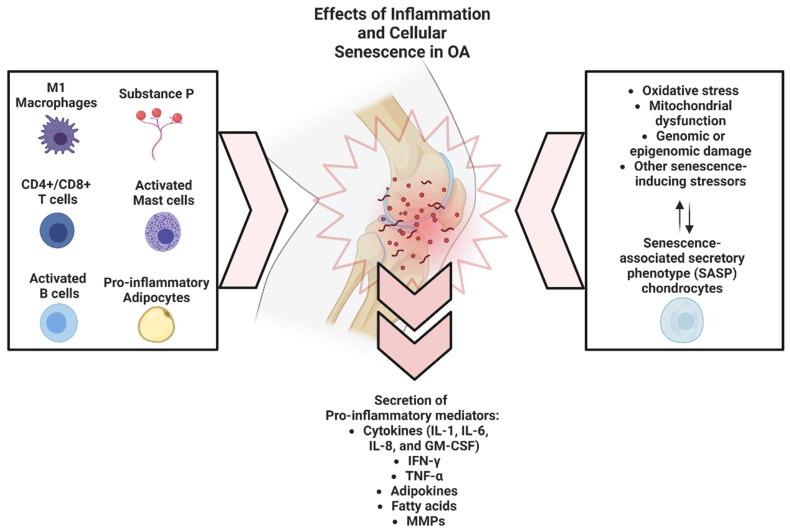
Osteoarthritis (OA) is the most common cause of disability worldwide among the elderly. Alarmingly, the incidence of OA in individuals less than 40 years of age is rising, likely due to the increase in obesity and post-traumatic osteoarthritis (PTOA). In recent years, due to a better understanding of the underlying pathophysiology of OA, several potential therapeutic approaches targeting specific molecular pathways have been identified. In particular, the role of inflammation and the immune system has been increasingly recognized as important in a variety of musculoskeletal diseases, including OA. Similarly, higher levels of host cellular senescence, characterized by cessation of cell division and the secretion of a senescence-associated secretory phenotype (SASP) within the local tissue microenvironments, have also been linked to OA and its progression. New advances in the field, including stem cell therapies and senolytics, are emerging with the goal of slowing disease progression. Mesenchymal stem/stromal cells (MSCs) are a subset of multipotent adult stem cells that have demonstrated the potential to modulate unchecked inflammation, reverse fibrosis, attenuate pain, and potentially treat patients with OA. Numerous studies have demonstrated the potential of MSC extracellular vesicles (EVs) as cell-free treatments that comply with FDA regulations. EVs, including exosomes and microvesicles, are released by numerous cell types and are increasingly recognized as playing a critical role in cell-cell communication in age-related diseases, including OA. Treatment strategies for OA are being developed that target senescent cells and the paracrine and autocrine secretions of SASP. This article highlights the encouraging potential for MSC or MSC-derived products alone or in combination with senolytics to control patient symptoms and potentially mitigate the progression of OA. We will also explore the application of genomic principles to the study of OA and the potential for the discovery of OA phenotypes that can motivate more precise patient-driven treatments.
骨关节炎(OA)是全球老年人中最常见的致残原因。令人震惊的是,40 岁以下人群中 OA 的发病率正在上升,这可能是由于肥胖和创伤后骨关节炎(PTOA)的增加所致。近年来,由于对 OA 潜在病理生理学的更好理解,已经确定了几种针对特定分子途径的潜在治疗方法。特别是,炎症和免疫系统的作用在包括 OA 在内的多种肌肉骨骼疾病中被认为越来越重要。同样,宿主细胞衰老程度较高,其特征是细胞分裂停止,以及在局部组织微环境中分泌衰老相关分泌表型(SASP),也与 OA 及其进展有关。该领域的新进展,包括干细胞疗法和衰老细胞清除疗法,正在出现,目的是减缓疾病进展。间充质干细胞(MSCs)是多能成体干细胞的一个子集,已证明具有调节失控性炎症、逆转纤维化、减轻疼痛和潜在治疗 OA 患者的潜力。许多研究表明 MSC 细胞外囊泡(EVs)作为符合 FDA 规定的无细胞治疗具有潜力。EVs,包括外泌体和微泡,由多种细胞类型释放,并越来越被认为在与年龄相关的疾病(包括 OA)中的细胞间通讯中发挥关键作用。正在开发针对衰老细胞和 SASP 的旁分泌和自分泌分泌的 OA 治疗策略。本文重点介绍了 MSC 或 MSC 衍生产品单独或与衰老细胞清除剂联合使用控制患者症状并可能减轻 OA 进展的令人鼓舞的潜力。我们还将探讨基因组原理在 OA 研究中的应用以及发现能够激发更精确的以患者为导向的治疗的 OA 表型的潜力。

 Zotero 插件