
全球啮齿动物中刚地弓形虫的流行情况:系统评价和荟萃分析。
Global prevalence of Neospora caninum in rodents: A systematic review and meta-analysis.
机构信息
Department of Medical Parasitology and Mycology, School of Medicine, Kermanshah University of Medical Sciences, Kermanshah, Iran.
Research Center for Environmental Determinants of Health, Health Institute, Kermanshah University of Medical Sciences, Kermanshah, Iran.
出版信息
Vet Med Sci. 2023 Sep;9(5):2192-2200. doi: 10.1002/vms3.1196. Epub 2023 Jul 7.
BACKGROUND
Neosporosis has been considered a cause of abortion in dairy and beef cattle worldwide. Rodents are reservoir hosts for several infectious diseases. It is necessary to determine the prevalence of Neospora caninum in rodents to improve the current understanding of the transmission dynamics of Neospora as well as its life cycle and risk of transmission to livestock. Therefore, the objective of the present study was to estimate the pooled global prevalence of N. caninum in different rodent species.
METHODS
Published studies on the prevalence of N. caninum in different rodent species were searched in the MEDLINE/PubMed, ScienceDirect, Web of Science, Scopus and Google Scholar and the reference lists of the retrieved articles until July 30, 2022. The eligible studies were selected using inclusion and exclusion criteria. The extracted data were verified and analysed using the random-effect meta-analysis.
RESULT
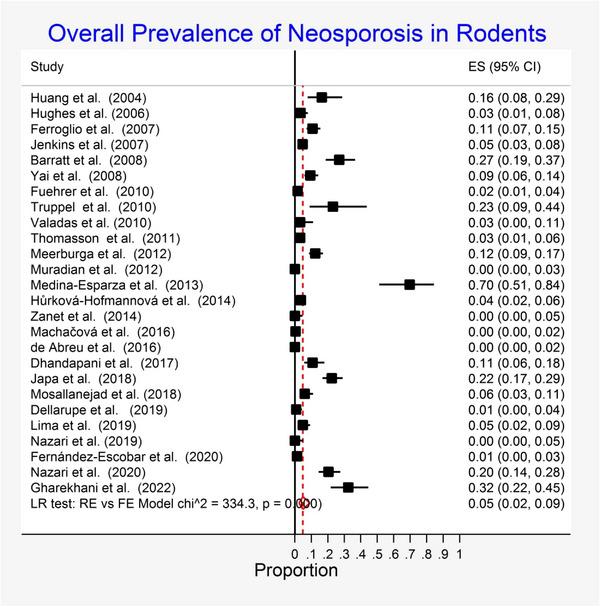
For this meta-analysis, a total of 4372 rodents from 26 eligible studies were included. The global prevalence of N. caninum in rodents was estimated at 5% (95% CI 2%-9%), with the highest prevalence in Asia (12%; 95% CI 6%-24%) and lowest prevalence in America (3%; 95% CI 1%-14%) and Europe (3%; 95% CI 1%-6%). N. caninum was more prevalent in females (4%; 95% CI 2%-9%) than in males (3%; 95% CI 1%-11%). The most common diagnostic test was polymerase chain reaction (PCR) (21 studies). The pooled prevalence of N. caninum in rodents based on the diagnostic method was as follows: immunohistochemistry: 11% (95% CI 6%-20%), NAT: 5% (95% CI 4%-7%), IFAT: 5% (95% CI 2%-13%) and PCR: 3% (95% CI 1%-9%).
CONCLUSION
The results of this study showed a relatively low but widespread prevalence of N. caninum infection in rodents.
背景
世界各地的奶牛和肉牛的流产都被认为与弓形体病有关。啮齿动物是几种传染病的储存宿主。有必要确定啮齿动物中弓形虫的流行率,以提高对弓形虫传播动态及其生命周期和向牲畜传播风险的现有认识。因此,本研究的目的是估计不同啮齿动物物种中弓形虫的全球合并流行率。
方法
在 MEDLINE/PubMed、ScienceDirect、Web of Science、Scopus 和 Google Scholar 中搜索了关于不同啮齿动物物种中弓形虫流行率的已发表研究,并查阅了检索文章的参考文献列表,直到 2022 年 7 月 30 日。使用纳入和排除标准选择合格的研究。使用随机效应荟萃分析验证和分析提取的数据。
结果
在这项荟萃分析中,共有 26 项合格研究中的 4372 只啮齿动物被纳入。啮齿动物中弓形虫的全球流行率估计为 5%(95%CI 2%-9%),亚洲的流行率最高(12%;95%CI 6%-24%),美洲和欧洲的流行率最低(3%;95%CI 1%-14% 和 3%;95%CI 1%-6%)。雌性(4%;95%CI 2%-9%)比雄性(3%;95%CI 1%-11%)更易感染弓形虫。最常用的诊断检测方法是聚合酶链反应(PCR)(21 项研究)。根据诊断方法,啮齿动物中弓形虫的合并流行率如下:免疫组织化学:11%(95%CI 6%-20%)、NAT:5%(95%CI 4%-7%)、IFAT:5%(95%CI 2%-13%)和 PCR:3%(95%CI 1%-9%)。
结论
本研究结果表明,啮齿动物中弓形虫感染的流行率虽然相对较低,但分布广泛。

 Zotero 插件