
基于巨噬细胞的椎间盘突出症治疗:临床前概念验证
Macrophage-based therapy for intervertebral disc herniation: preclinical proof-of-concept.
作者信息
Ribeiro-Machado Cláudia, Santos Susana G, Amaral Inês A, Caldeira Joana, Pereira Paulo, Barbosa Mário A, Cunha Carla
机构信息
i3S - Instituto de Investigação e Inovação em Saúde, Universidade do Porto, Porto, Portugal.
INEB - Instituto Nacional de Engenharia Biomédica, Universidade do Porto, Porto, Portugal.
出版信息
NPJ Regen Med. 2023 Jul 10;8(1):34. doi: 10.1038/s41536-023-00309-z.
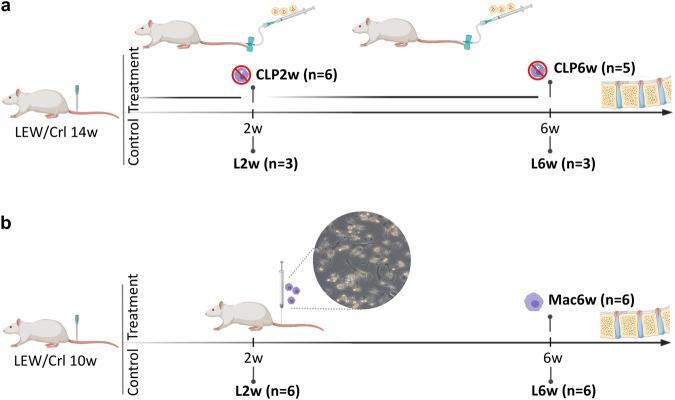
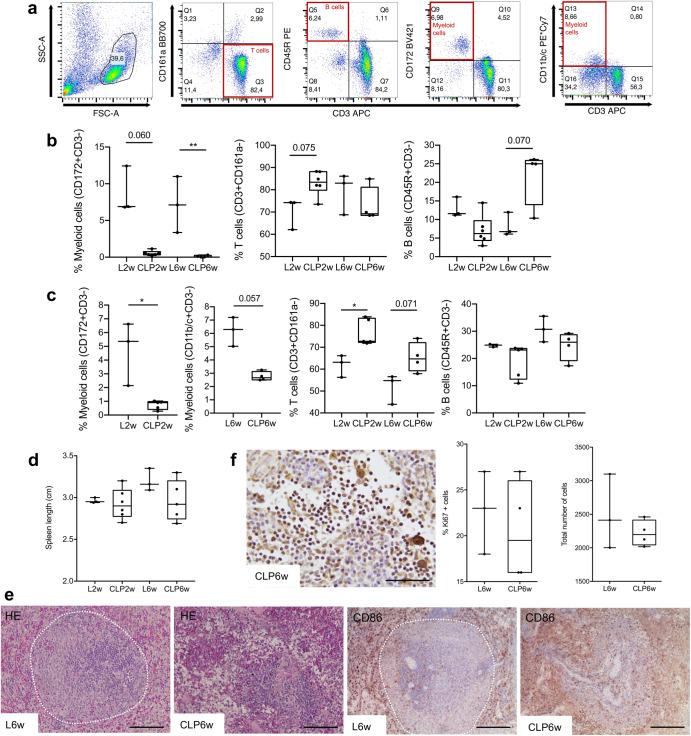
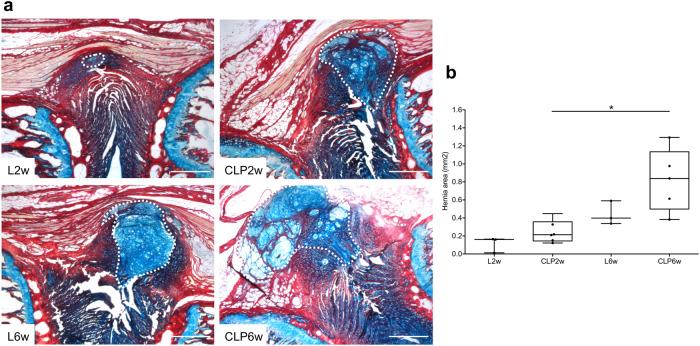
Intervertebral disc (IVD) degeneration and herniation is a leading cause of disability globally and a large unmet clinical need. No efficient non-surgical therapy is available, and there is an urgency for minimally invasive therapies capable of restoring tissue function. IVD spontaneous hernia regression following conservative treatment is a clinically relevant phenomenon that has been linked to an inflammatory response. This study establishes the central role of macrophages in IVD spontaneous hernia regression and provides the first preclinical demonstration of a macrophage-based therapy for IVD herniation. A rat model of IVD herniation was used to test complementary experimental setups: (1) macrophage systemic depletion via intravenous administration of clodronate liposomes (Group CLP2w: depletion between 0 and 2 weeks post-lesion; Group CLP6w: depletion between 2 and 6 weeks post-lesion), and (2) administration of bone marrow-derived macrophages into the herniated IVD, 2 weeks post-lesion (Group Mac6w). Herniated animals without treatment were used as controls. The herniated area was quantified by histology in consecutive proteoglycan/collagen IVD sections at 2 and 6 weeks post-lesion. Clodronate-mediated macrophage systemic depletion was confirmed by flow cytometry and resulted in increased hernia sizes. Bone marrow-derived macrophages were successfully administered into rat IVD hernias resulting in a 44% decrease in hernia size. No relevant systemic immune reaction was identified by flow cytometry, cytokine, or proteomic analysis. Furthermore, a possible mechanism for macrophage-induced hernia regression and tissue repair was unveiled through IL4, IL17a, IL18, LIX, and RANTES increase. This study represents the first preclinical proof-of-concept of macrophage-based immunotherapy for IVD herniation.
椎间盘(IVD)退变和突出是全球导致残疾的主要原因,也是临床上尚未满足的巨大需求。目前尚无有效的非手术治疗方法,因此迫切需要能够恢复组织功能的微创治疗方法。保守治疗后IVD自发性疝回纳是一种与炎症反应相关的临床相关现象。本研究确立了巨噬细胞在IVD自发性疝回纳中的核心作用,并首次在临床前证明了基于巨噬细胞的IVD突出治疗方法。使用IVD突出的大鼠模型来测试互补的实验设置:(1)通过静脉注射氯膦酸盐脂质体进行巨噬细胞全身清除(CLP2w组:损伤后0至2周清除;CLP6w组:损伤后2至6周清除),以及(2)在损伤后2周将骨髓来源的巨噬细胞注入突出的IVD中(Mac6w组)。未治疗的突出动物用作对照。在损伤后2周和6周,通过组织学对连续的蛋白聚糖/胶原蛋白IVD切片中的突出面积进行定量。通过流式细胞术证实了氯膦酸盐介导的巨噬细胞全身清除,并导致疝大小增加。骨髓来源的巨噬细胞成功注入大鼠IVD突出部位,导致疝大小减少44%。通过流式细胞术、细胞因子或蛋白质组学分析未发现相关的全身免疫反应。此外,通过IL4、IL17a、IL18、LIX和RANTES的增加揭示了巨噬细胞诱导疝回纳和组织修复的可能机制。本研究代表了基于巨噬细胞的IVD突出免疫治疗的首个临床前概念验证。



 Zotero 插件