
氯化钠预处理通过光合适应增强番茄的低温耐受性。
NaCl Pretreatment Enhances the Low Temperature Tolerance of Tomato Through Photosynthetic Acclimation.
作者信息
Yang Xiaolong, Zou Fengyu, Zhang Yumeng, Shi Jiali, Qi Mingfang, Liu Yufeng, Li Tianlai
机构信息
Key Laboratory of Protected Horticulture of Ministry of Education, National and Local Joint Engineering Research Center of Northern Horticultural Facilities Design and Application Technology (Liaoning), College of Horticulture, Shenyang Agricultural University, Shenyang, China.
College of Horticulture, South China Agricultural University, Guangzhou, China.
出版信息
Front Plant Sci. 2022 Jun 13;13:891697. doi: 10.3389/fpls.2022.891697. eCollection 2022.
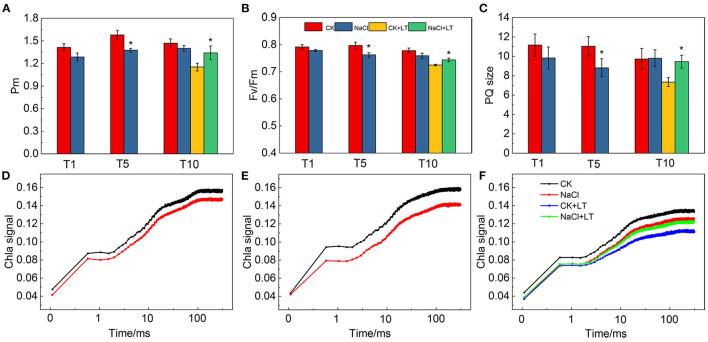
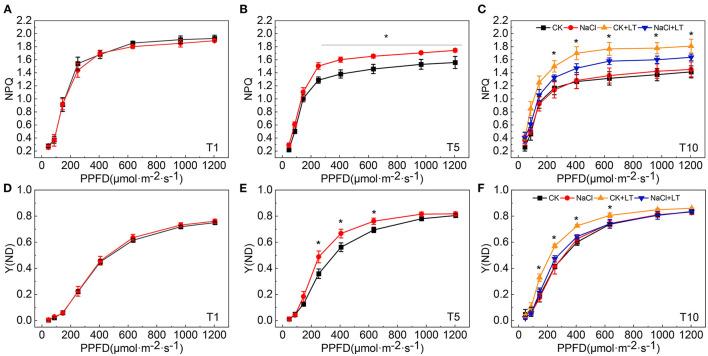
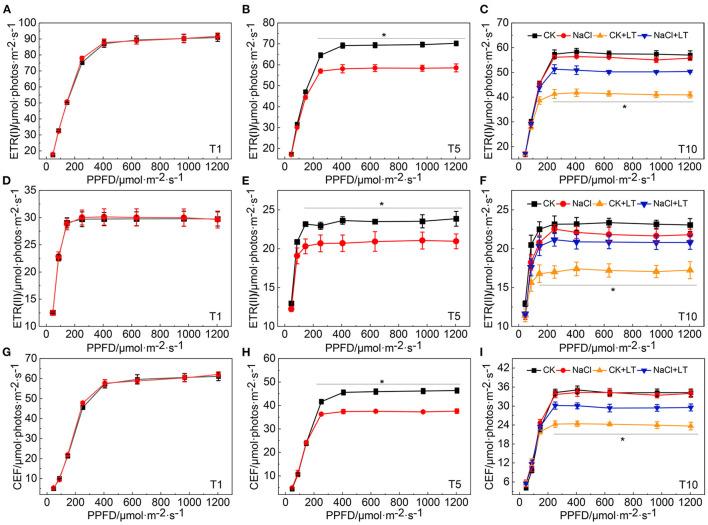
Plants often need to withstand multiple types of environmental stresses (e.g., salt and low temperature stress) because of their sessile nature. Although the physiological responses of plants to single stressor have been well-characterized, few studies have evaluated the extent to which pretreatment with non-lethal stressors can maintain the photosynthetic performance of plants in adverse environments (i.e., acclimation-induced cross-tolerance). Here, we studied the effects of sodium chloride (NaCl) pretreatment on the photosynthetic performance of tomato plants exposed to low temperature stress by measuring photosynthetic and chlorophyll fluorescence parameters, stomatal aperture, chloroplast quality, and the expression of stress signaling pathway-related genes. NaCl pretreatment significantly reduced the carbon dioxide assimilation rate, transpiration rate, and stomatal aperture of tomato leaves, but these physiological acclimations could mitigate the adverse effects of subsequent low temperatures compared with non-pretreated tomato plants. The content of photosynthetic pigments decreased and the ultra-microstructure of chloroplasts was damaged under low temperature stress, and the magnitude of these adverse effects was alleviated by NaCl pretreatment. The quantum yield of photosystem I (PSI) and photosystem II (PSII), the quantum yield of regulatory energy dissipation, and non-photochemical energy dissipation owing to donor-side limitation decreased following NaCl treatment; however, the opposite patterns were observed when NaCl-pretreated plants were exposed to low temperature stress. Similar results were obtained for the electron transfer rate of PSI, the electron transfer rate of PSII, and the estimated cyclic electron flow value (CEF). The production of reactive oxygen species induced by low temperature stress was also significantly alleviated by NaCl pretreatment. The expression of ion channel and tubulin-related genes affecting stomatal aperture, chlorophyll synthesis genes, antioxidant enzyme-related genes, and abscisic acid (ABA) and low temperature signaling-related genes was up-regulated in NaCl-pretreated plants under low temperature stress. Our findings indicated that CEF-mediated photoprotection, stomatal movement, the maintenance of chloroplast quality, and ABA and low temperature signaling pathways all play key roles in maintaining the photosynthetic capacity of NaCl-treated tomato plants under low temperature stress.
由于植物固着生长的特性,它们常常需要抵御多种类型的环境胁迫(例如盐胁迫和低温胁迫)。尽管植物对单一胁迫因子的生理响应已得到充分表征,但很少有研究评估用非致死胁迫因子进行预处理能在多大程度上维持植物在逆境中的光合性能(即驯化诱导的交叉耐受性)。在此,我们通过测量光合和叶绿素荧光参数、气孔孔径、叶绿体质量以及胁迫信号通路相关基因的表达,研究了氯化钠(NaCl)预处理对遭受低温胁迫的番茄植株光合性能的影响。NaCl预处理显著降低了番茄叶片的二氧化碳同化率、蒸腾速率和气孔孔径,但与未预处理的番茄植株相比,这些生理适应性变化能够减轻后续低温的不利影响。在低温胁迫下,光合色素含量下降,叶绿体超微结构受损,而NaCl预处理减轻了这些不利影响的程度。NaCl处理后,光系统I(PSI)和光系统II(PSII)的量子产率、调节性能量耗散的量子产率以及由于供体侧限制导致的非光化学能量耗散均降低;然而,当NaCl预处理的植株遭受低温胁迫时,观察到相反的模式。PSI的电子传递速率、PSII的电子传递速率以及估计的循环电子流值(CEF)也得到了类似结果。NaCl预处理还显著减轻了低温胁迫诱导的活性氧产生。在低温胁迫下,NaCl预处理的植株中影响气孔孔径的离子通道和微管蛋白相关基因、叶绿素合成基因、抗氧化酶相关基因以及脱落酸(ABA)和低温信号相关基因的表达上调。我们的研究结果表明,CEF介导的光保护、气孔运动、叶绿体质量的维持以及ABA和低温信号通路在维持低温胁迫下NaCl处理的番茄植株光合能力方面均发挥关键作用。




 Zotero 插件