
新型冠状病毒肺炎大流行期间非药物干预措施对早产的影响:韩国一项全国性观察性研究
The impact of non-pharmaceutical interventions on premature births during the COVID-19 pandemic: a nationwide observational study in Korea.
作者信息
Lee Ji Young, Park Joonsik, Lee Myeongjee, Han Minkyung, Jung Inkyung, Lim Sung Min, Baek Jee Yeon, Kang Ji-Man, Park Min Soo, Ahn Jong Gyun
机构信息
Department of Pediatrics, Severance Children's Hospital, Yonsei University College of Medicine, Seoul, Republic of Korea.
Division of Neonatology, Department of Pediatrics, Severance Children's Hospital, Yonsei University College of Medicine, Seoul, Republic of Korea.
出版信息
Front Pediatr. 2023 Jun 27;11:1140556. doi: 10.3389/fped.2023.1140556. eCollection 2023.
BACKGROUND
Non-pharmaceutical interventions (NPIs), such as social distancing and hand washing, have been associated with a decline in the preterm birth rate worldwide. We aimed to evaluate whether the preterm birth rate in Korea during the coronavirus disease 2019 lockdown has changed compared to that in previous years.
METHOD
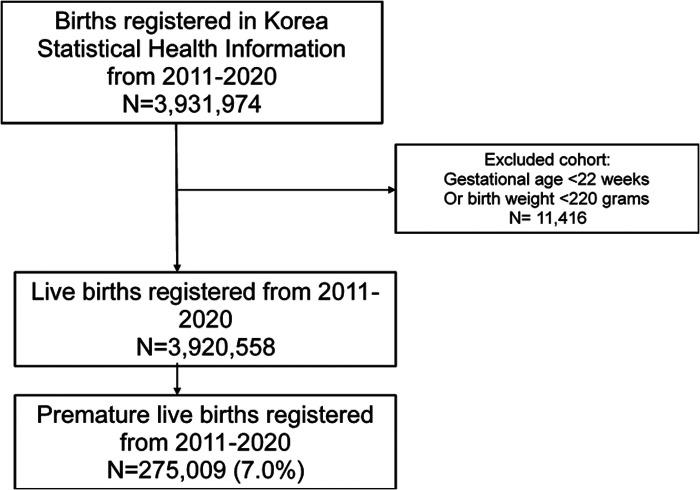
A birth registry from the Korea Statistical Information Service, which is a nationwide official database, was used to include all births claimed to have occurred between 2011 and 2020. Newborns with gestational age (GA) less than 22 weeks and birth weight less than 220 g were excluded. The pre-NPI period was designated as January 2011 to January 2020, and the NPI period was defined as February 2020 to December 2020. We assessed the effect of NPI on the incidence of prematurity per 100 births using an interrupted time-series quasi-experimental design and implementing an autoregressive integrated moving average (ARIMA) model.
RESULTS
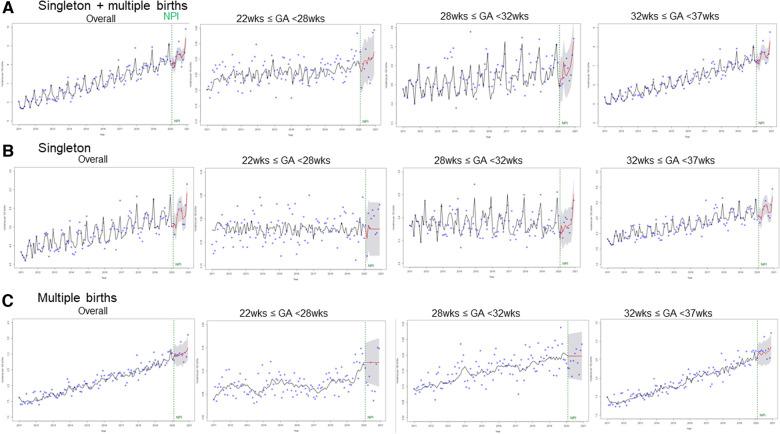
From 2011 to 2020, a total of 3,931,974 live births were registered, among which 11,416 were excluded. Consequently, the final study population included 3,920,558 live births (both singleton and multiple births) among which 275,009 (7.0%) were preterm. The preterm birth rate was significantly higher during the NPI period (8.68%) compared to that in the pre-NPI period (6.92%) (< 0.001). The ARIMA model showed that in all singleton and multiple births, except those in July (observed 9.24, expected 8.54, [95% prediction interval {PI} 8.13-8.96], percent difference 7.81%), September (observed 7.89, expected 8.35, [95% PI 7.93-8.76], percent difference -5.66%), and December (observed 9.90, expected 9.40, [95% PI 8.98-9.82], percent difference 5.2%), most observed values were within the 95% PI of the expected values and showed an increasing trend.
CONCLUSION
In this nationwide observational study, the trend in premature birth rate did not significantly change due to NPI implementation in Korea, as it had been increasing since 2011. The trend of Korea's birth rate appears to be unaffected by the implementation of NPIs; however, further studies with a longer follow-up period are needed.
背景
非药物干预措施(NPIs),如社交距离和洗手,已被认为与全球早产率下降有关。我们旨在评估2019年冠状病毒病封锁期间韩国的早产率与前几年相比是否发生了变化。
方法
使用韩国统计信息服务中心的出生登记处,这是一个全国性的官方数据库,纳入了所有声称在2011年至2020年期间出生的婴儿。排除孕周(GA)小于22周且出生体重小于220克的新生儿。非NPIs实施前时期被指定为2011年1月至2020年1月,NPIs实施时期定义为2020年2月至2020年12月。我们采用中断时间序列准实验设计并实施自回归积分移动平均(ARIMA)模型,评估NPIs对每100例出生中早产发生率的影响。
结果
2011年至2020年期间,共登记了3931974例活产,其中11416例被排除。因此,最终研究人群包括3920558例活产(单胎和多胎),其中275009例(7.0%)为早产。与非NPIs实施前时期(6.92%)相比,NPIs实施期间的早产率显著更高(8.68%)(<0.001)。ARIMA模型显示,在所有单胎和多胎中,除了7月(观察值9.24,预期值8.54,[95%预测区间{PI}8.13 - 8.96],百分比差异7.81%)、9月(观察值7.89,预期值8.35,[95% PI 7.93 - 8.76],百分比差异 -5.66%)和12月(观察值9.90,预期值9.40,[95% PI 8.98 - 9.82],百分比差异5.2%)外,大多数观察值都在预期值的95% PI范围内且呈上升趋势。
结论
在这项全国性观察研究中,由于韩国实施NPIs,早产率趋势并未显著改变,因为自2011年以来其一直在上升。韩国的出生率趋势似乎不受NPIs实施的影响;然而,需要进行更长随访期的进一步研究。
 Zotero 插件