
adipokines 在肌肉减少症中的作用。
Role of adipokines in sarcopenia.
机构信息
Department of Orthopaedics, Xiangya Hospital, Central South University, Changsha, Hunan 410008, China.
National Clinical Research Center for Geriatric Disorders, Xiangya Hospital, Central South University, Changsha, Hunan 410008, China.
出版信息
Chin Med J (Engl). 2023 Aug 5;136(15):1794-1804. doi: 10.1097/CM9.0000000000002255.
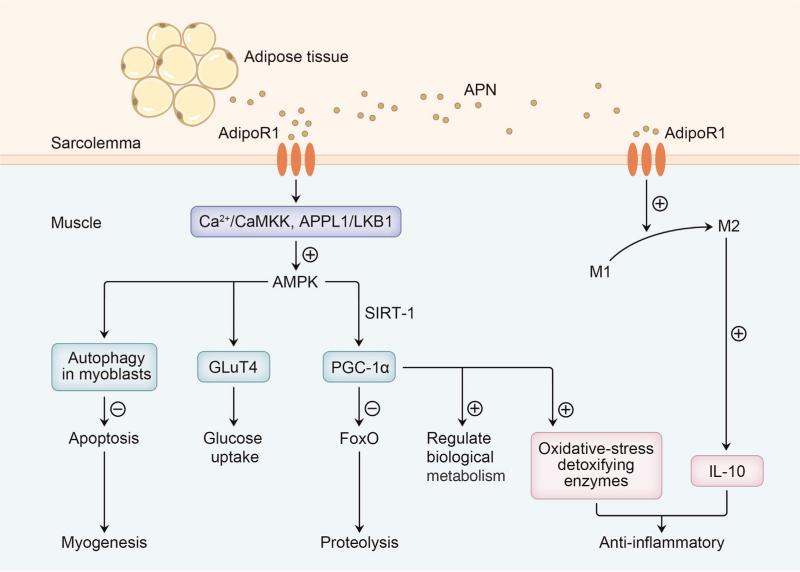
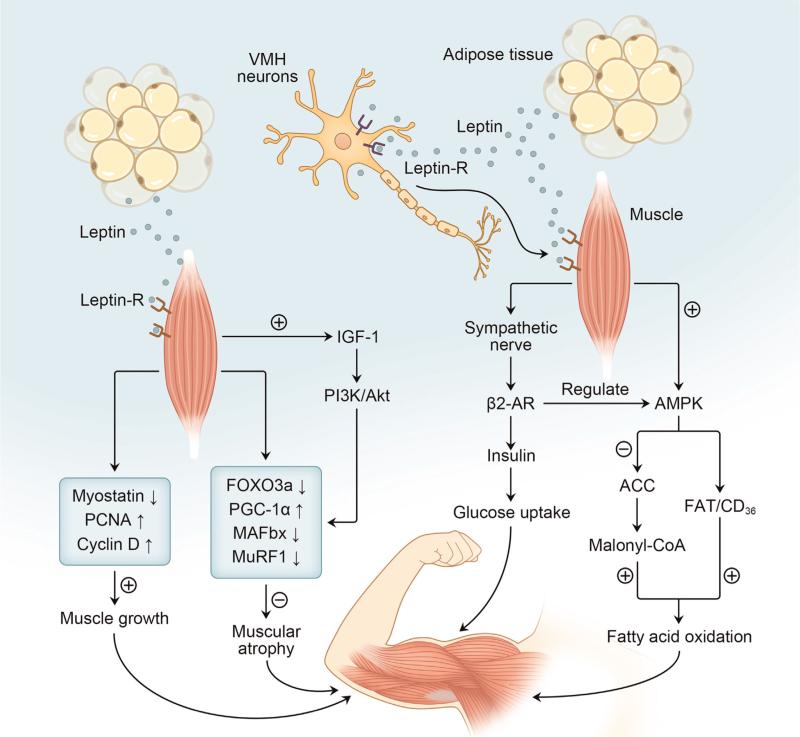
Sarcopenia is an age-related disease that mainly involves decreases in muscle mass, muscle strength and muscle function. At the same time, the body fat content increases with aging, especially the visceral fat content. Adipose tissue is an endocrine organ that secretes biologically active factors called adipokines, which act on local and distant tissues. Studies have revealed that some adipokines exert regulatory effects on muscle, such as higher serum leptin levels causing a decrease in muscle function and adiponectin inhibits the transcriptional activity of Forkhead box O3 (FoxO3) by activating peroxisome proliferators-activated receptor-γ coactivator -1α (PGC-1α) and sensitizing cells to insulin, thereby repressing atrophy-related genes (atrogin-1 and muscle RING finger 1 [MuRF1]) to prevent the loss of muscle mass. Here, we describe the effects on muscle of adipokines produced by adipose tissue, such as leptin, adiponectin, resistin, mucin and lipocalin-2, and discuss the importance of these adipokines for understanding the development of sarcopenia.
肌肉减少症是一种与年龄相关的疾病,主要涉及肌肉质量、肌肉力量和肌肉功能的下降。同时,随着年龄的增长,人体脂肪含量增加,尤其是内脏脂肪含量。脂肪组织是一种内分泌器官,它分泌称为脂肪因子的生物活性因子,作用于局部和远处的组织。研究表明,一些脂肪因子对肌肉有调节作用,例如较高的血清瘦素水平会导致肌肉功能下降,而脂联素通过激活过氧化物酶体增殖物激活受体-γ共激活因子-1α(PGC-1α)抑制叉头框 O3(FoxO3)的转录活性,并使细胞对胰岛素敏感,从而抑制与萎缩相关的基因(atrogin-1 和肌肉环指蛋白 1 [MuRF1]),防止肌肉质量的丧失。在这里,我们描述了脂肪组织产生的脂肪因子对肌肉的影响,如瘦素、脂联素、抵抗素、黏蛋白和脂钙蛋白-2,并讨论了这些脂肪因子对于理解肌肉减少症的发展的重要性。
 Zotero 插件