
饮食炎症指数与静息代谢率联合对成年人心肺功能适应性的影响。
The combined association of dietary inflammatory index and resting metabolic rate on cardiorespiratory fitness in adults.
机构信息
Department of Nutrition, School of Public Health, Iran University of Medical Sciences, Tehran, Iran.
Department of Community Nutrition, School of Nutritional Sciences and Dietetics, Tehran University of Medical Sciences (TUMS), No 44, Hojjat-dost Alley, Naderi St., Keshavarz Blvd, Tehran, Iran.
出版信息
J Health Popul Nutr. 2023 Jul 13;42(1):68. doi: 10.1186/s41043-023-00413-2.
BACKGROUND
No study has examined the combined association of dietary inflammatory index (DII) of the diet and resting metabolic rate (RMR) on cardiorespiratory fitness (CRF). Therefore, we investigated the combined association between DII and RMR on CRF.
METHODS
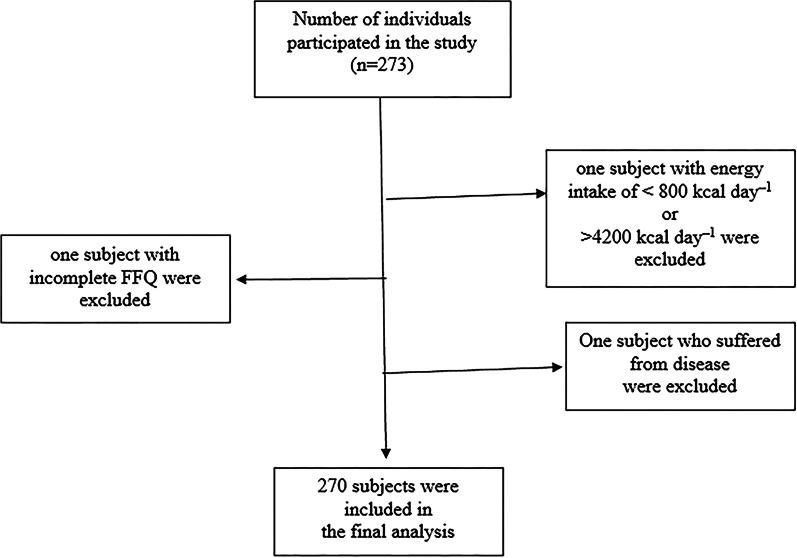
This cross-sectional study was conducted on 270 adult subjects. The DII was calculated using a validated semi-quantified food frequency questionnaire. RMR was measured using an indirect calorimetric method. Socioeconomic status, anthropometric measures, body composition and blood pressure were documented by a trained interviewer. CRF was assessed by using Bruce protocol. Binary logistic regression was performed to find the association of CRF with DII/RMR categories in various models.
RESULTS
The participants categorized into four groups including: (1) low DII/high RMR, (2) low DII/low RMR, (3) high DII/low RMR, (4) high DII/high RMR. The mean of VO (mL/kg/min), VO (L/min) and VO relative to lean body mass (LBM) was lower in participants that were classified as high DII/low RMR compared to those in low DII/high RMR. After controlling for age, sex, education status, smoking status, and physical activity those who were in the high DII/low RMR group, compared to the low DII/high RMR group were 28% less likely to have higher VO (ml/kg/min) (OR 0.72; 95% CI 0.18, 0.82, p = 0.04). Moreover, had 25% lower odds of VO (L/min) which was significant (OR 0.75, 95% CI 0.11, 0.89, p = 0.03). In addition, were 21% less likely to have higher VO (LBM) (OR 0.79; 95% CI 0.30, 0.92, p = 0.02).
CONCLUSIONS
Overall, consumption of a pro-inflammatory diet in combination with low RMR status is associated with lower odds of CRF compared to those who had anti-inflammatory diet in combination with high RMR status among Iranian healthy adults. This study suggests that researchers should focus on combined relationships rather than single pair-wise associations for having a better judgment.
背景
目前尚无研究探讨饮食炎症指数(DII)与静息代谢率(RMR)对心肺功能适应性(CRF)的联合影响。因此,本研究旨在调查 DII 和 RMR 对 CRF 的联合影响。
方法
本横断面研究纳入 270 名成年受试者。采用经过验证的半定量食物频率问卷计算 DII。使用间接量热法测量 RMR。由经过培训的访谈员记录社会经济地位、人体测量学指标、身体成分和血压。采用 Bruce 方案评估 CRF。采用二元逻辑回归分析在不同模型中探究 CRF 与 DII/RMR 类别的关联。
结果
研究对象被分为四组:(1)低 DII/高 RMR,(2)低 DII/低 RMR,(3)高 DII/低 RMR,(4)高 DII/高 RMR。与低 DII/高 RMR 组相比,高 DII/低 RMR 组的 VO(mL/kg/min)、VO(L/min)和 VO 相对于去脂体重(LBM)均值更低。在校正年龄、性别、教育程度、吸烟状况和身体活动后,与低 DII/高 RMR 组相比,高 DII/低 RMR 组的 VO(ml/kg/min)更高的可能性低 28%(OR 0.72;95% CI 0.18,0.82,p=0.04)。此外,高 DII/低 RMR 组的 VO(L/min)水平更低,且差异具有统计学意义(OR 0.75,95% CI 0.11,0.89,p=0.03)。此外,高 DII/低 RMR 组的 VO(LBM)更高的可能性低 21%(OR 0.79;95% CI 0.30,0.92,p=0.02)。
结论
总之,与具有抗炎饮食和高 RMR 状态的个体相比,伊朗健康成年人中具有促炎饮食和低 RMR 状态与 CRF 可能性降低有关。本研究提示研究人员应关注联合关系,而非单一的两两关联,以便做出更好的判断。

 Zotero 插件