
头皮神经阻滞在微血管减压术后疼痛管理中的疗效:一项随机临床试验。
The Efficacy of Scalp Nerve Block in Postoperative Pain Management after Microvascular Decompression: A Randomized Clinical Trial.
作者信息
Lee Eun Kyung, Lee Seungwon, Kwon Ji-Hye, Lee Seung Hoon, Park Soo Jung, Kim Yunghun, Kang RyungA, Jeong Ji Seon, Lee Jeong Jin
机构信息
Department of Anesthesiology and Pain Medicine, Chung-Ang University College of Medicine, Seoul 06973, Republic of Korea.
Department of Anesthesiology and Pain Medicine, Samsung Medical Center, Sungkyunkwan University School of Medicine, Seoul 06351, Republic of Korea.
出版信息
J Clin Med. 2023 Jun 24;12(13):4242. doi: 10.3390/jcm12134242.
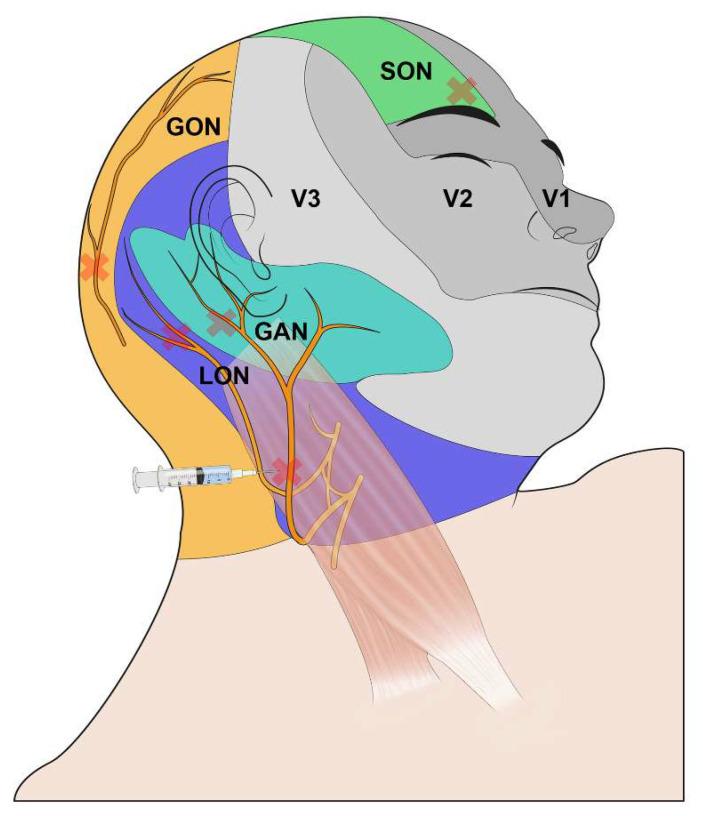
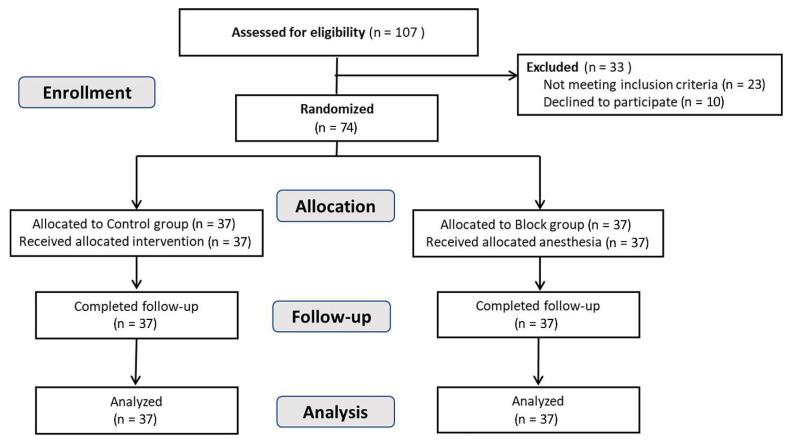
The scalp nerve block, created by injecting local anesthetics around the scalp nerves, is reported to effectively reduce pain after surgery. In this study, we evaluated the efficacy of scalp nerve block in patients with hemifacial spasm (HFS) undergoing microvascular decompression (MVD). Seventy-four patients who underwent MVD for HFS were enrolled. The block group received scalp nerve block with 0.5% ropivacaine before surgery. The primary outcome was cumulative dose of rescue analgesics 24 h postoperatively. The secondary outcomes were included pain scores, postoperative antiemetic consumption, and Quality of Recovery-15 scale. The cumulative dose of rescue analgesics at 24 h postoperatively was not significantly different between the two groups (4.80 ± 3.64 mg vs. 5.92 ± 3.95 mg, = 0.633). However, the pain score was significantly reduced in the block group at 6, 12, and 24 h postoperatively. Postoperative antiemetic consumption was lower in the block group than the control group at 12 h. There were no significant differences between the two groups for other secondary outcomes. In MVD for HFS, a preoperative scalp nerve block might reduce postoperative pain in the early postoperative period, but a larger study using a multimodal approach is needed to confirm the efficacy of a scalp block.
头皮神经阻滞是通过在头皮神经周围注射局部麻醉剂来实现的,据报道它能有效减轻术后疼痛。在本研究中,我们评估了头皮神经阻滞在接受微血管减压术(MVD)治疗的面肌痉挛(HFS)患者中的疗效。纳入了74例因HFS接受MVD治疗的患者。阻滞组在手术前接受了0.5%罗哌卡因的头皮神经阻滞。主要结局是术后24小时的补救镇痛药累积剂量。次要结局包括疼痛评分、术后止吐药用量和恢复质量-15量表。两组术后24小时的补救镇痛药累积剂量无显著差异(4.80±3.64毫克对5.92±3.95毫克,P=0.633)。然而,阻滞组在术后6小时、12小时和24小时的疼痛评分显著降低。阻滞组在术后12小时的术后止吐药用量低于对照组。两组在其他次要结局方面无显著差异。在HFS的MVD中,术前头皮神经阻滞可能会减轻术后早期的疼痛,但需要采用多模式方法进行更大规模的研究来证实头皮阻滞的疗效。

 Zotero 插件