
局部应用酮咯酸氨丁三醇对糖尿病患者超声乳化术后黄斑增厚的影响。
The effect of topical ketorolac tromethamine on macular thickening after phacoemulsification in diabetic patients.
机构信息
Ophthalmic Research Center, Research Institute for Ophthalmology and Vision Science, Shahid Beheshti University of Medical Sciences, Tehran, Iran.
Department of Ophthalmology, Torfe Hospital, Shahid Beheshti University of Medical Sciences, Tehran, Iran.
出版信息
BMC Ophthalmol. 2023 Jul 14;23(1):320. doi: 10.1186/s12886-023-03077-y.
BACKGROUND
To determine the effect of ketorolac tromethamine 0.5% in preventing post-phacoemulsification macular thickening. This randomized clinical trial. patients randomized 1:1 to receive either topical ketorolac three times a day or a placebo.
METHODS
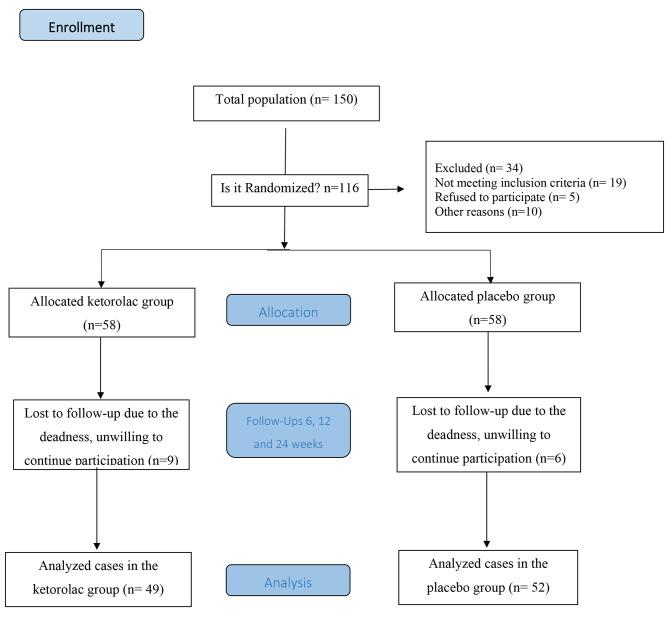
A total of 101 eyes of 101 diabetic patients who were scheduled for phacoemulsification and had normal macular contour and thickness enrolled consecutively. The topical ketorolac and placebo were prescribed on the day before surgery and continued up to 4 weeks after surgery. Patients with proliferative diabetic retinopathy, a history of intravitreal injection in less than three months, a history of macular photocoagulation in less than 6 months, and any other concomitant ocular pathologies were excluded. Central macular thickness (CMT) and best corrected visual acuity (BCVA) was recorded in the follow-ups of 6, 12, and 24 weeks after the surgery and compared with the controls.
RESULTS
49 eyes in the case group and 52 eyes in the control group were analyzed. Mean BCVA was significantly improved in both groups at all follow-ups (P < 0.001 for all). There was no statistically significant difference regarding the BCVA in different time points except week 12 (P = 0.028) among the study group. In the case and control groups, CMT was increased at all follow-ups (P < 0.05). There was no statistically significant difference when comparing the two groups regarding the mean of CMT at any time point postoperatively (P > 0.05 for all).
CONCLUSION
Based on our findings, topical ketorolac tromethamine 0.5% is not effective in the prevention of post-phacoemulsification macular thickening in diabetic patients.
TRAIL REGISTRATION
The study protocol was registered into www.
CLINICALTRIAL
gov with the RCT registration number NCT03551808. (2018/06/11 ) CLINICAL TRIAL REGISTRATION NUMBER: NCT03551808.
背景
为了确定酮咯酸氨丁三醇 0.5%滴眼剂预防白内障超声乳化术后黄斑增厚的效果,进行了这项随机临床试验。将患者 1:1 随机分为局部使用酮咯酸氨丁三醇组和安慰剂组,每天滴眼 3 次。
方法
连续纳入了 101 例拟行白内障超声乳化术且黄斑形态和厚度正常的糖尿病患者(共 101 只眼)。手术前 1 天开始处方局部使用酮咯酸氨丁三醇和安慰剂,并持续至术后 4 周。患有增生性糖尿病视网膜病变、3 个月内玻璃体腔内注射史、6 个月内黄斑光凝史和任何其他伴发眼部疾病的患者被排除在外。在术后 6、12 和 24 周的随访中记录中央黄斑厚度(CMT)和最佳矫正视力(BCVA),并与对照组进行比较。
结果
在病例组和对照组中,分别有 49 只眼和 52 只眼纳入分析。两组在所有随访时间点的平均 BCVA 均显著提高(所有 P 值均<0.001)。除了第 12 周(P=0.028)以外,两组在不同时间点的 BCVA 无统计学差异。两组在所有随访时间点的 CMT 均增加(P<0.05)。两组在术后任何时间点的 CMT 平均值之间无统计学差异(所有 P 值均>0.05)。
结论
根据我们的研究结果,局部使用酮咯酸氨丁三醇 0.5%滴眼剂对预防糖尿病患者白内障超声乳化术后黄斑增厚无效。
试验注册号
本研究方案在 www.clinicaltrials.gov 上注册,注册号为 NCT03551808。(2018/06/11)临床试验注册号:NCT03551808。
 Zotero 插件