
信号转导中的半胱氨酸残基及其在胰腺β细胞中的相关性。
Cysteine residues in signal transduction and its relevance in pancreatic beta cells.
机构信息
Laboratory of Pancreatic Islet Research, Institute of Physiology, Czech Academy of Sciences, Prague, Czechia.
出版信息
Front Endocrinol (Lausanne). 2023 Jun 29;14:1221520. doi: 10.3389/fendo.2023.1221520. eCollection 2023.
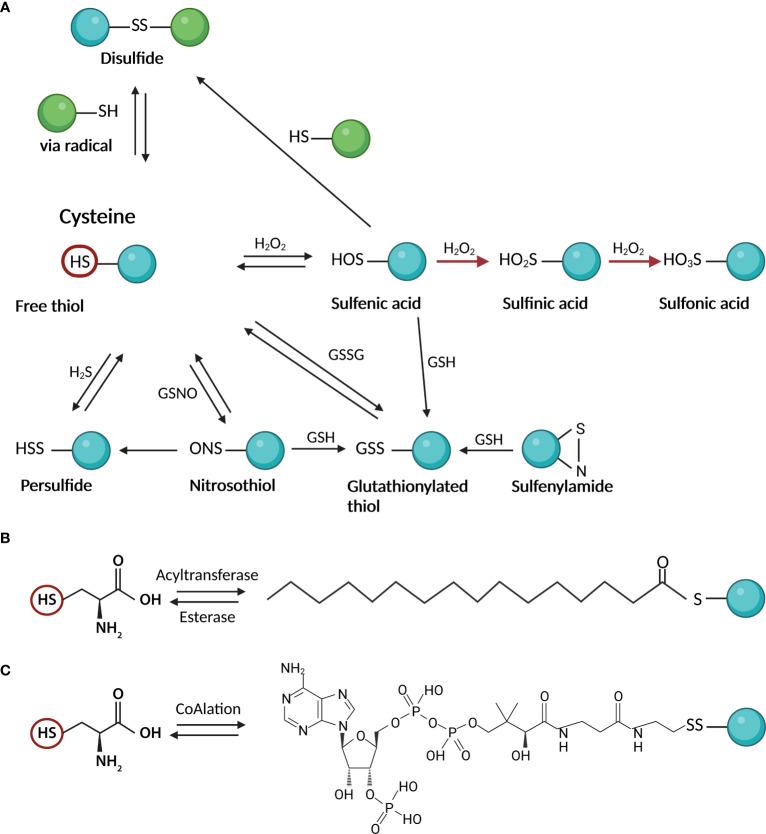
Cysteine is one of the least abundant but most conserved amino acid residues in proteins, playing a role in their structure, metal binding, catalysis, and redox chemistry. Thiols present in cysteines can be modified by post-translational modifications like sulfenylation, acylation, or glutathionylation, regulating protein activity and function and serving as signals. Their modification depends on their position in the structure, surrounding amino acids, solvent accessibility, pH, etc. The most studied modifications are the redox modifications by reactive oxygen, nitrogen, and sulfur species, leading to reversible changes that serve as cell signals or irreversible changes indicating oxidative stress and cell damage. Selected antioxidants undergoing reversible oxidative modifications like peroxiredoxin-thioredoxin system are involved in a redox-relay signaling that can propagate to target proteins. Cysteine thiols can also be modified by acyl moieties' addition (derived from lipid metabolism), resulting in protein functional modification or changes in protein anchoring in the membrane. In this review, we update the current knowledge on cysteine modifications and their consequences in pancreatic β-cells. Because β-cells exhibit well-balanced redox homeostasis, the redox modifications of cysteines here serve primarily for signaling purposes. Similarly, lipid metabolism provides regulatory intermediates that have been shown to be necessary in addition to redox modifications for proper β-cell function and, in particular, for efficient insulin secretion. On the contrary, the excess of reactive oxygen, nitrogen, and sulfur species and the imbalance of lipids under pathological conditions cause irreversible changes and contribute to oxidative stress leading to cell failure and the development of type 2 diabetes.
半胱氨酸是蛋白质中含量最少但最保守的氨基酸残基之一,在蛋白质的结构、金属结合、催化和氧化还原化学中发挥作用。半胱氨酸中的巯基可以通过翻译后修饰(如磺酰化、酰化或谷胱甘肽化)进行修饰,调节蛋白质的活性和功能,并作为信号。它们的修饰取决于它们在结构中的位置、周围的氨基酸、溶剂可及性、pH 值等。最受研究的修饰是由活性氧、氮和硫物种引起的氧化还原修饰,导致作为细胞信号的可逆变化或指示氧化应激和细胞损伤的不可逆变化。经历过如过氧化物酶-硫氧还蛋白系统等可逆氧化修饰的选定抗氧化剂参与了可以传播到靶蛋白的氧化还原接力信号。半胱氨酸巯基也可以通过酰基部分(源自脂质代谢)的添加进行修饰,导致蛋白质功能修饰或在膜中蛋白质锚定的变化。在这篇综述中,我们更新了关于半胱氨酸修饰及其在胰腺β细胞中的后果的最新知识。由于β细胞表现出良好平衡的氧化还原稳态,这里的半胱氨酸的氧化还原修饰主要用于信号目的。同样,脂质代谢提供了调节中间体,除了氧化还原修饰外,这些调节中间体对于β细胞的正常功能,特别是对于有效的胰岛素分泌也是必需的。相反,在病理条件下,活性氧、氮和硫物种的过剩以及脂质的失衡会导致不可逆变化,并导致氧化应激,导致细胞衰竭和 2 型糖尿病的发展。

 Zotero 插件